Representative J. T. Rutherford
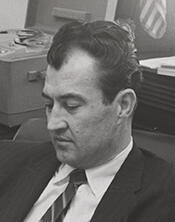
Here you will find contact information for Representative J. T. Rutherford, including email address, phone number, and mailing address.
| Name | J. T. Rutherford |
| Position | Representative |
| State | Texas |
| District | 16 |
| Party | Democratic |
| Status | Former Representative |
| Term Start | January 5, 1955 |
| Term End | January 3, 1963 |
| Terms Served | 4 |
| Born | May 30, 1921 |
| Gender | Male |
| Bioguide ID | R000547 |
About Representative J. T. Rutherford
J. T. Rutherford (May 30, 1921 – November 6, 2006) was an American lawyer, World War II veteran, and Democratic politician who represented Texas in the United States House of Representatives for four consecutive terms from 1955 to 1963. He was born James Thaddeus Rutherford Jr. in Hot Springs, Arkansas, to James Thaddeus Rutherford and the former Nancy Lillian Johnson. In 1934, his family relocated to Odessa, Texas, where he attended public schools, laying the foundation for his later political base in West Texas.
Rutherford’s early adulthood was marked by distinguished military service during World War II. He enlisted in the United States Marine Corps in 1942 and served on active duty until 1946, spending twenty-eight months overseas. As an assault amphibian vehicle crewman, he landed in the first waves during the D-Day assaults at Tarawa, Saipan—where he was wounded—and Tinian in the Pacific theater. For his combat wounds he was awarded the Purple Heart. After the war, he continued his association with the Marine Corps as a reservist and ultimately retired with the rank of major in the United States Marine Corps Reserve.
Following his military service, Rutherford pursued higher education in Texas. From 1946 to 1947 he studied at San Angelo College in San Angelo, then attended Sul Ross State College in Alpine from 1947 to 1948. He subsequently enrolled at Baylor Law School in Waco, Texas, where he studied from 1948 to 1950, preparing for a career in law and public service. In 1948, he married Sara Jane Armstrong, and the couple had three children: Cleo Ann, Charles Lane Rutherford, and Jane Ellen. Alongside his legal training and early political activity, Rutherford engaged in private enterprise as a partner in an industrial electrical construction firm and as the owner of an advertising business.
Rutherford entered elective office soon after beginning his legal studies. He served in the Texas House of Representatives from 1948 to 1952, representing his West Texas constituency during the postwar period. He then advanced to the Texas State Senate, serving from 1953 to 1954. His tenure in the state legislature helped establish his reputation as a capable Democratic lawmaker and positioned him for a successful run for national office.
In 1954, Rutherford was elected as a Democrat to the Eighty-fourth Congress and was subsequently re-elected to the Eighty-fifth, Eighty-sixth, and Eighty-seventh Congresses, serving from January 3, 1955, to January 3, 1963. As a member of the United States House of Representatives from Texas, he represented the sprawling “jumbo” 16th congressional district, whose 19 counties covered 42,067 square miles—geographically larger than several U.S. states, including Ohio and Tennessee. The district stretched from Midland on its eastern edge to El Paso on its western boundary and extended for hundreds of miles along the border with Mexico. During his four terms in Congress, Rutherford was known for his diligence; he reportedly missed only one floor vote out of the several thousand cast while he was a representative, and he actively participated in the legislative process on behalf of his constituents.
Rutherford’s congressional service coincided with a pivotal era in American politics, particularly on civil rights and conservation. He was among the majority of the Texas delegation who declined to sign the 1956 Southern Manifesto, which opposed the Supreme Court’s decision in Brown v. Board of Education mandating desegregation of public schools. Nonetheless, he voted against the Civil Rights Acts of 1957 and 1960, reflecting the complex and often conservative political currents in Texas at the time. He did, however, vote in favor of the Twenty-fourth Amendment to the United States Constitution, which abolished the poll tax in federal elections. In the area of natural resources and public lands, Rutherford emerged as an influential figure. He became the first chairman of the House Subcommittee on National Parks and played a leading role in advancing major conservation legislation. For his efforts in helping to establish Padre Island National Seashore in Texas, Cape Cod National Seashore in Massachusetts, and Point Reyes National Seashore in California, he received the U.S. Department of the Interior’s Conservation Service Award in 1962.
Rutherford’s congressional career came to an end following the 1962 elections. He was an unsuccessful candidate for re-election to the Eighty-eighth Congress, losing his seat to Republican Ed Foreman of Odessa, who later became associated with Dallas. His defeat was widely attributed to the political fallout from the Billie Sol Estes scandal, which damaged several Texas Democrats during that election cycle. After leaving Congress in January 1963, Rutherford transitioned to work in the private sector related to public affairs and policy.
In his post-congressional years, Rutherford formed J. T. Rutherford and Associates, a government relations consulting firm, drawing on his legislative experience and knowledge of federal processes. He also devoted time to charitable and civic causes. He served as a director of the Gonzales Warm Springs Foundation for Crippled Children, established in 1943 in Gonzales County, Texas, and was active as a Shriner, supporting efforts to promote the welfare and medical care of children with physical disabilities. In his later years, Rutherford resided in Arlington, Virginia. He died there on November 6, 2006, from complications of Alzheimer’s disease, closing a life that spanned military service, state and national legislative leadership, and continued engagement in public and philanthropic endeavors.