Representative Jabez Gridley Sutherland
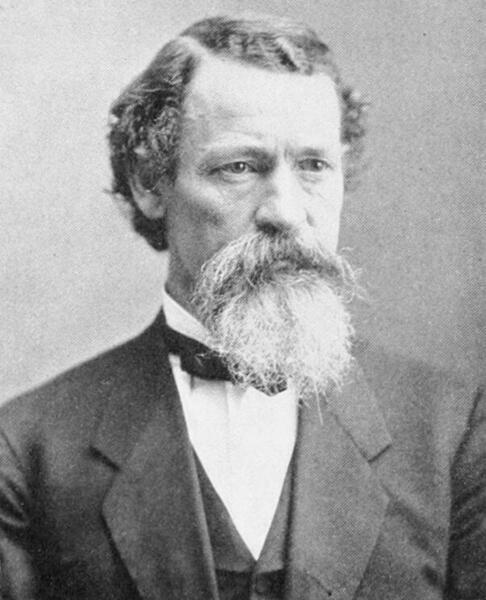
Here you will find contact information for Representative Jabez Gridley Sutherland, including email address, phone number, and mailing address.
| Name | Jabez Gridley Sutherland |
| Position | Representative |
| State | Michigan |
| District | 6 |
| Party | Democratic |
| Status | Former Representative |
| Term Start | March 4, 1871 |
| Term End | March 3, 1873 |
| Terms Served | 1 |
| Born | October 6, 1825 |
| Gender | Male |
| Bioguide ID | S001082 |
About Representative Jabez Gridley Sutherland
Jabez Gridley Sutherland (October 6, 1825 – November 20, 1902) was a politician, jurist, legal scholar, and member of the United States House of Representatives from the State of Michigan. He was born in Van Buren, Onondaga County, New York, where he completed his preparatory studies before turning to the study of law. After reading law in the traditional manner of the period, he was admitted to the bar in 1848.
Following his admission to the bar, Sutherland moved to Michigan and commenced the practice of law in Saginaw. Almost immediately he entered public service, serving as prosecuting attorney of Saginaw County in 1848 and 1849. His early legal and political activities in Michigan brought him into state-level affairs, and he soon became involved in the shaping of the state’s constitutional framework.
Sutherland was a delegate to the Michigan state constitutional convention of 1850, participating in the revision of the state’s fundamental law. He was elected to the Michigan House of Representatives in 1853, further establishing his position in state politics. He later returned to constitutional work as a delegate to the Michigan state constitutional convention of 1867, reflecting his continuing influence in state governance and legal reform.
In 1863, Sutherland was appointed judge of the tenth judicial circuit court of Michigan. He served on the circuit bench from 1863 to 1871, presiding over a broad range of civil and criminal matters during a period that spanned the Civil War and Reconstruction. He resigned from the judiciary in 1871 to enter national office.
Sutherland was elected as a Democrat from Michigan’s 6th congressional district to the Forty-second Congress and served in the U.S. House of Representatives from March 4, 1871, to March 3, 1873. During his single term in Congress he represented a district in a rapidly developing region of Michigan. He was not a candidate for renomination in 1872 and returned to private life at the close of his term.
In 1873, Sutherland moved to Salt Lake City, in the Utah Territory, where he resumed the practice of law. He became a prominent member of the territorial bar and contributed to the development of legal education in the region. In 1889 he served on the faculty of what is now the University of Utah, helping to train a new generation of lawyers. His professional standing was further recognized when he was elected president of the Territorial Bar Association in 1894 and 1895.
Sutherland also achieved national recognition as a legal scholar. In 1891 he published the treatise “Statutes and Statutory Construction,” which became, and has remained, an influential guide to the interpretation of legislative enactments. The work, often cited simply as “Sutherland on Statutory Construction,” helped shape American jurisprudence on how courts should read and apply statutes.
In 1897, Sutherland moved from Utah to California, settling in Berkeley. He lived there during his final years, remaining identified with the legal profession and his scholarly contributions. He died in Berkeley, California, on November 20, 1902. His remains were returned to Utah, and he is interred in Mount Olivet Cemetery in Salt Lake City.