Representative Jack Kingston
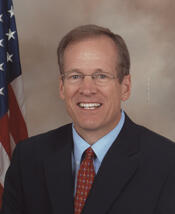
Here you will find contact information for Representative Jack Kingston, including email address, phone number, and mailing address.
| Name | Jack Kingston |
| Position | Representative |
| State | Georgia |
| District | 1 |
| Party | Republican |
| Status | Former Representative |
| Term Start | January 5, 1993 |
| Term End | January 3, 2015 |
| Terms Served | 11 |
| Born | April 24, 1955 |
| Gender | Male |
| Bioguide ID | K000220 |
About Representative Jack Kingston
John Heddens “Jack” Kingston (born April 24, 1955) is an American businessman, lobbyist, and Republican politician who represented Georgia in the United States House of Representatives from 1993 to 2015. His 11 consecutive terms in Congress coincided with a period of significant political, economic, and social change in the United States, during which he participated actively in the legislative process and represented the interests of his constituents in Georgia’s 1st congressional district in the southeast of the state. Over more than two decades in office, he became a prominent conservative voice in the House, particularly on fiscal and regulatory issues.
Kingston was born on April 24, 1955, in Bryan, Texas, to Martha Ann (née Heddens) and Albert James Kingston Jr. His father, born in Brooklyn, New York, was a widely published university professor and co‑founder of the National Reading Conference, and his mother was born in Los Angeles, California. During his childhood, Kingston lived briefly in Ethiopia before the family settled in Athens, Georgia, where he was raised. This geographically varied upbringing exposed him to different regions and cultures at an early age and ultimately rooted him in the state he would later represent in Congress.
After growing up in Athens, Kingston attended the University of Georgia in Athens, where he earned a Bachelor of Arts degree in economics in 1978. While at the university, he joined the Lambda Chi Alpha fraternity and became a member of the Demosthenian Literary Society, a historic campus debating society that has long attracted students interested in public speaking and civic life. His academic training in economics and his extracurricular involvement in debate and campus organizations helped lay the foundation for his later focus on fiscal policy and legislative advocacy. Kingston is an Episcopalian, a religious affiliation that has remained a part of his personal identity.
Kingston moved to Savannah, Georgia, in 1977 and has lived there since. Before entering electoral politics, he worked in the private sector, selling insurance and working in agribusiness throughout southeastern Georgia. From 1979 to 1992, he served as vice president of Palmer, Cay and Carswell, an insurance and risk‑management firm. His career in business and agribusiness gave him direct experience with the economic concerns of coastal and rural Georgia, including small businesses, agriculture, and trade, experience that would later inform his legislative priorities. He entered politics in 1982 and, in 1984, won election to the Georgia House of Representatives, defeating Democratic candidate Bobby Phillips with 62% of the vote to 38%. Kingston was subsequently reelected to the state house in 1986, 1988, and 1990, each time without opposition, underscoring his growing political strength in the region.
In 1992, Kingston gave up his state legislative seat to run for the U.S. House of Representatives from Georgia’s 1st congressional district after five‑term Democratic incumbent Lindsay Thomas announced his retirement. The district, centered historically on Savannah, had long been represented by conservative Democrats but had increasingly supported Republican candidates at the national level, backing a Democratic presidential nominee only once since 1960, when Jimmy Carter carried every county in Georgia in 1976. Benefiting from these partisan trends and from redistricting in the early 1990s that shifted most of Savannah’s African American residents into the newly created 12th congressional district, Kingston won the November 1992 general election with 58% of the vote. He thus became the first Republican to represent Georgia’s 1st district since Reconstruction and the first to win an undisputed election there in 118 years. He took office on January 3, 1993, and would go on to serve 11 terms, never dropping below 63% of the vote in reelection campaigns and running unopposed in 1998 and 2004, even during periods when the district again included all of Savannah.
During his congressional career from January 3, 1993, to January 3, 2015, Kingston was an active participant in the democratic process and a consistent representative of his southeastern Georgia constituents. From 2003 through the end of 2006, he served in the House Republican leadership as vice‑chairman of the House Republican Conference, the sixth‑ranking position among House Republicans. He sought, but did not obtain, the chairmanship of the influential House Appropriations Committee for the 112th Congress (2011–2013). Kingston was an early supporter of earmark reforms and spending reductions and signed the Taxpayer Protection Pledge sponsored by Americans for Tax Reform, committing to oppose tax increases. In 2009, the Council for Citizens Against Government Waste named him a “Taxpayer Hero” for his votes to reduce government spending and taxes. In 2010, he signed a pledge sponsored by Americans for Prosperity promising to vote against any global‑warming legislation that would raise taxes. Over the course of his tenure, he received more than 40 awards from various interest groups on a wide range of issues, reflecting his engagement across multiple policy areas.
Kingston’s voting record in Congress reflected a generally conservative approach to health care, environmental regulation, and gun policy, while also supporting certain expansions of federal benefits. He supported Medicare prescription drug coverage and voted to allow health maintenance organizations (HMOs) to be sued, while also backing measures to limit damages and shorten time limits for medical lawsuits. In 2010, he voted against the Affordable Care Act, arguing that the law would raise premiums and taxes and cut Medicare. On environmental and energy issues, he voted to bar the Environmental Protection Agency from regulating greenhouse gases and supported adding certain pollutants to the scope of the Clean Water Act. He opposed tax incentives for renewable energy and voted in favor of opening the Outer Continental Shelf to expanded oil drilling. On gun policy, Kingston voted to loosen restrictions on interstate gun purchases and to allow veterans to register unlicensed firearms acquired abroad. He also played a role in the efforts to impeach President Bill Clinton: in November 1997, he was one of 18 House Republicans to co‑sponsor a resolution by Representative Bob Barr to launch an impeachment inquiry that did not specify charges, and on October 8, 1998, he voted to open a formal impeachment inquiry. On December 19, 1998, he voted in favor of all four proposed articles of impeachment, two of which were adopted by the House.
In 2014, as his long House career neared its conclusion, Kingston sought higher office by running for the U.S. Senate seat held by retiring Republican Senator Saxby Chambliss. He advanced from the Republican primary held on May 20, 2014, to a July 22 runoff but was defeated in that runoff by David Perdue. Kingston’s service in the House ended on January 3, 2015, closing a 22‑year congressional tenure during which he consistently represented Georgia’s 1st congressional district and contributed to national legislative debates on fiscal policy, health care, environmental regulation, and federal spending. After leaving Congress, he continued his involvement in public affairs as a businessman and lobbyist, drawing on his long experience in both the private sector and elective office.