Representative Jackson Orr
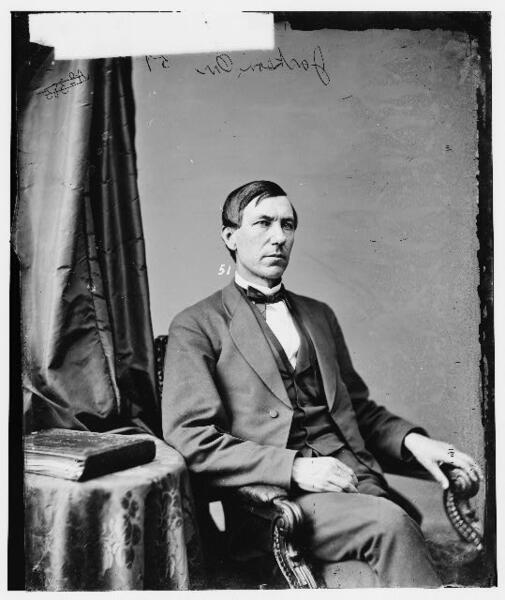
Here you will find contact information for Representative Jackson Orr, including email address, phone number, and mailing address.
| Name | Jackson Orr |
| Position | Representative |
| State | Iowa |
| District | 9 |
| Party | Republican |
| Status | Former Representative |
| Term Start | March 4, 1871 |
| Term End | March 3, 1875 |
| Terms Served | 2 |
| Born | September 21, 1832 |
| Gender | Male |
| Bioguide ID | O000103 |
About Representative Jackson Orr
Jackson Orr (September 21, 1832 – March 15, 1926) was a lawyer, Civil War officer, businessman, and two-term Republican U.S. Representative from western Iowa who later became a prominent public official and real estate businessman in Colorado. He spent the last five decades of his life in Colorado, where he remained active in legal, civic, and political affairs well into the late nineteenth century.
Orr was born at Washington Court House, Fayette County, Ohio, on September 21, 1832. In 1836, when he was still a small child, he moved with his parents to Benton, Indiana. He attended the common schools there and later pursued higher education at Indiana University in Bloomington, Indiana. His early education provided the foundation for his later legal and political career on the western frontier.
In 1856, Orr moved further west to Jefferson, in Greene County, Iowa. There he studied law, was admitted to the bar, and began the practice of law. In addition to his legal work, he became involved in local business and civic life in a region that was still developing rapidly. His move to Iowa marked the beginning of a public career that would span state politics, military service, and the United States Congress.
With the outbreak of the Civil War, Orr entered the Union Army. From 1861 to 1863, he served as captain of Company H, 10th Iowa Volunteer Infantry Regiment. In that capacity he participated in the Union war effort during a critical period of the conflict, gaining leadership experience and a public reputation that would assist him in his subsequent political endeavors. After his military service, he settled in the City of Montana, Iowa—later renamed Boone—where he engaged in mercantile pursuits while continuing his legal practice.
Orr’s political career in Iowa began in earnest in the late 1860s. He was elected as a member of the Iowa House of Representatives in 1868, representing his community in the state legislature. That same year, when Iowa had six seats in the U.S. House of Representatives, he sought the Republican nomination for the state’s 6th congressional district but fell just two votes short of securing it. Undeterred, he remained active in party affairs and public life, positioning himself for a future bid for national office.
In 1870, Orr won the Republican nomination for Iowa’s 6th congressional district and was elected to the 42nd United States Congress. Following the 1870 census, Iowa was apportioned three additional seats in the U.S. House, and Orr’s home county was placed in the newly created 9th congressional district. Running in that new district, he was elected to the 43rd United States Congress as well. He served in Congress from March 4, 1871, to March 3, 1875. During his second term he chaired the Committee on Expenditures in the Department of the Interior, giving him a role in overseeing federal spending and administration in an era of western expansion and development. After two terms, he chose not to be a candidate for renomination in 1874.
In 1875, Orr again moved west, this time to Silverton, a mining town in the newly opened area of southwestern Colorado Territory. There he was elected county judge and served in that judicial capacity for three years, applying his legal training to the administration of local justice in a rapidly growing mining region. After his service as county judge, he moved to Denver, Colorado, where he resumed the practice of law and became active in the real estate business, participating in the city’s expansion during the late nineteenth century.
Orr’s public service continued in Colorado at both the federal and local levels. In 1882, President Chester A. Arthur appointed him as one of three commissioners to implement a treaty between the United States and the Ute tribe, a role that involved managing complex issues of land, sovereignty, and relations between the federal government and Native American communities. In 1884, he sought the Republican nomination for Colorado’s at-large congressional seat, but was unsuccessful. He remained a respected figure in Denver civic life and served as president of the Denver Fire and Police Board in 1893 and 1894, overseeing important aspects of the city’s public safety administration during a period of urban growth.
Jackson Orr died in Denver, Colorado, on March 15, 1926. He was interred in Fairmount Cemetery in Denver. His long life spanned from the early decades of the American republic through the First World War era, and his career reflected the westward movement of the nation, from Ohio and Indiana to Iowa and finally to Colorado, where he spent his final five decades.