Representative Jacob Turney
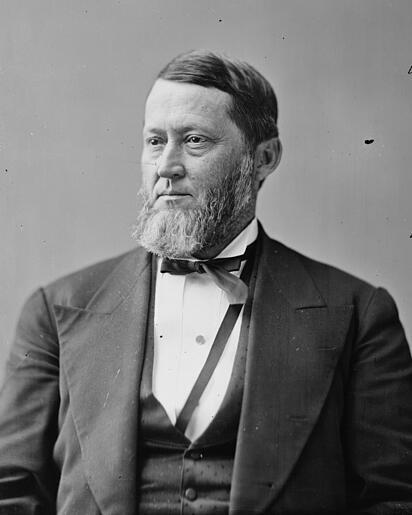
Here you will find contact information for Representative Jacob Turney, including email address, phone number, and mailing address.
| Name | Jacob Turney |
| Position | Representative |
| State | Pennsylvania |
| District | 21 |
| Party | Democratic |
| Status | Former Representative |
| Term Start | December 6, 1875 |
| Term End | March 3, 1879 |
| Terms Served | 2 |
| Born | February 18, 1825 |
| Gender | Male |
| Bioguide ID | T000431 |
About Representative Jacob Turney
Jacob Turney (February 18, 1825 – October 4, 1891) was an American lawyer and Democratic politician from Pennsylvania who served as a Representative in the United States Congress from 1875 to 1879. He was born in Greensburg, Westmoreland County, Pennsylvania, to Dutch immigrants Jacob Turney Sr. and Margaret (Singer) Turney. Raised in a community of recent immigrants, he grew up in Greensburg and spent his early years in the region that he would later represent in state and national office.
Turney completed his preparatory studies in Greensburg and attended Greensburg Academy. As a young man, he apprenticed as a printer, a trade that exposed him to public affairs and the printed debates of the day. He also worked as a deputy sheriff and as a clerk in the register and recorder’s office in Westmoreland County, gaining early experience in local government and the administration of public records.
Pursuing a legal career, Turney studied law under Albert Marchand in Greensburg. He was admitted to the bar in 1849 and commenced the practice of law in his hometown. His legal abilities soon brought him to public attention. From 1850 to 1855, he served as district attorney for Westmoreland County, Pennsylvania, where he gained prominence through the successful prosecution of several high-profile murder trials. His growing stature in Democratic Party circles led to his selection as a presidential elector in 1856, in which capacity he cast his electoral vote for James Buchanan.
Turney’s state legislative career began when he was elected to the Pennsylvania State Senate for the 22nd district, serving from 1858 to 1860. During this period he was chosen president of the Pennsylvania Senate in 1859, reflecting the confidence his colleagues placed in his leadership. He remained active in politics after his initial term, although he was an unsuccessful candidate for State Senator in 1871. Throughout these years he continued his legal practice in Greensburg, balancing professional and political responsibilities.
In national politics, Turney was elected as a Democrat to the Forty-fourth and Forty-fifth Congresses, representing Pennsylvania’s 21st congressional district from March 4, 1875, to March 3, 1879. His service in the United States House of Representatives occurred during a significant period in American history, in the decade following the Civil War and during the latter phase of Reconstruction. As a member of the House of Representatives, he participated in the democratic process and represented the interests of his constituents in western Pennsylvania.
During his two terms in Congress, Turney contributed to the legislative process as a member of several important committees. He served on the Committees on Privileges and Elections, Mines, Territories, and Currencies, positions that placed him at the center of debates over electoral integrity, western expansion, resource development, and national monetary policy. He played a key role in the passage of the Bland–Allison Act of 1878, which reintroduced the legality of silver currency and mandated the limited coinage of silver dollars, a major issue in the economic policy debates of the era. Through this work, he helped shape federal responses to questions of currency and economic stability.
After leaving Congress in 1879, Turney resumed the practice of law in Greensburg, returning to the profession in which he had first established his reputation. He remained a respected figure in local legal and political circles, continuing to live in the community where he had been born and had built his career. Jacob Turney died in Greensburg, Pennsylvania, on October 4, 1891. He was interred in St. Clair Cemetery in Greensburg, closing a life spent largely in service to his county, state, and nation.