Representative James Brooks
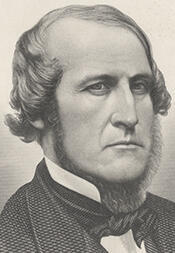
Here you will find contact information for Representative James Brooks, including email address, phone number, and mailing address.
| Name | James Brooks |
| Position | Representative |
| State | New York |
| District | 6 |
| Party | Democratic |
| Status | Former Representative |
| Term Start | December 3, 1849 |
| Term End | March 3, 1875 |
| Terms Served | 8 |
| Born | November 10, 1810 |
| Gender | Male |
| Bioguide ID | B000881 |
About Representative James Brooks
James Brooks (1810–1873) was a United States Representative from New York and a prominent Democratic politician whose congressional service extended, in total, from 1849 to 1875. He served eight terms in the U.S. House of Representatives and participated actively in the legislative process during a period that spanned the sectional crises preceding the Civil War, the war years themselves, and the early phases of Reconstruction. Over the course of his public life, he represented the interests of his New York constituents while engaging with many of the central political questions of mid‑nineteenth‑century America.
Born in Portland, Maine, on November 10, 1810, Brooks came of age in a New England environment shaped by maritime commerce and the early industrial economy. Details of his family background and early upbringing are sparse in the surviving record, but his youth in Maine placed him at some distance—geographically and culturally—from the New York political world in which he would later rise to prominence. His early experiences in a coastal community exposed him to the commercial and political currents that were beginning to knit together the expanding United States.
Brooks’s formal education was obtained in the schools of his native region, where he received the grounding in classical and literary studies typical of aspiring professionals of his generation. While specific institutions and degrees are not extensively documented, his subsequent career as a public man and legislator reflected a solid command of language, argument, and public affairs. This educational foundation prepared him for entry into journalism and politics, fields in which rhetorical skill and familiarity with contemporary issues were essential.
Before and alongside his congressional career, Brooks was active in public life as a member of the Democratic Party, aligning himself with the urban, commercial, and immigrant constituencies that increasingly defined New York’s political landscape. By the late 1840s, he had established himself sufficiently within party ranks to secure election to the U.S. House of Representatives. His emergence as a national legislator coincided with a time of intense debate over territorial expansion, slavery, and the balance of power between free and slave states, issues that would dominate the national agenda during his years in Washington.
Brooks first entered Congress as a Representative from New York in 1849. Over the course of eight terms in the House of Representatives, his service extended—though not continuously—through to 1875, placing him at the center of federal decision‑making during some of the most consequential decades in American history. As a Democratic member of the House, he participated in the democratic process by debating and voting on legislation related to the Compromise measures of the 1850s, the conduct and financing of the Civil War, and the complex questions of Reconstruction policy that followed the Union victory. In representing his New York constituents, he engaged with matters ranging from commerce and finance to immigration and urban governance, reflecting the concerns of a rapidly growing and diversifying state.
During his tenure, Brooks’s role in Congress was shaped by the shifting fortunes of the Democratic Party, which moved from national dominance in the 1850s to deep internal division over secession and the war, and then to opposition status during much of Reconstruction. Within this turbulent context, he contributed to the legislative process as part of the Democratic minority or majority at various times, helping to articulate his party’s positions on executive power, federal authority, and the reintegration of the Southern states. His long experience in the House gave him familiarity with parliamentary procedure and committee work, enabling him to influence debates even when his party’s broader agenda faced resistance.
In his later years, Brooks continued to serve in Congress as the nation grappled with the political, economic, and social consequences of the Civil War. He remained a figure in New York and national politics until the early 1870s, when his career drew to a close. James Brooks died on April 30, 1873, in Washington, D.C. His death brought an end to more than two decades of intermittent but significant service in the House of Representatives, during which he had borne witness to—and helped shape—the transformation of the United States from a fractious antebellum republic into a reunified, though deeply contested, postwar nation.