Representative James Hepburn Campbell
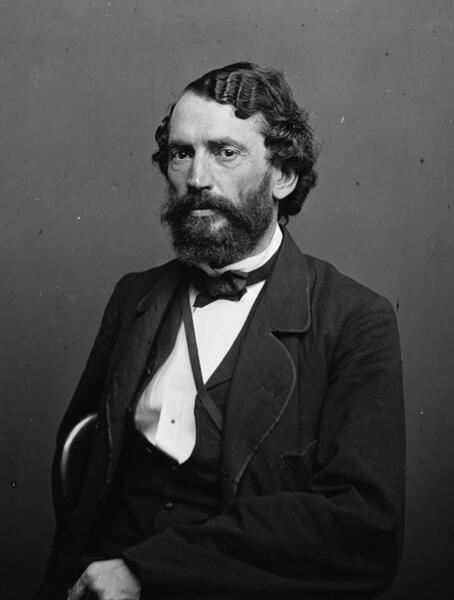
Here you will find contact information for Representative James Hepburn Campbell, including email address, phone number, and mailing address.
| Name | James Hepburn Campbell |
| Position | Representative |
| State | Pennsylvania |
| District | 11 |
| Party | Republican |
| Status | Former Representative |
| Term Start | December 3, 1855 |
| Term End | March 3, 1863 |
| Terms Served | 3 |
| Born | February 8, 1820 |
| Gender | Male |
| Bioguide ID | C000088 |
About Representative James Hepburn Campbell
James Hepburn Campbell (February 8, 1820 – April 12, 1895) was an American lawyer, diplomat, and legislator who represented Pennsylvania in the United States House of Representatives from 1855 to 1863. He was born in Williamsport, Pennsylvania, on February 8, 1820. In 1842, he married Juliet Hamersley Lewis, an author and the daughter of Judge Ellis Lewis, who served as Pennsylvania Attorney General and later as Chief Justice of the Pennsylvania Supreme Court. This marriage connected Campbell to one of the prominent legal and political families in the Commonwealth.
Campbell pursued formal legal training at Dickinson College in Carlisle, Pennsylvania, where he graduated from the law department in 1841. That same year he was admitted to the bar and commenced the practice of law in Pottsville, Pennsylvania. His early professional life was firmly rooted in the legal field, and his growing reputation as an attorney helped lay the groundwork for his subsequent involvement in state and national politics.
By the mid-1840s, Campbell had become active in national political affairs. He served as a delegate to the Whig National Convention in 1844, reflecting his early alignment with the Whig Party and his engagement with the major political questions of the era. Over the next decade, as the national party system realigned in response to sectional tensions and the collapse of the Whig Party, Campbell’s political affiliations evolved along with the emerging Opposition and Republican movements in Pennsylvania.
Campbell was elected as an Opposition Party candidate to the Thirty-fourth Congress, serving from March 4, 1855, to March 3, 1857, as a Representative from Pennsylvania. He was an unsuccessful candidate for reelection in 1856 to the Thirty-fifth Congress. He returned to Congress as a member of the Republican Party, winning election to the Thirty-sixth and Thirty-seventh Congresses and serving from March 4, 1859, to March 3, 1863. In total, he served three terms in the U.S. House of Representatives. During this significant period in American history, on the eve of and into the early years of the Civil War, Campbell participated in the legislative process, contributed to debates over the future of the Union, and represented the interests of his Pennsylvania constituents. He was not a candidate for renomination in 1862, concluding his congressional service at the end of the Thirty-seventh Congress.
During the American Civil War, Campbell continued his public service in a military capacity. He served as a major in the Twenty-fifth Regiment of Pennsylvania Infantry, reflecting his support for the Union cause in a time of national crisis. His wartime service complemented his earlier legislative role, placing him among those Northern political leaders who also took on direct military responsibilities during the conflict.
Campbell’s career next turned to diplomacy. In May 1864, President Abraham Lincoln appointed him Minister to Sweden. He served in that post until March 29, 1867, representing United States interests in Scandinavia during the closing stages of the Civil War and the early Reconstruction era. In 1867 he declined an offer of a diplomatic mission to Colombia, choosing instead to return to private life. Later that year he located in Philadelphia, Pennsylvania, where he resumed the practice of law, drawing on the extensive legal and governmental experience he had accumulated over the previous decades.
James Hepburn Campbell spent his later years in the Philadelphia area, maintaining his legal practice and his standing as a respected former legislator and diplomat. He died on April 12, 1895, on his estate, “Aeola,” near Wayne, Pennsylvania. He was interred in Woodlands Cemetery in Philadelphia. His papers from the Civil War and diplomatic period, preserved in collections such as the James H. Campbell Papers, 1861–1866, at the William L. Clements Library of the University of Michigan, along with entries in the Biographical Directory of the United States Congress and The Political Graveyard, document a career that spanned law, politics, military service, and international diplomacy during one of the most consequential eras in American history.