Representative James Ronald Chalmers
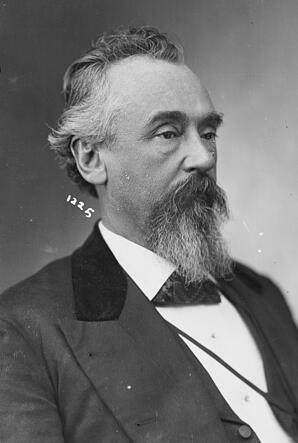
Here you will find contact information for Representative James Ronald Chalmers, including email address, phone number, and mailing address.
| Name | James Ronald Chalmers |
| Position | Representative |
| State | Mississippi |
| District | 2 |
| Party | Independent |
| Status | Former Representative |
| Term Start | October 15, 1877 |
| Term End | March 3, 1885 |
| Terms Served | 4 |
| Born | January 12, 1831 |
| Gender | Male |
| Bioguide ID | C000272 |
About Representative James Ronald Chalmers
James Ronald Chalmers (January 11, 1831 – April 9, 1898) was an American lawyer, Confederate major general, and politician who served as a Representative from Mississippi in the United States Congress from 1877 to 1885. A member of the Democratic Party who later ran as an Independent Democrat on fusionist tickets, he represented Mississippi’s 6th congressional district during a turbulent period in the post–Civil War South and contributed to the legislative process during four terms in office. His congressional service occurred during a significant period in American history, as Reconstruction waned and white Democrats reasserted political dominance in Mississippi and throughout the region.
Chalmers was born in Halifax County, Virginia, on January 11, 1831. His father, Joseph Chalmers, moved the family to Mississippi when James was a boy, settling in Holly Springs in 1839. Joseph Chalmers became active in state politics and was first appointed by the governor to fill a term in the United States Senate, then elected by the Mississippi legislature as U.S. Senator, helping to shape his son’s early exposure to public life. James Chalmers was prepared for South Carolina College at Columbia (now the University of South Carolina), where he was graduated in 1851. Like his father, he embraced the doctrines of states’ rights and the pro-slavery Democratic politics that predominated among Mississippi’s white elite in the antebellum era.
After completing his education, Chalmers returned to Holly Springs to read law with an established firm and was admitted to the bar in 1853. He entered private practice and quickly advanced in his profession. In 1858 he was elected district attorney, gaining experience as a courtroom advocate and public official. As sectional tensions intensified, he emerged as an ardent States’ rights Democrat. In 1861 he was elected as a delegate to the Mississippi convention that passed the ordinance of secession, and he voted in favor of secession, aligning himself firmly with the Confederate cause.
With the outbreak of the Civil War, Chalmers entered the Confederate States Army as a captain and was soon promoted to colonel of the 9th Mississippi Infantry in 1861. For a time he commanded at Pensacola, Florida. On February 13, 1862, he was promoted to brigadier general, and on April 6 he was assigned to command the Second Brigade, Withers’ Division, Army of the Mississippi. He and his command fought with distinction at the Battle of Shiloh. During General Braxton Bragg’s operations in north Mississippi, Chalmers was sent with a force of cavalry to make a feint upon Rienzi, Mississippi, in order to cover the movement of infantry to Ripley. In executing this order, he encountered Union forces under Philip Sheridan on July 1, and a stubborn engagement ensued from about 8:30 a.m. until late in the afternoon; learning that Sheridan had been reinforced by infantry and artillery, Chalmers withdrew. His command accompanied Bragg’s advance into Kentucky in the summer of 1862, performing its duties with courage and zeal, and again rendered notable service at the Battle of Murfreesboro (Stones River).
In April 1863, at the request of Lieutenant General John C. Pemberton, Chalmers was transferred to the Department of Mississippi and East Louisiana and placed in command of the Fifth Military District, comprising the top two tiers of counties in Mississippi. In 1864 he was assigned to command the cavalry brigades of Jeffrey Forrest and McCulloch, forming the First Division of General Nathan Bedford Forrest’s Cavalry Corps. This cavalry division was later enlarged by the addition of Rucker’s Brigade. Chalmers bore a conspicuous part in the Battle of Fort Pillow—an engagement notorious for the massacre of surrendered Black Union troops—and in all of Forrest’s campaigns in north Mississippi, west Tennessee, and Kentucky. He also led forces in General John Bell Hood’s Tennessee Campaign. On February 18, 1865, he was placed in command of all Mississippi cavalry in Confederate service in Mississippi and west Tennessee, serving in that capacity until the collapse of the Confederacy.
After the war, Chalmers resumed the practice of law in Mississippi and reentered political life as white Democrats sought to overturn Reconstruction. In the waning days of the Reconstruction era, he was elected to the Mississippi State Senate in 1875 and 1876. These campaign seasons in Mississippi were marked by increasing violence and intimidation directed at Republican and African American voters. Chapters of the Red Shirts, a paramilitary group working for the Democratic Party that sought to disrupt and suppress Republican voting, helped Democrats regain control of state and federal offices in Mississippi and the Carolinas. Within this context, Chalmers emerged as a prominent Democratic leader in the state.
In 1876 Chalmers was elected as Representative from Mississippi’s 6th congressional district to the United States House of Representatives, serving in the Forty-fifth and Forty-sixth Congresses from March 4, 1877, to March 3, 1881. His Republican African-American opponent, John R. Lynch, who had previously been strongly elected from this Black-majority district, contested the 1876 result, but with the House then dominated by Democrats, the Committee on Elections refused to hear the case. Chalmers won re-election in 1880 and received the certificate of election to the Forty-seventh Congress, serving from March 4, 1881, until April 29, 1882. Lynch again contested the election, alleging widespread fraud and manipulation of returns.
When the case came before the Committee on Elections on April 27, 1882, Lynch argued that in five counties more than 5,000 of his votes had been counted for Chalmers and that several thousand Republican ballots had been discarded after a secret hearing on technical grounds, such as the failure to transmit a list of names with the returns or the presence of unusual marks on ballots. Lynch’s strongest arguments drew on Chalmers’s own remarks that Lynch’s votes had been thrown out and that he (Chalmers) was “in favor of using every means short of violence to preserve [for] intelligent white people of Mississippi supreme control of political affairs.” The committee ruled in Lynch’s favor, and on April 29, 1882, the House voted 125 to 83, with 62 Members abstaining, to unseat Chalmers and seat Lynch for the remainder of the term. This decision underscored the deep partisan and racial conflicts surrounding elections in Mississippi during the late Reconstruction and post-Reconstruction years.
In the fall of 1882, Chalmers sought to return to Congress by running as an Independent Democrat as part of a fusion ticket supported by Republicans and the Greenback Party for the Forty-eighth Congress. Democrat Van H. Manning claimed victory, and Chalmers again contested the legality of the election. After extended review, Congress finally verified Chalmers as the winner, and he was allowed to take his seat on June 25, 1884. During this period he was often described as a member of the Independent Party or an Independent Democrat, reflecting his break with the regular Democratic organization. He wrote to Republican President Chester A. Arthur in December 1882 outlining strategies to defeat the regular Democrats in Mississippi, suggesting that Independents like himself could align with Greenbackers, dissident Democrats, and Republicans on fusionist tickets. He drew inspiration from Senator William Mahone of Virginia, who had organized the Readjuster Party to unite diverse factions in that state. Neither Chalmers nor Mahone, however, succeeded in dismantling the Democratic “Solid South.” Chalmers was unsuccessful in his bid for re-election in the fall of 1884, and his service in Congress effectively ended in 1885.
After failing to win election in 1884, Chalmers left electoral politics and returned to full-time law practice. He moved his practice to Memphis, Tennessee, where he continued his legal career and remained a figure of regional note as a former Confederate general and congressman. James Ronald Chalmers died in Memphis on April 9, 1898. His life spanned the antebellum, Civil War, Reconstruction, and post-Reconstruction eras, and his career reflected both the military and political struggles that shaped Mississippi and the broader South in the nineteenth century.