Representative James Brown Clay
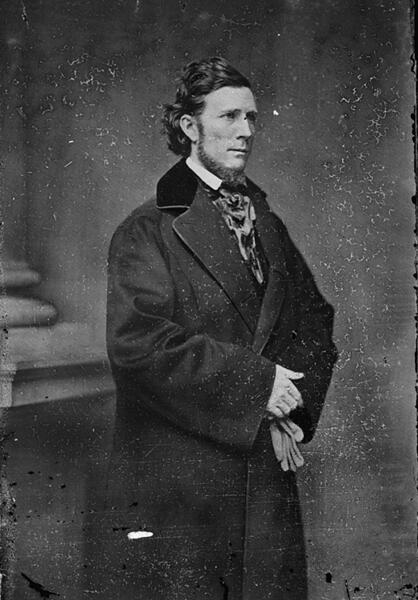
Here you will find contact information for Representative James Brown Clay, including email address, phone number, and mailing address.
| Name | James Brown Clay |
| Position | Representative |
| State | Kentucky |
| District | 8 |
| Party | Democratic |
| Status | Former Representative |
| Term Start | December 7, 1857 |
| Term End | March 3, 1859 |
| Terms Served | 1 |
| Born | November 9, 1817 |
| Gender | Male |
| Bioguide ID | C000483 |
About Representative James Brown Clay
James Brown Clay (November 9, 1817 – January 26, 1864) was an American politician and diplomat who served as a member of the United States House of Representatives for Kentucky’s 8th congressional district from 1857 to 1859. A member of the Democratic Party during his congressional service, he represented Kentucky for one term in the Thirty-fifth Congress at a time of mounting sectional tension in the United States.
Clay was born in Washington, D.C., while his father, Henry Clay, was serving in the United States Congress. He was named for his uncle by marriage, James Brown, the husband of his maternal aunt. He was part of the prominent Clay family of Kentucky; his brothers included Henry Clay, Jr., who was killed in the Mexican–American War, and John Morrison Clay. Raised in the political and social milieu surrounding his father’s national career, he grew up between the nation’s capital and Kentucky, absorbing early exposure to public life and politics.
Clay’s formal education began at a boys’ school associated with Kenyon College in Gambier, Ohio, an institution founded by the family’s friend, Episcopal Bishop Philander Chase. He later attended Transylvania University in Lexington, Kentucky, one of the leading institutions of higher learning in the West at the time and a center of legal and political education for many future Kentucky leaders. This educational background prepared him for both commercial and legal pursuits.
From 1832 to 1834, Clay worked in a countinghouse in Boston, Massachusetts, gaining experience in business and finance. After returning to Kentucky, he studied law and was admitted to the bar. He practiced law in Lexington in partnership with his father, Henry Clay, thereby entering both the legal profession and the orbit of national politics. In 1843, he married Susan Maria Jacob, daughter of Louisville capitalist John J. Jacob, widely regarded as the city’s first millionaire, and sister of Charles Donald Jacob, who later became mayor of Louisville. James and Susan Clay eventually had ten children, further entwining the Clay family with other prominent Kentucky families.
Clay’s public career extended beyond law into diplomacy and agriculture. He was appointed chargé d’affaires of the United States to Portugal and served in that post from August 1, 1849, to July 19, 1850, handling American interests in Lisbon at a time when commercial and claims issues occupied U.S. relations with that country. After his diplomatic service, he farmed in Missouri during 1851 and 1852 before returning to Lexington, Kentucky. Following the death of his father and the disintegration of the Whig Party, to which he had been a lifelong adherent, Clay shifted his political allegiance. The controversy surrounding the Kansas–Nebraska Act and the collapse of the Whig coalition led him to join the Democratic Party, aligning himself with many Southern and border-state politicians of the period.
As a Democrat, Clay was elected to the United States House of Representatives from Kentucky’s 8th congressional district and served in the Thirty-fifth Congress from March 4, 1857, to March 3, 1859. During this single term in office, he participated in the legislative process at a critical juncture in American history, representing the interests of his Kentucky constituents as the nation moved closer to civil war. He did not seek renomination in 1858 and declined an offer from President James Buchanan to serve on a diplomatic mission to Germany. After leaving Congress, he returned to Lexington, where he engaged in agriculture. Census records from 1860 show that he farmed using enslaved labor in Fayette County, owning about a dozen enslaved people, and that his household also included three male boarders, reflecting both his status as a substantial landholder and the entrenched system of slavery in Kentucky.
In the final years before the Civil War, Clay continued to be involved in efforts to address the sectional crisis. He was a member of the Peace Conference of 1861 held in Washington, D.C., an eleventh-hour attempt by leaders from various states to avert the impending conflict between North and South. Despite this effort at compromise, once the Civil War began he supported the Confederacy. He was commissioned to raise a regiment for the Confederate cause, but chronic ill health, particularly tuberculosis, prevented him from fulfilling this military role.
Seeking relief from his illness, Clay traveled to Montreal, Quebec, Canada, where he died on January 26, 1864. His body was returned to Kentucky, and he was interred in the family plot at Lexington Cemetery in Lexington, Kentucky. His life and career, shaped by his lineage as the son of Henry Clay and by the political realignments of the 1850s, reflected the shifting loyalties and deepening divisions of the border states in the years leading up to and during the American Civil War.