Representative James C. Corman
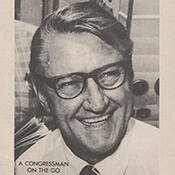
Here you will find contact information for Representative James C. Corman, including email address, phone number, and mailing address.
| Name | James C. Corman |
| Position | Representative |
| State | California |
| District | 21 |
| Party | Democratic |
| Status | Former Representative |
| Term Start | January 3, 1961 |
| Term End | January 3, 1981 |
| Terms Served | 10 |
| Born | October 20, 1920 |
| Gender | Male |
| Bioguide ID | C000780 |
About Representative James C. Corman
James Charles Corman (October 20, 1920 – December 30, 2000) was an American politician and attorney who served as a member of the Los Angeles City Council from 1957 to 1961 and as a member of the United States House of Representatives from California between 1961 and 1981. A member of the Democratic Party, he represented his San Fernando Valley–based district for ten consecutive terms, contributing to the legislative process during a significant period in modern American history.
Corman was born in Galena, Kansas, and moved with his family to Los Angeles, California, during his youth. He attended public schools in Los Angeles and came of age during the Great Depression, an experience that helped shape his later interest in public service and social policy. He went on to attend the University of California, Los Angeles (UCLA), where he completed his undergraduate studies, and then earned a law degree from the University of Southern California (USC) Law School. His legal education provided the foundation for a career that combined law, military service, and politics.
During World War II, Corman served in the United States Army, seeing combat in the European theater. His wartime experiences left a lasting impression on him. He later recounted an incident in which he and fellow soldiers heard the tap of a grenade and ducked into their foxholes just before it exploded, escaping injury. The following morning, they discovered that the Japanese soldier who had thrown the grenade had decapitated himself in the blast; in the soldier’s wallet was a magazine clipping showing Japanese-American soldiers fighting with United States forces in Italy. Experiences such as this deepened Corman’s appreciation for the complexities of war and the contributions of minority servicemembers, perspectives that would inform his later support for civil rights and social justice legislation.
After the war, Corman returned to Los Angeles, completed his legal training, and was admitted to the bar. He entered private practice and soon became active in local Democratic politics. In 1957 he was elected to the Los Angeles City Council, where he served until 1961. On the council he represented a growing suburban area of the San Fernando Valley, focusing on issues of urban development, municipal services, and the needs of a rapidly expanding postwar population. His work on the council helped establish his reputation as an effective advocate for his constituents and positioned him for higher office.
In 1960, Corman was elected to the U.S. House of Representatives as a Democrat from California, taking office on January 3, 1961. His ten terms in Congress, lasting until January 3, 1981, coincided with the administrations of Presidents John F. Kennedy, Lyndon B. Johnson, Richard Nixon, Gerald Ford, and Jimmy Carter. Reflecting on his years in Washington after leaving office, he would sometimes summarize his tenure by saying he went “in with President Kennedy and out with President Carter.” As a member of the House of Representatives, Corman participated fully in the democratic process and represented the interests of his San Fernando Valley constituents during a period marked by the civil rights movement, the Great Society, the Vietnam War, and significant economic and social change.
Corman developed a record as a strong supporter of civil rights, voting rights, and social welfare legislation. He voted in favor of the 24th Amendment to the U.S. Constitution, which abolished the poll tax in federal elections, and supported the Civil Rights Act of 1964 and the Voting Rights Act of 1965, landmark measures that expanded legal protections and access to the ballot for African Americans and other minorities. He also voted for the creation of the Medicare program, helping to establish federal health insurance for older Americans, and supported the Civil Rights Act of 1968, which included fair housing provisions. In 1971, alongside fellow Democrat Martha Griffiths and Republicans Charles Adams Mosher and Ogden Reid, he was one of the main co-sponsors of the House version of Senator Edward “Ted” Kennedy’s Health Security Act, an ambitious universal healthcare proposal. These legislative positions reflected Corman’s long-standing commitment to expanding social programs and protecting civil liberties.
Within the Democratic Party, Corman rose to a position of national influence. He served as chair of the Democratic Congressional Campaign Committee (DCCC) from 1976 to 1981, overseeing House campaign strategy during a period that included the post-Watergate realignment and the 1980 election that brought Ronald Reagan to the presidency. His tenure at the DCCC made him a key figure in efforts to recruit candidates, raise funds, and defend Democratic seats in the House. In the 1980 election, however, amid a strong national swing toward Republican candidates, Corman was narrowly defeated for re-election by Los Angeles School Board member Bobbi Fiedler. His loss was notable because, until the defeat of Sean Patrick Maloney in 2022, Corman was the most recent chairman of the DCCC to lose his own seat while serving in that role.
Following his departure from Congress in January 1981, Corman returned to private life and resumed work in the legal and public policy arenas, remaining engaged in civic and political affairs in California. He continued to be recognized for his two decades of congressional service and his earlier work in Los Angeles city government. James Charles Corman died on December 30, 2000. In 2001, the Van Nuys Federal Building in the San Fernando Valley was named in his honor, commemorating his long service to the region and the nation. His legacy has also been preserved in scholarship and popular culture: the James C. Corman papers are held in the University Library at California State University, Northridge, providing a resource for researchers studying mid-twentieth-century politics, and he was portrayed by actor Stoney Westmoreland in the 2016 film “All the Way,” which dramatized the presidency of Lyndon B. Johnson and the passage of civil rights legislation.