Senator James Couzens
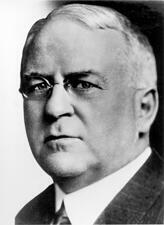
Here you will find contact information for Senator James Couzens, including email address, phone number, and mailing address.
| Name | James Couzens |
| Position | Senator |
| State | Michigan |
| Party | Republican |
| Status | Former Representative |
| Term Start | November 29, 1922 |
| Term End | October 22, 1936 |
| Terms Served | 3 |
| Born | August 26, 1872 |
| Gender | Male |
| Bioguide ID | C000812 |
About Senator James Couzens
James Joseph Couzens (August 26, 1872 – October 22, 1936) was an American businessman, politician, and philanthropist who rose from modest beginnings to become a leading industrial executive, mayor of Detroit, and United States senator from Michigan. A member of the Republican Party, he served as mayor of Detroit from 1919 to 1922 and as a U.S. senator from 1922 until his death in 1936, contributing to the legislative process during three terms in office and playing a prominent role among Progressive Republicans.
Couzens was born in Chatham, Ontario, Canada, the son of soapmaker James Couzens and Emma Clift Couzens. He attended the public schools of Chatham and spent time at a business college before seeking broader opportunities in the United States. In 1890 he moved to Detroit, Michigan, where he worked as a railroad car checker for the New York Central Railroad from 1890 to 1897. His diligence and reliability in this position attracted the attention of Detroit coal dealer Alexander Y. Malcomson, who hired him as a clerk in his coal business. Couzens worked for Malcomson from 1897 to 1903, gaining practical experience in business management and finance that would later prove critical to his success in the emerging automobile industry.
In 1898 Couzens married Margaret Manning. The couple had six children: a son born in 1899 who died in infancy; Homer Couzens, born in 1900; Frank Couzens, born in 1902 and later mayor of Detroit; Madeline, born in 1904; Margo, born in 1910; and Edith, born in 1911. The family’s life in Detroit unfolded alongside Couzens’s rapid ascent in business and public affairs, and his later philanthropic interests in children’s health and welfare reflected, in part, his own experience as a husband and father.
Couzens’s business career was closely intertwined with the early history of the Ford Motor Company. In 1902 Henry Ford was organizing what would become Ford Motor Company, with Alexander Malcomson as a major stakeholder. Seeking additional capital, Ford and Malcomson invited Couzens to invest. Borrowing heavily, he put $2,500 into the new firm. When Ford Motor Company was incorporated in 1903, John S. Gray served as president, Henry Ford as vice president, Malcomson as treasurer, and Couzens as secretary. Couzens assumed responsibility for the business management of the company for an annual salary of $2,400, overseeing production, sales, and administration. After Gray’s death in 1906 and Malcomson’s departure from the firm, Couzens became vice president and general manager. His administrative skill and insistence on efficiency were central to Ford’s rapid expansion and profitability, and the company made both Ford and Couzens wealthy. Relations between the two men, however, gradually deteriorated, and in 1915 Couzens resigned as general manager, though he remained on the board of directors. In 1919 Henry Ford purchased Couzens’s shares for $30,000,000, a transaction that secured Couzens’s financial independence. He later served as president of the Bank of Detroit and as a director of the Detroit Trust Company, further solidifying his stature in the city’s financial and business community. In recognition of his role in the early automobile industry, he was posthumously inducted into the Automotive Hall of Fame in 2012.
Couzens’s entry into public service began at the municipal level in Detroit. He served as commissioner of street railways from 1913 to 1915, where he worked to improve and expand public transit, and as commissioner of the metropolitan police department from 1916 to 1918, focusing on administrative reform and public safety. In 1919 he was elected mayor of Detroit, serving until 1922. As mayor, Couzens pursued progressive municipal policies, including the installation and expansion of municipal street railways, reflecting his belief in public ownership of essential utilities and services. His tenure coincided with Detroit’s rapid growth as an industrial center, and he gained a reputation as an independent-minded reformer committed to efficient, honest government.
Couzens’s state and national prominence led to his appointment to the United States Senate. On November 29, 1922, he was appointed as a Republican senator from Michigan to fill the vacancy caused by the resignation of Senator Truman H. Newberry. His appointment was confirmed by a special election on November 4, 1924, in which he was elected to serve the remainder of Newberry’s term; at the same time, he won election to a full term commencing March 4, 1925. He was reelected in 1930, serving continuously from November 29, 1922, until his death on October 22, 1936. During this period, which encompassed the later years of the Roaring Twenties and the Great Depression, Couzens participated actively in the democratic process and represented the interests of his Michigan constituents in a time of profound economic and social change.
In the Senate, Couzens aligned himself with the Progressive wing of the Republican Party. He advocated a high graduated income tax, stronger regulation of business, and public ownership or control of key utilities, reflecting his belief that concentrated economic power should be balanced by public oversight. He served as chairman of the Senate Committee on Civil Service in the Sixty-ninth Congress, chairman of the Senate Committee on Education and Labor in the Sixty-ninth and Seventieth Congresses, and chairman of the Senate Committee on Interstate Commerce in the Seventy-first and Seventy-second Congresses. His support for many of President Franklin D. Roosevelt’s New Deal programs, unusual for a Republican senator, contributed to his defeat as a candidate for renomination in 1936. Nonetheless, his legislative record marked him as an independent, reform-minded lawmaker who often placed policy convictions above party discipline.
Parallel to his public career, Couzens became one of the leading philanthropists in Michigan. He established the Children’s Fund of Michigan with a $10,000,000 grant, creating a 25-year foundation that, under the leadership of Dr. Frank Norton, Dr. Kenneth Richard Gibson, and secretary Kathryn Hutchison, provided free health and dental care for indigent children in Detroit and across the state until the mid-1950s. He gave $1,000,000 for relief efforts in Detroit during periods of economic hardship and created a fund to make loans to physically handicapped individuals, aiming to expand their opportunities for self-support. In response to the 1927 Bath School Disaster in Bath Township, Michigan—where Andrew Kehoe, an embittered school board member and treasurer, killed 38 children by detonating explosives in the Bath Consolidated School—Couzens donated $75,000 to rebuild the school. The new facility was dedicated as the “James Couzens Agricultural School” in his honor.
Couzens’s philanthropy extended to higher education, health care, and housing. He donated $600,000 to the University of Michigan for the construction of a residence hall for female nursing students near the university’s hospital and medical campus; the building, completed in the 1920s, was named Couzens Hall in recognition of his gift. He also contributed funds to build a nurses’ home at the Farrand Training School in Detroit, a nurses’ training institution associated with Harper Hospital. Completed in 1922, the building was named McLaughlin Hall at his request, honoring Emily A. McLaughlin, principal of the Farrand Training School. In the 1930s, responding to a birthday request from his wife for “a simple box in which to keep my pearls,” Couzens presented her with such a box containing a note describing a $1,000,000 donation to Children’s Hospital of Michigan, explaining, “My dear, your new pearls will be all the children who are eventually treated there.” Children’s Hospital of Michigan later became part of the Detroit Medical Center. Troubled by the shortcomings of many low-income housing projects that emerged during the Depression, he also funded an alternative model: he contributed $550,000 of his own money, combined with $300,000 from Oakland Housing, to create Westacres, a managed low-income housing project in West Bloomfield, Michigan. The development offered factory workers the opportunity to own homes on one-acre lots, with the expectation that residents would farm their land to help sustain their families during seasonal layoffs.
James Couzens died in Detroit on October 22, 1936, while still serving in the United States Senate, placing him among the members of Congress who died in office between 1900 and 1949. He was interred in Woodlawn Cemetery in Detroit. Known for his straightforward manner, he once told The Literary Digest that his surname was “pronounced exactly as cousins.” On November 9, 1937, just over a year after his death, the Detroit City Council, led by Mayor Frank Couzens, his son, voted to rename the portion of Northwestern Highway within the city of Detroit—beginning at Wyoming Avenue and extending toward Oakland County—as James Couzens Highway, though the segment in Oakland County retained its original name. When the John C. Lodge Freeway was extended along this route in the 1960s, the Lodge name was applied to the new freeway segment, while the service drives between Wyoming Avenue and Eight Mile Road (M-102) continued to bear the James Couzens designation. Born outside the United States and later serving in its Senate, Couzens occupies a distinctive place in American political and business history as an immigrant industrialist, reform mayor, progressive Republican senator, and major benefactor of Michigan’s civic and charitable institutions.