Senator James Rood Doolittle
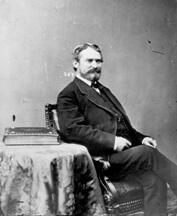
Here you will find contact information for Senator James Rood Doolittle, including email address, phone number, and mailing address.
| Name | James Rood Doolittle |
| Position | Senator |
| State | Wisconsin |
| Party | Republican |
| Status | Former Representative |
| Term Start | December 7, 1857 |
| Term End | March 3, 1869 |
| Terms Served | 2 |
| Born | January 3, 1815 |
| Gender | Male |
| Bioguide ID | D000428 |
About Senator James Rood Doolittle
James Rood Doolittle Sr. (January 3, 1815 – July 27, 1897) was an American lawyer, jurist, politician, and Wisconsin pioneer who represented Wisconsin as a United States senator from March 4, 1857, to March 4, 1869. A member of the Republican Party during his Senate career and a strong supporter of President Abraham Lincoln’s administration during the American Civil War, he later became a Democrat and made an unsuccessful run for governor of Wisconsin. Over two terms in the Senate, he played a significant role in the legislative process during one of the most consequential periods in American history, serving as chairman of the Senate Committee on Indian Affairs from 1861 to 1867 and participating prominently in debates over war and Reconstruction.
Doolittle was born in Hampton, Washington County, New York, the son of Reuben Doolittle and Sarah (Rood) Doolittle. He was educated in upstate New York, attending Middlebury Academy in Wyoming, New York, before matriculating at Hobart College in Geneva, New York. He graduated from Hobart College in 1834. After college he read law, was admitted to the New York bar in 1837, and began the legal career that would underpin his later prominence in public life. On July 27, 1837, he married Mary Lovina Cutting; the couple had four sons and two daughters and remained married for forty‑two years until her death in 1879.
Following his admission to the bar, Doolittle established a law practice in Rochester, New York. In 1841 he moved to Warsaw, New York, where he continued to practice law and became increasingly involved in public affairs. From 1847 to 1850 he served as district attorney for Wyoming County, New York, and he also held a commission as a colonel in the New York State militia. Until the repeal of the Missouri Compromise in 1850, he was aligned with the Democratic Party, but the sectional crisis and the controversy over the expansion of slavery led him to break with the Democrats in the early 1850s.
In 1851 Doolittle moved west to Racine, in the then-young state of Wisconsin, becoming one of its notable legal and political pioneers. Two years later, in 1853, he was elected Wisconsin Circuit Court Judge for the 1st Judicial Circuit, defeating the incumbent appointee Wyman Spooner. As a circuit judge he presided over a range of civil and criminal matters in southeastern Wisconsin. His tenure included the July 1855 case of The State of Wisconsin v. David F. Mayberry, the outcome of which led to the only recorded lynching in the history of Rock County, Wisconsin, an episode that drew public attention to questions of law, order, and mob violence in the frontier state. Doolittle resigned from the circuit court in March 1856, positioning himself for a larger role in national politics.
With the collapse of the old party system over slavery and the repeal of the Missouri Compromise, Doolittle left the Democratic Party and joined the emerging Republican Party. In 1857 he was elected to the United States Senate from Wisconsin as a Republican, and he was reelected in 1863, serving two full terms from March 4, 1857, to March 4, 1869. His service in Congress coincided with the secession crisis, the Civil War, and the early years of Reconstruction. He was a delegate to the Peace Conference of 1861 in Washington, D.C., an eleventh‑hour effort by Unionist leaders to avert civil war. In the Senate he participated actively in the democratic process and represented the interests of his Wisconsin constituents while engaging in the great national debates of the era.
During his Senate career, Doolittle emerged as an important figure on issues relating to Native American policy and the constitutional status of the seceding states. He served as chairman of the Committee on Indian Affairs from 1861 to 1867 and was also chairman of the Joint Special Committee on Conditions of Indian Tribes. In June 1860 he joined Jacob Collamer of Vermont in presenting the minority view in the Mason Report, the Senate investigation into John Brown’s raid on Harpers Ferry. During the Civil War he supported many of Lincoln’s policies and upheld the authority of the federal government, while insisting that the seceding states had never legally ceased to be part of the Union. He proposed a constitutional amendment to ban secession outright. In the summer of 1865, as chairman of the Joint Special Committee on Conditions of Indian Tribes, he traveled west of the Mississippi River to investigate the condition and treatment of Native tribes, participating in inquiries in Kansas, the Indian Territory, and Colorado. The committee’s report, “The Condition of the Tribes,” was issued on January 26, 1867. Years later, in 1872, The New York Times accused Doolittle of having suppressed this report—alleging that it exposed a “Native ring” of fraudulent suppliers of goods under treaty obligations—and claimed it was printed only after the Cincinnati Gazette obtained a copy, an accusation that surfaced while Doolittle was under consideration for appointment as Secretary of the Interior in Horace Greeley’s projected “reform cabinet. ”
Doolittle took a prominent part in Senate debates on war measures and Reconstruction policy. While he consistently supported the Union war effort and the restoration of the seceded states to their place in the Union, he often differed from the more radical wing of his party. He argued that each state should determine questions of suffrage for itself and strongly opposed the Fifteenth Amendment, which prohibited denying the right to vote on account of race, color, or previous condition of servitude. His increasingly conservative stance on Reconstruction and civil rights contributed to a political realignment in the postwar years. He presided as president of the National Union Convention of 1866 in Philadelphia, a gathering that sought to rally support for President Andrew Johnson’s lenient Reconstruction policies, and later served as president of the 1872 Democratic National Convention in Baltimore, which formally adopted the nomination of Horace Greeley for the presidency.
After leaving the Senate in 1869, Doolittle formally aligned himself with the Democratic Party. In 1871 he ran for governor of Wisconsin as a Democrat, but his campaign was unsuccessful, and he subsequently retired from active electoral politics. He remained, however, a respected public figure and legal authority. He returned to the Midwest and practiced law in Chicago, Illinois, while maintaining his residence in Racine, Wisconsin. He served for a year as acting president of the Old University of Chicago and spent many years on its faculty as a professor in the law school, in addition to serving on the university’s Board of Trustees. His family continued his legal legacy; his son James R. Doolittle Jr. became a prominent lawyer in Chicago and served five years on the Chicago Board of Education.
In his later years, Doolittle divided his time between his professional responsibilities and family life. He remained engaged in legal and educational work well into old age. James Rood Doolittle died of Bright’s disease on July 27, 1897, in Edgewood, Rhode Island. He was interred in Mound Cemetery in Racine, Wisconsin, the community that had been central to his career as a Wisconsin pioneer, jurist, and United States senator.