Senator James Graham Fair
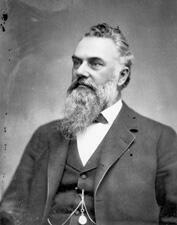
Here you will find contact information for Senator James Graham Fair, including email address, phone number, and mailing address.
| Name | James Graham Fair |
| Position | Senator |
| State | Nevada |
| Party | Democratic |
| Status | Former Representative |
| Term Start | December 5, 1881 |
| Term End | March 3, 1887 |
| Terms Served | 1 |
| Born | December 3, 1831 |
| Gender | Male |
| Bioguide ID | F000002 |
About Senator James Graham Fair
James Graham Fair (December 3, 1831 – December 28, 1894) was an Irish immigrant to the United States who became a highly successful mining engineer, businessman, and politician, and who served as a United States Senator from Nevada from 1881 to 1887. Born into poverty to Anglican parents in Ireland, he emigrated to the United States as a young man and worked his way west during the era of rapid territorial expansion and mineral discovery. Settling in the American West, he developed expertise in mining at a time when new technologies and large-scale capital investment were transforming the industry.
Fair’s rise to prominence came through his investments in the silver mines of Nevada. On the Comstock Lode, one of the most important mining districts in American history, he became one of the famed “silver kings,” a small group of mine owners whose fortunes were built on the immense output of silver ore in the 1860s and 1870s. His work as a mining engineer and operator, combined with shrewd financial management, made him a millionaire and placed him among the leading industrial figures of the Gilded Age. Nearly all other major so‑called robber barons of the period were Protestants, typically Episcopal or Presbyterian, while Fair, though born into an Anglican family, ultimately died a Roman Catholic, a distinction that set him apart socially and religiously from many of his contemporaries in high finance and industry.
With his mining fortune established, Fair diversified into real estate and railroads, particularly in California. In 1876, in partnership with several others, he helped establish the narrow‑gauge South Pacific Coast Railroad. Originating near present‑day Newark on the east side of San Francisco Bay, the line ran south through San Jose and Los Gatos and then over the Santa Cruz Mountains, a route that required major engineering works, including a 6,200‑foot tunnel, a 5,000‑foot tunnel, and six shorter tunnels. Approximately six hundred Chinese laborers were employed in clearing, grading, laying track, and tunneling; in the tunneling operations, thirty‑one workers lost their lives, primarily due to explosions of underground natural gas. At its southern end, the railroad acquired the Santa Cruz & Felton Railroad in Felton, and the over‑the‑mountains segment was completed in May 1880. The South Pacific Coast Railroad quickly became successful and profitable. Fair sought to expand further by purchasing the street railroad assets of the Oakland Railroad Company, but intense local opposition to operating steam trains on city streets led to the cancellation of these plans, and he soon abandoned his railroad ambitions in Oakland. In 1886, the Southern Pacific Company purchased the South Pacific Coast Railroad for six million dollars (approximately $210 million in 2024 dollars). Southern Pacific later converted the line to San Jose to standard gauge and operated it until 1940, when the mountain portion of the route was abandoned.
Fair’s business success propelled him into public life. A member of the Democratic Party, he was elected by the Nevada legislature to the United States Senate and served one term from 1881 to 1887. His tenure in the Senate coincided with a significant period in American history marked by industrial expansion, debates over monetary policy, and the consolidation of corporate power. Representing a state whose economy was deeply tied to mining and the silver industry, Fair participated in the legislative process and the broader democratic governance of the era, advocating for the interests of his Nevada constituents. During his six years in office, he contributed to the work of the Senate at a time when questions of currency, tariffs, and federal regulation of industry were central to national politics.
In his personal life, Fair married Theresa Rooney in 1861. Rooney had been keeping a boarding house before their marriage, and the couple had four children together. Their union ended in 1883, when she divorced him on the grounds of “habitual adultery.” She raised their four children largely on her own, supported by a very considerable financial settlement that reflected Fair’s substantial wealth. Despite the dissolution of the marriage, Fair continued to play a role in the financial arrangements of his children’s lives, particularly as they entered into prominent social and marital alliances.
Fair’s children became notable figures in American high society. In 1890, his eldest daughter, Theresa “Tessie” Alice Fair, married Hermann Oelrichs of the Norddeutsche Lloyd shipping lines in what was widely described as the grandest wedding San Francisco had yet seen. Fair himself remained in his hotel suite during the festivities and did not attend, although he presented Tessie with a wedding gift of one million dollars. Another daughter, Virginia Graham Fair, later married William Kissam Vanderbilt II, further linking the Fair family to the leading financial and social dynasties of the United States. His surviving son, Charles Lewis Fair, was initially included in his father’s estate plans but was later disinherited; Charles died in a car accident in France on August 14, 1902, at age thirty‑five.
At the time of his death on December 28, 1894, Fair left a substantial estate. His will placed approximately $40 million in trust for his two daughters, Mrs. Hermann Oelrichs (née Theresa “Tessie” Alice Fair) and Virginia Graham Fair, and for his son Charles Lewis Fair, notwithstanding the later disinheritance of Charles during Fair’s lifetime. The size of this fortune underscored the scale of wealth that could be accumulated through mining, real estate, and railroads in the late nineteenth century, and it positioned his heirs among the wealthiest individuals of their generation.
Following Fair’s death, his estate and personal life became the subject of litigation and public controversy. A woman named Mrs. Nettie Cravens came forward claiming to have been his wife and presented her evidence in court, but she ultimately lost her case. She later moved to Iowa, where she lived in obscurity and spent her final days in a mental institution. In addition, women’s rights advocate Phoebe Couzins also claimed a relationship with Fair, adding to the posthumous disputes and rumors surrounding his private affairs. Despite these controversies, James Graham Fair’s historical significance rests on his role as a Comstock “silver king,” a major railroad and real estate investor, and a Democratic United States Senator from Nevada during a formative period in the nation’s economic and political development.