Representative James Herbert Fay
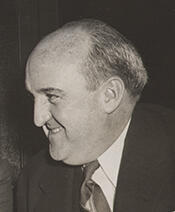
Here you will find contact information for Representative James Herbert Fay, including email address, phone number, and mailing address.
| Name | James Herbert Fay |
| Position | Representative |
| State | New York |
| District | 16 |
| Party | Democratic |
| Status | Former Representative |
| Term Start | January 3, 1939 |
| Term End | January 3, 1945 |
| Terms Served | 2 |
| Born | April 29, 1899 |
| Gender | Male |
| Bioguide ID | F000051 |
About Representative James Herbert Fay
James Herbert Fay (April 29, 1899 – September 10, 1948) was an American veteran of World War I, government official, and Democratic politician from New York. He served two nonconsecutive terms as a member of the United States House of Representatives, representing New York from 1939 to 1941 and from 1943 to 1945, participating in the legislative process during a significant period in American history and representing the interests of his constituents in the House of Representatives.
Fay was born in Manhattan, New York, on April 29, 1899. He was educated in Manhattan and graduated from the De La Salle Institute, a Catholic secondary school that prepared him for both professional training and public service. His early life in New York City, particularly in Manhattan, placed him at the center of the nation’s largest urban environment at a time of rapid growth and change, experiences that would later inform his work in municipal administration and national politics.
In 1917, during World War I, Fay enlisted in the New York National Guard’s 69th Infantry Regiment, a unit with a distinguished history and strong New York identity. When the regiment was federalized for overseas service, it became the 165th Infantry Regiment of the United States Army. Fay served in France and attained the rank of private first class. During his wartime service he was wounded in action and lost his left leg below the knee. For his sacrifice and injuries sustained in combat, he received the Purple Heart. He was discharged from the military in 1919, returning to New York as a disabled veteran with firsthand experience of the costs of war.
Following his military service, Fay embarked on a career in public administration and the law. In 1923, he was appointed secretary to the president of Bellevue and Allied Hospitals, one of New York City’s principal public hospital systems. While working in the hospital administration, he pursued legal studies and in 1929 received his LL.B. degree from Brooklyn Law School. His training in law complemented his growing experience in municipal government. From 1929 to 1934, he served as New York City’s deputy commissioner and acting commissioner of hospitals, playing a role in the management of the city’s public health institutions during the early years of the Great Depression. From 1935 to 1938, he continued his civilian government career as the Internal Revenue Service’s chief field deputy for New York’s 3rd district, gaining further experience in federal administration and tax enforcement.
Fay’s entry into elective office came in 1938, when he became the Democratic nominee for the United States House of Representatives from New York’s 16th congressional district. A supporter of President Franklin D. Roosevelt and the New Deal, he challenged and defeated incumbent Democrat John J. O’Connor, a prominent critic of the New Deal, in the primary election. Fay then won the general election and served in the Seventy-sixth Congress from 1939 to 1941. As a member of the House of Representatives during this period, he contributed to the legislative process at a time when the United States was emerging from the Great Depression and confronting the growing threat of global conflict. In the 1940 election, he was defeated for reelection by Republican nominee William T. Pheiffer, temporarily ending his first period of congressional service.
In 1942, Fay sought to return to Congress and won a rematch against William T. Pheiffer, regaining the seat for the Democrats. He served in the Seventy-eighth Congress from 1943 to 1945, his second nonconsecutive term in the House. His service in Congress thus spanned the critical years immediately preceding and during World War II, when major questions of national defense, economic mobilization, and social policy were before the legislature. Fay did not run for reelection in 1944, and his term concluded in January 1945; he was succeeded by Republican Ellsworth B. Buck. Over the course of his two terms, from 1939 to 1941 and from 1943 to 1945, he participated in the democratic process and represented his New York constituents during a transformative era in American history.
After leaving Congress, Fay returned to Manhattan and entered the private sector, working in the fields of advertising and public relations. Drawing on his experience in government, law, and public administration, he remained active in civic and professional circles in New York City. His post-congressional career reflected a continued engagement with public affairs, albeit outside of elective office.
In his personal life, Fay married Hazel DeWitt Kelly in 1931. The couple had two children, a son, James Herbert, and a daughter, Hazel. The family resided in New York City, where Fay’s professional and political activities were centered. His experiences as a wounded veteran, municipal official, and legislator shaped both his public service and his private life.
James Herbert Fay died at his home in the Gramercy Park neighborhood of Manhattan on September 10, 1948. He was interred at Pinelawn National Cemetery in East Farmingdale, New York, which is now part of Long Island National Cemetery. His career as a soldier, government official, and congressman from New York left a record of service that spanned local, national, and international arenas during the first half of the twentieth century.