Representative James Crawford Freeman
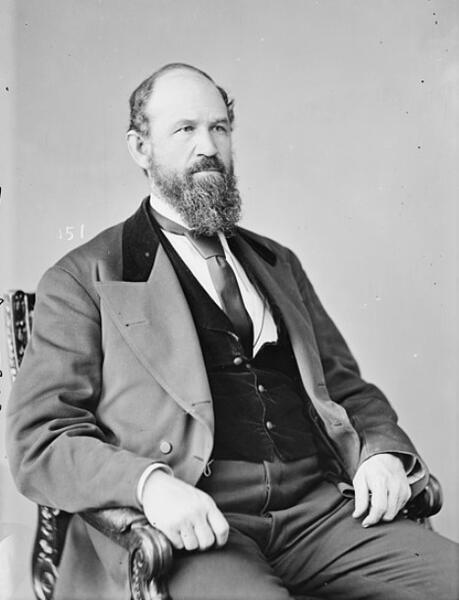
Here you will find contact information for Representative James Crawford Freeman, including email address, phone number, and mailing address.
| Name | James Crawford Freeman |
| Position | Representative |
| State | Georgia |
| District | 5 |
| Party | Republican |
| Status | Former Representative |
| Term Start | December 1, 1873 |
| Term End | March 3, 1875 |
| Terms Served | 1 |
| Born | April 1, 1820 |
| Gender | Male |
| Bioguide ID | F000362 |
About Representative James Crawford Freeman
James Crawford Freeman (April 1, 1820 – September 3, 1885) was a Georgia planter and slaveowner who, after serving in the Confederate States Army during the American Civil War, received a presidential pardon and became a banker, jeweler, and politician. He served one term in the U.S. House of Representatives as a Republican from Georgia during the Reconstruction era, participating in the legislative process at a significant moment in American history and representing the interests of his constituents in the Forty-third Congress.
Freeman was born on April 1, 1820, in Clinton, Jones County, Georgia. He was the second son of planter James Freeman and his first wife, the former Rebecca Rhymes. Raised in a slaveholding family, he was educated in private schools. His younger brother, John Rhymes Freeman, would later move to Rome in Floyd County, Georgia, where he became a major slaveowner and a Confederate officer, ultimately attaining at least the rank of lieutenant colonel. Unlike his brother, James Crawford Freeman did not receive a commission during his own Confederate service. On May 9, 1843, he married Amanda Malvania Neal in Pike County, Georgia. The couple had at least five children: sons David Neal Freeman (1847–1911), Edmund Freeman (born 1849), and James Crawford Freeman Jr. (1860–1905), and daughters Mary Freeman (born 1851) and Frances Freeman Iverson (1863–1930).
As an adult, Freeman farmed using enslaved labor and became a substantial slaveowner by mid-century. In 1850, he and/or his father owned 82 slaves in Jones County, Georgia, and an additional 10 slaves in adjoining Pike County. By 1860, Freeman was living near Flat Shoals in Meriwether County, adjacent to Pike County, where he owned 16 slaves, 8 of whom were noted as fugitives. He also rented rooms on his property to a local grocer and two clerks, reflecting his engagement in local commercial as well as agricultural activity. His brother John Rhymes Freeman, by contrast, owned 60 slaves in Rome, Floyd County, Georgia, by 1860 and entered Confederate service earlier and at a higher rank.
During the Civil War, Freeman entered the Confederate States Army. In May 1862 he either volunteered or was conscripted into Company B of the 42nd Georgia Infantry, known as the Echols Guards, a Confederate unit formed in Meriwether County. He served as an enlisted man rather than as a commissioned officer. Freeman was mustered out of service on March 19, 1865, at Salisbury, North Carolina, as the Confederacy collapsed. Later in 1865, President Andrew Johnson granted him a pardon, restoring his civil and political rights in the aftermath of the rebellion.
Following the defeat of the Confederacy and the abolition of slavery, Freeman faced the loss of his enslaved labor force and the transformation of the Southern economy. He moved to Griffin, the county seat of Spalding County, Georgia, adjacent to Meriwether County and not far from Atlanta, where he resumed and expanded his business activities. Griffin already had several residents bearing the Freeman name, including a 36-year-old Methodist preacher, James D. Freeman, and another slaveowner, Adeline Freeman, recorded there in 1860, and it is possible that relatives or family connections influenced his relocation. In Griffin, James Crawford Freeman engaged in business investments and banking, establishing himself as a local banker and businessman as the region adjusted to Reconstruction.
In 1872, Georgia voters of the 5th Congressional District elected Freeman as a Republican to the Forty-third Congress, where he served from March 4, 1873, to March 3, 1875. He succeeded Democrat Dudley M. DuBose, a former Confederate officer and protégé of former U.S. Senator and unreconstructed Confederate general Robert Toombs; like DuBose, Freeman would serve only a single term. As a member of the Republican Party representing Georgia, he contributed to the legislative process during a critical period in Reconstruction, participating in the democratic process and representing the interests of his constituents in a district that encompassed Atlanta and surrounding communities. One of the most notable acts of his congressional service was his appointment of Henry Ossian Flipper to the United States Military Academy at West Point. Flipper subsequently became the first Black person to graduate from that institution, a landmark in the history of African American military service and higher education.
After losing his bid for reelection in 1874 to Democrat Milton A. Candler, Freeman left Congress at the close of his term in March 1875. He then moved with his wife and their youngest son and daughter to nearby Atlanta, Georgia, which was emerging as the commercial and transportation hub of the postwar South. In Atlanta, Freeman continued his business pursuits and was identified as a jeweler in the 1880 United States census, indicating a shift from his earlier agricultural and banking activities to urban commercial enterprise.
Freeman survived his wife by less than two years, dying in Atlanta on September 3, 1885. His life traced the arc of the nineteenth-century South, from antebellum plantation slavery through Confederate military service to Reconstruction-era politics and urban business, and included a brief but historically notable tenure in the U.S. House of Representatives.