Representative James Lawrence Getz
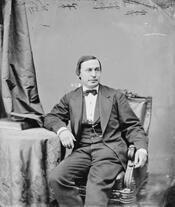
Here you will find contact information for Representative James Lawrence Getz, including email address, phone number, and mailing address.
| Name | James Lawrence Getz |
| Position | Representative |
| State | Pennsylvania |
| District | 8 |
| Party | Democratic |
| Status | Former Representative |
| Term Start | March 4, 1867 |
| Term End | March 3, 1873 |
| Terms Served | 3 |
| Born | September 14, 1821 |
| Gender | Male |
| Bioguide ID | G000145 |
About Representative James Lawrence Getz
James Lawrence Getz (September 14, 1821 – December 25, 1891) was an American newspaperman and Democratic politician who served three terms as a member of the United States House of Representatives from Pennsylvania from 1867 to 1873. His congressional service took place during the Reconstruction era, a significant period in American history, during which he participated in the legislative process and represented the interests of his constituents in the U.S. House of Representatives.
Getz was born in Reading, Pennsylvania, on September 14, 1821. He pursued an academic course in his youth, reflecting the educational preparation typical of aspiring professionals and public men of his generation. Remaining closely tied to his native city throughout his life, his early experiences in Reading helped shape his later career in journalism and politics.
Entering the world of publishing at a young age, Getz became one of the founders of the Reading Gazette in 1840. He soon expanded his influence in local journalism by purchasing the Jeffersonian Democrat and merging it with the Reading Gazette. The combined paper was issued under the title the Reading Gazette and Democrat, a publication that became an important Democratic voice in Berks County and the surrounding region. Alongside his newspaper work, he studied law and was admitted to the bar in 1846, although he never engaged in active legal practice, choosing instead to devote himself primarily to journalism and public affairs. He retained his interest in the newspaper until 1868, when he disposed of his holdings.
Getz’s political career began at the state level. A member of the Democratic Party, he was elected to the Pennsylvania House of Representatives and served there in 1856 and 1857. During his second year in the state legislature, he was chosen Speaker of the House, a position that reflected both his standing within the Democratic Party and his skill in legislative leadership. His experience in Harrisburg provided him with a foundation in parliamentary procedure and public policy that would later inform his work in Congress.
In national politics, Getz was elected as a Democrat to the Fortieth, Forty-first, and Forty-second Congresses, serving in the U.S. House of Representatives from March 4, 1867, to March 3, 1873. Representing Pennsylvania during the tumultuous Reconstruction period following the Civil War, he contributed to the legislative process over three consecutive terms in office. As a member of the House of Representatives, he participated in debates and votes on issues central to the reunification of the nation and the redefinition of federal and state powers in the postwar era. He was not a candidate for renomination in 1872, thus concluding his service in Congress after six years.
After leaving Congress, Getz returned to his earlier vocation in the newspaper business, again engaging in journalism in Reading. His continued involvement in local affairs underscored his long-standing commitment to his community. Later in life, he entered municipal service and was appointed or elected city comptroller of Reading, a position he held from 1888 until his death. In this capacity, he was responsible for overseeing aspects of the city’s financial administration, bringing to the office the experience he had gained over decades in public life.
James Lawrence Getz died in Reading, Pennsylvania, on December 25, 1891. He was interred in Charles Evans Cemetery in Reading, a burial place for many of the city’s prominent citizens. His career as a newspaperman, state legislator, Speaker of the Pennsylvania House, and three-term member of the United States Congress reflected a lifelong engagement with public service and the political life of Pennsylvania during the mid-19th century.