Representative James Joyce
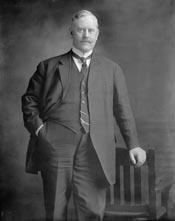
Here you will find contact information for Representative James Joyce, including email address, phone number, and mailing address.
| Name | James Joyce |
| Position | Representative |
| State | Ohio |
| District | 15 |
| Party | Republican |
| Status | Former Representative |
| Term Start | March 15, 1909 |
| Term End | March 3, 1911 |
| Terms Served | 1 |
| Born | July 2, 1870 |
| Gender | Male |
| Bioguide ID | J000276 |
About Representative James Joyce
James Joyce served as a Representative from Ohio in the United States Congress from 1909 to 1911. A member of the Republican Party, he contributed to the legislative process during one term in office, participating in debates and votes in the House of Representatives and representing the interests of his constituents during a significant period in American history. His service in Congress placed him within the broader national discourse of the early twentieth century, when questions of economic development, political reform, and the role of the federal government were increasingly prominent.
James Augustine Aloysius Joyce (born James Augusta Joyce) was born on 2 February 1882 at 41 Brighton Square, Rathgar, Dublin, Ireland, to John Stanislaus Joyce and Mary Jane “May” (née Murray) Joyce. Baptised a Catholic as James Augustine Joyce at St Joseph’s Church in Terenure on 5 February 1882, he was the eldest of ten surviving siblings in a family whose fortunes declined over time due to his father’s drinking and financial mismanagement. His paternal family came from Fermoy, County Cork, where they had owned a small salt and lime works, and his paternal grandfather, also named James Augustine, had married Ellen O’Connell, whose family claimed kinship with the Irish political leader Daniel O’Connell. In 1887 his father was appointed rate collector by Dublin Corporation, and the family moved to Bray, County Wicklow, where the young Joyce developed a lifelong fear of dogs after being attacked, and later a fear of thunderstorms, influenced by a superstitious aunt.
Joyce’s early education began in 1888 at Clongowes Wood College, a Jesuit boarding school near Clane, County Kildare, which he left in 1891 when his father could no longer afford the fees after the family’s slide into poverty. He then studied at home and briefly attended the Christian Brothers’ O’Connell School on North Richmond Street in Dublin. A chance meeting between his father and Jesuit priest John Conmee led to Joyce and his brother Stanislaus being admitted without fees to Belvedere College in 1893. There Joyce excelled academically, particularly in English composition, and was elected at age 13 to the Sodality of Our Lady. He graduated from Belvedere in 1898 and that same year enrolled at University College, then part of the Royal University of Ireland, to study English, French, and Italian. Exposed there to the scholastic philosophy of Thomas Aquinas, he also became active in Dublin’s literary and theatrical circles, forming friendships with contemporaries such as George Clancy, Tom Kettle, and Francis Sheehy-Skeffington, many of whom later appeared in fictionalised form in his work.
As a young man, Joyce began to establish himself as a writer and critic. In 1900 his first publication, a laudatory review of Henrik Ibsen’s play When We Dead Awaken, appeared in The Fortnightly Review, and he wrote a fan letter to Ibsen in Norwegian. In November 1901 he published, outside official college channels, the polemical essay “The Day of the Rabblement,” criticising the Irish Literary Theatre for its reluctance to stage works by European modern dramatists such as Ibsen, Leo Tolstoy, and Gerhart Hauptmann, and arguing for a more cosmopolitan Irish literature. He graduated from the Royal University of Ireland in October 1902 and briefly pursued medical studies, first at the Catholic University Medical School in Dublin and then in Paris, where he attended courses in physics, chemistry, and biology at the École de Médecine. By early 1903 he had abandoned plans for a medical career, but he continued to read extensively in the Bibliothèque Sainte-Geneviève and to write, even as he struggled financially and relied on money sent from home.
Joyce’s literary and personal life took a decisive turn after his return to Dublin in April 1903 to attend his dying mother, who passed away on 13 August 1903. In the following year he intensified his efforts to publish his work, drafting an early prose treatise on aesthetics titled A Portrait of the Artist, beginning the novel Stephen Hero, and composing the satirical poem “The Holy Office” and the poetry collection Chamber Music. On 10 June 1904 he met Nora Barnacle, a young woman from Galway working as a chambermaid in Dublin, and their first outing on 16 June 1904 later became the basis for the date on which his novel Ulysses is set, commemorated as “Bloomsday.” In September 1904 he briefly lived in a Martello tower at Sandycove, near Dublin, before leaving Ireland in October 1904 with Nora for self-imposed exile on the European continent. After short stays in London, Paris, and Zurich, he took up work as an English instructor for the Berlitz school in Pola, then a major Austro-Hungarian naval base (now in Croatia), before moving in March 1905 to Trieste, then also part of Austria-Hungary, which became his principal residence until 1920.
In Trieste Joyce taught English, first at Berlitz and later privately, and continued to develop his fiction. His son Giorgio was born there on 27 July 1905, and his daughter Lucia on 26 July 1907. During these years he completed most of the stories that would form Dubliners and drafted Stephen Hero, which he later reworked into the more compact and interior A Portrait of the Artist as a Young Man. He also wrote his only play, Exiles, and began to conceive Ulysses, initially as a short story that grew into a full-length novel. Financial insecurity and difficulties with publishers marked this period: an early contract with London publisher Grant Richards for Dubliners collapsed over fears of obscenity and libel, and a later Dublin edition with Maunsel and Company was destroyed in proof. Joyce spent several months in Rome in 1906–1907 working as a bank correspondence clerk, where he revised Dubliners and conceived “The Dead,” the collection’s final story, before returning to Trieste. There he formed important friendships, notably with the Triestine writer Ettore Schmitz (Italo Svevo), who became both a model for Leopold Bloom in Ulysses and a crucial supporter of Joyce’s literary ambitions.
The outbreak of World War I in August 1914 and Italy’s entry into the conflict in May 1915 forced Joyce to leave Trieste. In June 1915 he moved with his family to neutral Zurich, Switzerland, arriving as a “double exile” with a British passport and Triestine ties. In Zurich he worked intensively on Ulysses while relying on financial assistance from patrons and supporters, including the editor Harriet Shaw Weaver, who would support him for the rest of his life, and the American philanthropist Edith Rockefeller McCormick. During these years he also saw A Portrait of the Artist as a Young Man published in book form in 1916 and arranged for the serial publication of Ulysses in the New York-based magazine The Little Review beginning in 1918, with the help of Ezra Pound. After the war Joyce briefly returned to Trieste and then, in 1920, moved to Paris, which became his principal home until 1940. There he completed Ulysses, first published in Paris on 2 February 1922, and began work in 1923 on his next major project, the experimental novel Finnegans Wake, which would occupy him for the next sixteen years and be published in 1939.
Joyce’s later life was marked by both international literary renown and serious personal and health difficulties. Ulysses, though initially banned in the United States and the United Kingdom for alleged obscenity, circulated in smuggled and pirated editions until legal publication was finally permitted in the mid-1930s, by which time it had come to be regarded as a landmark of modernist literature, notable for its stream-of-consciousness technique, interior monologue, wordplay, and radical reworking of narrative form. Throughout the 1920s and 1930s Joyce travelled frequently, seeking treatment in Switzerland and elsewhere for his worsening eye problems, and he and Nora were married in a civil ceremony in London on 4 July 1931. He also devoted considerable energy and resources to securing medical and psychological care for his daughter Lucia. When German forces occupied France in 1940, Joyce and his family left Paris and returned to Zurich. He died there on 13 January 1941, at the age of 58, following surgery for a perforated ulcer.