Senator James Henry Lane
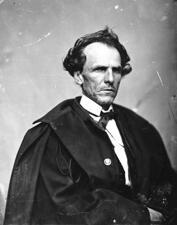
Here you will find contact information for Senator James Henry Lane, including email address, phone number, and mailing address.
| Name | James Henry Lane |
| Position | Senator |
| State | Kansas |
| Party | Republican |
| Status | Former Representative |
| Term Start | December 5, 1853 |
| Term End | March 3, 1867 |
| Terms Served | 3 |
| Born | June 22, 1814 |
| Gender | Male |
| Bioguide ID | L000061 |
About Senator James Henry Lane
James Henry Lane was an American politician and military leader who served as a Senator from Kansas in the United States Congress from 1861 until his death in 1866. A prominent member of the Republican Party, James Henry Lane contributed to the legislative process during a critical period in American history, serving during the Civil War and the early years of Reconstruction. Over the course of his service in Congress, he participated in the democratic process and represented the interests of his Kansas constituents while also playing a significant role in the political and military struggles that shaped the era. He is historically distinguished from several other notable figures bearing similar names, including James Lane (settler) (1626–1688), a British emigrant to the American colonies; James Henry Lane (Confederate general) (1833–1907), a university professor and Confederate general in the American Civil War; James Tyson Lane (1835–1885), a Louisiana state legislator; Jim Lane (Irish republican) (born 1938), an Irish republican and socialist; James T. Lane (born 1977), an actor and dancer; Jim Lane (mayor) (born 1951), mayor of Scottsdale, Arizona; and Jimmy D. Lane (born 1965), an American electric blues guitarist.
James Henry Lane (Union general) was born on June 22, 1814, in Lawrenceburg, Dearborn County, Indiana. He was the son of Amos Lane, a lawyer and Jacksonian Democrat who served in the U.S. House of Representatives from Indiana, which exposed the younger Lane early to politics and public life. Growing up in the Old Northwest, Lane came of age in a region undergoing rapid settlement and political development, experiences that would later inform his views on expansion, slavery, and popular sovereignty. His early years in Indiana laid the foundation for a career that would span law, politics, and military service.
Lane received a basic education in Indiana and read law, following his father into the legal profession. He was admitted to the bar and established himself as an attorney, which provided both a livelihood and a platform for political engagement. His legal training and familiarity with public affairs prepared him for elective office and helped him navigate the complex constitutional and statutory questions that would arise in the turbulent years before the Civil War. Through his legal and early political work, he developed a reputation as an energetic and forceful advocate.
Lane’s formal political career began in Indiana. He served as a Democratic member of the Indiana legislature and rose to national office when he was elected as a Democrat to the United States House of Representatives from Indiana, serving in the Thirty‑Third Congress from March 4, 1853, to March 3, 1855. During this period he supported the Kansas–Nebraska Act, which opened the territories to the possibility of slavery under the doctrine of popular sovereignty. After leaving the House, he was appointed a brigadier general of volunteers during the Mexican–American War and took part in the conflict, gaining military experience that would later prove important. His shifting views on slavery and territorial policy, however, would eventually lead him away from the Democratic Party and toward the emerging Republican coalition.
Lane moved to the Kansas Territory in the mid‑1850s, where he quickly became one of the most prominent leaders of the Free‑State movement opposing the extension of slavery into Kansas. He played a central role in the organization of Free‑State settlers, helped frame the Topeka Constitution, and became known as a forceful orator and organizer in the violent struggle known as “Bleeding Kansas.” His leadership among antislavery settlers and his advocacy for Kansas’s admission to the Union as a free state elevated him to national prominence and aligned him with the new Republican Party, which opposed the spread of slavery into the western territories.
Upon Kansas’s admission to the Union on January 29, 1861, Lane was elected as one of the state’s first United States Senators, taking his seat in the Senate in 1861. A member of the Republican Party, he served in the Senate from 1861 until 1866, during a significant period in American history marked by secession, civil war, and the beginnings of Reconstruction. In the Senate, James Henry Lane participated actively in the legislative process, supported the Lincoln administration, and advocated measures to prosecute the war and protect Unionist and antislavery interests in the West. He represented the interests of his Kansas constituents, many of whom had recently endured territorial conflict, and worked to secure federal support and protection for the new state.
Concurrently with his senatorial service, Lane was commissioned as a brigadier general of volunteers in the Union Army during the Civil War, reflecting his dual role as both legislator and military leader. Often referred to as “Jim Lane’s Brigade,” the forces under his influence conducted operations along the Kansas–Missouri border, a region marked by guerrilla warfare and deep political divisions. As a U.S. Army general, he was involved in organizing Kansas regiments and defending Unionist settlements, and his name became closely associated with the militant Free‑State cause. His activities in this period further distinguished him from his contemporary namesake, James Henry Lane (Confederate general), who served on the opposite side of the conflict as a Confederate general and later as a university professor.
In the later years of the Civil War and the early phase of Reconstruction, Lane remained an influential, if sometimes controversial, figure in Republican politics. He supported key wartime measures and took part in debates over the reintegration of the seceded states and the status of freedpeople, though his positions could be complex and occasionally at odds with more radical elements in his party. His career was cut short when he suffered from declining mental and physical health. On July 1, 1866, while still serving in the United States Senate, James Henry Lane attempted suicide near Leavenworth, Kansas, and died from his wounds on July 11, 1866. His death ended a career that had spanned service as a U.S. Representative from Indiana, a Free‑State leader in Kansas, a U.S. Army general, and a Republican Senator from Kansas during one of the most consequential eras in the nation’s history.