Senator James Lanman
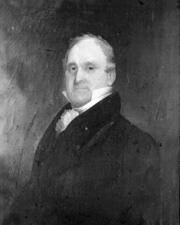
Here you will find contact information for Senator James Lanman, including email address, phone number, and mailing address.
| Name | James Lanman |
| Position | Senator |
| State | Connecticut |
| Party | Republican |
| Status | Former Representative |
| Term Start | December 6, 1819 |
| Term End | March 3, 1825 |
| Terms Served | 1 |
| Born | June 14, 1767 |
| Gender | Male |
| Bioguide ID | L000083 |
About Senator James Lanman
James Lanman (June 14, 1767 – August 7, 1841) was an American lawyer, jurist, and politician from Norwich, Connecticut, who served as a United States Senator from Connecticut from 1819 to 1825. A member of the Republican Party—then known as the Democratic-Republican Party and later aligned with the Crawford Republican faction—he contributed to the legislative process during one full term in the Senate. He was a cousin of Presidents John Adams and John Quincy Adams and was known in his own time both for his oratorical ability and for his adherence to the older style of dress associated with the Revolutionary generation.
Lanman was born in Norwich, Connecticut, the eldest of the seven children of shipping magnate Peter Lanman and Sarah Spaulding (née Coit) Lanman. Raised in a prominent mercantile family, he grew up in a milieu closely connected to the commercial and political life of eastern Connecticut. He pursued classical studies and enrolled at Yale College, beginning a family tradition that would see many Lanman descendants attend the institution. At Yale he was an active member of the debating society Brothers in Unity and distinguished himself academically, graduating Phi Beta Kappa in 1788. An early glimpse of his personality comes from the diary of his cousin John Quincy Adams, who recorded a stagecoach journey from Boston to Providence on September 8, 1789, during which the young Lanman entertained fellow passengers with songs, only to deny, when pressed, that he could sing at all.
After completing his collegiate studies, Lanman read law and was admitted to the bar in 1791. He began his legal practice in his native Norwich, where he quickly acquired local distinction for his eloquence and general ability as an advocate. His legal career unfolded alongside his growing involvement in civic and intellectual life. On July 4, 1798, he delivered and later published a notable Fourth of July address to the citizens of Norwich on the twenty-second anniversary of American independence, reflecting his engagement with the political ideas and patriotic sentiments of the early republic. When his father died in 1804, Lanman inherited and moved into his childhood home, the now historic “Peter Lanman House” on Main Street in Norwich, where he resided for the rest of his life. Nearby, at “Peter Lanman’s Corner” at Main and Broadway—later the site of the Norwich Savings Society—stood a tavern of local interest where George Washington had stayed in 1775.
Lanman’s formal political career in Connecticut began in the second decade of the nineteenth century. He was elected to the Connecticut House of Representatives in 1817, participating in state legislative affairs at a time when Connecticut was transitioning from its colonial-era charter to a more modern constitutional framework. In 1818 he served as a delegate to the Connecticut constitutional convention, which produced the state’s first written constitution and restructured its political institutions. The following year, in 1819, he was elected to the Connecticut State Senate, further consolidating his position as a leading public figure in the state.
In 1819 Lanman was elected to the United States Senate as a Democratic-Republican, later associated with the Crawford Republican faction, and he served from March 4, 1819, to March 3, 1825. His tenure in Congress coincided with a significant period in American history marked by the “Era of Good Feelings,” the Missouri Compromise, and evolving sectional tensions. As a member of the Senate, he participated in the democratic process and represented the interests of his Connecticut constituents while engaging in national debates. He held several important committee assignments: he chaired the Committee to Audit and Control the Contingent Expenses during the Seventeenth Congress, the Committee on Engrossed Bills in both the Seventeenth and Eighteenth Congresses, and the Committee on Post Office and Post Roads in the Eighteenth Congress. His grandson, Charles Lanman, later recalled that Senator Lanman voted with Southern interests on the Missouri Compromise and was burned in effigy in his native Norwich for that stance, yet his broad patriotism and independence of judgment earned him the warm friendship of prominent national leaders such as Henry Clay and Thomas H. Benton. Lanman was also remembered as the last United States Senator to wear a powdered wig, ruffled shirts, and knee breeches, a visible symbol of continuity with the Revolutionary era.
After leaving the Senate in 1825, Lanman continued to serve Connecticut in judicial and municipal roles. He was appointed a judge of the state superior and supreme courts, serving from 1826 to 1829, where he brought his long experience as a lawyer and legislator to the bench. In local government, he was elected mayor of Norwich and held that office from 1831 to 1834. His family’s civic involvement in the city continued into the next generation, as his son Charles succeeded him as mayor in 1838. While serving as mayor, Lanman delivered a commemorative address on March 1, 1832, marking the centennial anniversary of George Washington’s birth. Entitled “A Discourse, Addressed to the Citizens of Norwich,” the speech reviewed Washington’s military leadership and civic contributions to the founding of the United States, underscoring Lanman’s enduring interest in the nation’s revolutionary heritage and constitutional development.
Lanman’s private life was closely intertwined with other prominent New England families. On May 18, 1794, he married Marian Griswold Chandler (1774–1817), daughter of Charles Church Chandler and Marian Griswold, the latter a daughter of Connecticut Governor Matthew Griswold. Through this marriage he was connected to influential legal and political figures, including his wife’s half-brother, Chief Justice Ebenezer Lane. James and Marian Lanman had four sons and eight daughters. Among their children were Charles James Lanman (1795–1870), who married Marie Jeanne Guie in 1819; Mary Anne Lanman (1797–1851), who married Obadiah Penniman in 1829 and later Charles Waters; Eliza Lanman (1800–1872), who married Amos Hallam Hubbard in 1821; Sarah Coit Lanman (1802–1889), who married Josiah Harmar, son of Brigadier General Josiah Harmar, in 1830; Harriet Lanman (1804–1853), who married Jacob Wyckoff Piatt of Cincinnati around 1832; Jane Griswold Lanman (1806–1874), who married Dr. Daniel Tyler Coit; and Joanna Boylston Lanman (1808–1859), who married future U.S. Senator Lafayette S. Foster in 1837. Widowed in 1817, Lanman married his second wife, Mary Judith (née Gall) Benjamin (1778–1848), on October 26, 1826. He had no children by this second marriage. Mary Judith Benjamin was the widow of Parke Benjamin and the mother of four children from her first marriage, including Park Benjamin, who became a well-known American poet, editor, and newspaper founder.
James Lanman spent his final years in Norwich, continuing to reside in the family home he had inherited from his father. He remained a respected figure in the community, remembered for his long public service at the local, state, and national levels, his distinctive personal style, and his connections to some of the leading political families of the early United States. He died in Norwich, Connecticut, on August 7, 1841, at the age of 75, and was interred in the City Cemetery.