Representative James Joseph Lanzetta
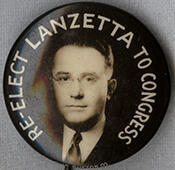
Here you will find contact information for Representative James Joseph Lanzetta, including email address, phone number, and mailing address.
| Name | James Joseph Lanzetta |
| Position | Representative |
| State | New York |
| District | 20 |
| Party | Democratic |
| Status | Former Representative |
| Term Start | March 9, 1933 |
| Term End | January 3, 1939 |
| Terms Served | 2 |
| Born | December 21, 1894 |
| Gender | Male |
| Bioguide ID | L000091 |
About Representative James Joseph Lanzetta
James Joseph Lanzetta (IPA: [lanˈtsetta]) (December 21, 1894 – October 27, 1956) was an American engineer, attorney, and Democratic politician who served as a member of the United States House of Representatives from New York for two non-consecutive terms, from 1933 to 1935 and from 1937 to 1939. He later became a legislative representative for the government of Puerto Rico in Washington, D.C., a city magistrate in New York, and, beginning in 1947, a justice of the Domestic Relations Court, in which position he served until his death. His congressional service occurred during a significant period in American history, and he contributed to the legislative process as a Representative from New York during two terms in office.
Lanzetta was born in New York City on December 21, 1894, and was educated in the city’s public schools. He pursued higher education at Columbia University School of Engineering, from which he graduated in 1917. After his military service, he continued his studies in law, enrolling at Fordham University School of Law and graduating in 1924. He was admitted to the bar in 1925 and commenced the practice of law in New York City, combining his technical training with legal expertise in the early stages of his professional life.
During World War I, Lanzetta joined the United States Army as a private in Company C, 302nd Engineers. He later served as a sergeant first class in the 1st Air Service Mechanics Regiment. He served overseas from February 1918 to July 1919, participating in the American war effort in Europe. Following his discharge, he returned to New York City, where from 1919 to 1922 he worked as an engineer and salesman. From 1922 to 1925 he was employed as an assistant supervisor in the city’s Department of Markets, gaining experience in municipal administration before entering full-time legal practice.
Active in Democratic Party politics, Lanzetta rose through the ranks of local government. He served on the New York City Board of Aldermen from January 1932 to March 1933, representing his community at the municipal level. With the support of Tammany Hall leader James “Jimmy” Hines, he successfully ran for Congress in 1932. In that election he defeated incumbent Congressman Fiorello H. La Guardia and was elected as a Democrat to the 73rd Congress, representing New York’s 20th Congressional District, then encompassing East Harlem. He served his first term in the U.S. House of Representatives from March 4, 1933, to January 3, 1935, participating in the legislative work of the early New Deal era and representing the interests of his constituents in New York.
In 1934 Lanzetta sought reelection to the 74th Congress but lost in a close race to Vito Marcantonio. He returned to electoral politics in 1936 and regained the seat, defeating Marcantonio and securing a place in the 75th Congress, where he served from January 3, 1937, to January 3, 1939. His service in Congress thus comprised two non-consecutive terms, from 1933 to 1935 and from 1937 to 1939. He ran again in 1938 and 1940 but was defeated both times by Marcantonio, who by then had aligned himself with the American Labor Party. Deeply dissatisfied with these defeats, Lanzetta wrote to Martin Dies, chairman of the House Committee on Un-American Activities, urging that the House refuse to seat Marcantonio on the grounds that, as head of what Lanzetta described as a “Communist front organization (International Labor Defense), … he must of necessity believe in communism and the overthrow of our present form of government.”
After his 1938 defeat for reelection, Lanzetta was appointed legislative representative or counsel for the government of Puerto Rico in Washington, D.C. Although he had never visited the island at the time of his appointment, he proved popular with Puerto Rican political leaders across party lines and with residents of Puerto Rico, and he played a role in representing their interests before the federal government. He later resumed the practice of law in New York City, continuing his legal career alongside his public service.
On July 2, 1947, New York City Mayor William O’Dwyer appointed Lanzetta as a city magistrate to fill a vacancy, and later that month he was named to a full ten-year term in that office. His work as magistrate attracted public notice in March 1948 when, during a one-day shortage of magistrates, he presided in five different courts in five hours and disposed of approximately 500 cases, 400 of them in the Downtown Traffic Court. He served as city magistrate until May 26, 1948, when Mayor O’Dwyer appointed him to a ten-year term as a justice of the city Domestic Relations Court. Lanzetta served on that court from 1948 until his death, handling matters involving family and domestic relations in New York City.
James Joseph Lanzetta died in New York City on the night of October 27, 1956, while visiting the Greystone Hotel on Broadway. At the time of his death, he was still serving as a justice of the Domestic Relations Court, a position he had held since 1947. He was 61 years old. Lanzetta was interred at Woodlawn Cemetery in the Bronx, New York, closing a career that had encompassed engineering, military service, law, municipal administration, congressional service, and judicial office.