Representative Jim Lightfoot
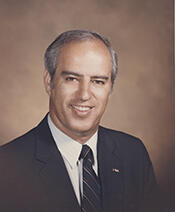
Here you will find contact information for Representative Jim Lightfoot, including email address, phone number, and mailing address.
| Name | Jim Lightfoot |
| Position | Representative |
| State | Iowa |
| District | 3 |
| Party | Republican |
| Status | Former Representative |
| Term Start | January 3, 1985 |
| Term End | January 3, 1997 |
| Terms Served | 6 |
| Born | September 27, 1938 |
| Gender | Male |
| Bioguide ID | L000305 |
About Representative Jim Lightfoot
James Ross Lightfoot (born September 27, 1938) is an American businessman and broadcaster who served as a member of the United States House of Representatives from Iowa. A member of the Republican Party, he represented his Iowa district in Congress for six consecutive terms from 1985 to 1997, contributing to the legislative process during a significant period in late twentieth-century American political history. Over the course of his public career, he also became a prominent statewide candidate, serving as the Republican nominee for the United States Senate in 1996 and for Governor of Iowa in 1998.
Lightfoot was born on September 27, 1938, and came of age in the mid-twentieth century, a period marked by rapid social and economic change in the United States. Before entering elective office, he built a professional background in business and broadcasting. His experience as a businessman-broadcaster helped shape his public persona as a communicator and contributed to his understanding of both the private sector and the media environment in which modern political campaigns are conducted.
Drawing on this professional foundation, Lightfoot entered electoral politics as a Republican in Iowa. He was first elected to the United States House of Representatives in 1984 and took office on January 3, 1985. During his twelve years in the House, he represented his Iowa constituents through six terms, participating in the democratic process and engaging in legislative deliberations on national policy. His tenure in Congress coincided with the latter part of the Reagan administration, the George H. W. Bush presidency, and the early years of the Clinton administration, a time of shifting domestic priorities and evolving international challenges. Throughout this period, he worked to represent the interests of his district within the broader framework of Republican Party positions and congressional policymaking.
Lightfoot’s service in Congress was shaped in part by his commitment to term limits. He had pledged to serve only twelve years in the House of Representatives, and in keeping with that promise he chose not to seek reelection to his House seat in 1996. Instead, he entered the race for the United States Senate from Iowa, challenging incumbent Democratic Senator Tom Harkin. His entry into the Senate contest came in March 1996, placing him at a significant financial disadvantage compared with the well-established incumbent. The campaign unfolded against the backdrop of President Bill Clinton’s reelection effort; Clinton campaigned vigorously on Harkin’s behalf and ultimately carried Iowa by ten points in the presidential election. In this environment, Lightfoot was unable to overcome the combined advantages of incumbency and national party support for his opponent and lost the Senate race.
Despite this setback, Lightfoot remained a prominent figure within the Iowa Republican Party. In 1998, at the request of party leaders seeking a strong statewide candidate, he agreed to run for governor of Iowa. He faced Democratic State Senator Tom Vilsack in what became a closely watched contest. For much of the campaign, Lightfoot led in public opinion polls, reflecting his name recognition from his years in Congress and his recent Senate bid. However, as the election drew closer, Senator Harkin again played an active role, campaigning on Vilsack’s behalf. This late surge of support for the Democratic nominee helped narrow the race, and Vilsack ultimately defeated Lightfoot by a narrow margin, ending Lightfoot’s bid for the governorship.
After his congressional service and statewide campaigns, Lightfoot returned to private life, drawing on his earlier experience as a businessman-broadcaster and his twelve years in the House of Representatives. His career in public office, spanning from his first election to Congress in 1984 through his gubernatorial campaign in 1998, reflected both his commitment to representing Iowa in the federal legislature and his willingness to seek higher office at the state and national levels.