Representative James McDevitt Magee
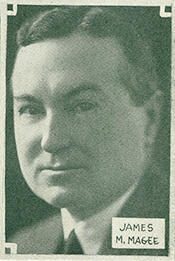
Here you will find contact information for Representative James McDevitt Magee, including email address, phone number, and mailing address.
| Name | James McDevitt Magee |
| Position | Representative |
| State | Pennsylvania |
| District | 35 |
| Party | Republican |
| Status | Former Representative |
| Term Start | December 3, 1923 |
| Term End | March 4, 1927 |
| Terms Served | 2 |
| Born | April 5, 1877 |
| Gender | Male |
| Bioguide ID | M000046 |
About Representative James McDevitt Magee
James McDevitt Magee (April 5, 1877 – April 16, 1949) was an aviator, attorney, and Republican member of the U.S. House of Representatives from Pennsylvania. He served as a Representative from Pennsylvania in the United States Congress from 1923 to 1927, contributing to the legislative process during two terms in office and representing the interests of his constituents during a significant period in American history.
Magee was born in Evergreen, Pennsylvania, near Pittsburgh, on April 5, 1877. He was part of a family that would later gain wider recognition through public service and religious work; he was the brother of missionary John Magee and the uncle of John Gillespie Magee Jr., the Royal Canadian Air Force pilot and poet best known as the author of the poem “High Flight.”
Magee pursued higher education at Yale University, from which he graduated in 1899. While at Yale he was a member of the secret society Skull and Bones, an affiliation that placed him among a network of future leaders in law, business, and public affairs. He continued his studies in law at the University of Pennsylvania in Philadelphia, earning his degree from the law department in 1902. The following year, in 1903, he was admitted to the bar and commenced the practice of law in Pittsburgh, Pennsylvania, establishing himself in the city’s legal and civic life.
During the First World War, Magee entered military service in the emerging field of military aviation. He was commissioned a first lieutenant in the United States Army Air Service and was later promoted to captain. Throughout his period of active duty, he was attached to the executive office of the Department of Military Aeronautics, where he was involved in the administrative and organizational aspects of America’s wartime aviation efforts. After the war, he continued his association with military aviation by receiving a commission as a lieutenant colonel in the Reserve, reflecting his ongoing connection to aeronautical affairs and his status as an aviator.
Magee’s national political career began with his election as a Republican to the Sixty-eighth Congress, taking office on March 4, 1923. He was subsequently reelected to the Sixty-ninth Congress, serving continuously until March 3, 1927. As a member of the House of Representatives, he participated in the democratic process and contributed to the legislative work of the post–World War I era, a time marked by economic growth, evolving regulatory policies, and debates over America’s role in world affairs. His service in Congress occurred during a significant period in American history, and he was part of the Republican majority that shaped federal policy in the mid-1920s. In 1926 he sought renomination but was unsuccessful, bringing his congressional service to a close after two terms.
Following his departure from Congress, Magee returned to public service at the state level while maintaining his legal career. From 1931 to 1935 he served as chairman of the Pennsylvania Securities Commission in Harrisburg, Pennsylvania. In that role he oversaw aspects of securities regulation during the early years of the Great Depression, a period when financial oversight and investor protection were of growing concern. After completing his term as chairman, he continued the practice of law in Pittsburgh, remaining active in his profession and in the civic affairs of the region.
James McDevitt Magee died in Pittsburgh, Pennsylvania, on April 16, 1949. He was interred in Calvary Cemetery in Pittsburgh. His life encompassed significant contributions as a lawyer, military aviator, and legislator, and his family connections extended his legacy into both religious mission work and wartime literature through his brother John Magee and his nephew, the poet-aviator John Gillespie Magee Jr.