Representative James Andrew McKenzie
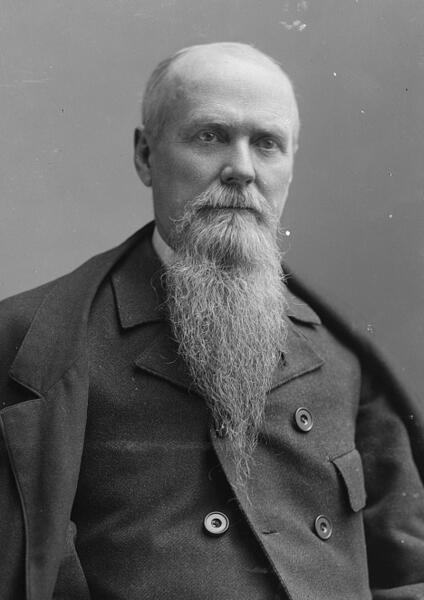
Here you will find contact information for Representative James Andrew McKenzie, including email address, phone number, and mailing address.
| Name | James Andrew McKenzie |
| Position | Representative |
| State | Kentucky |
| District | 2 |
| Party | Democratic |
| Status | Former Representative |
| Term Start | October 15, 1877 |
| Term End | March 3, 1883 |
| Terms Served | 3 |
| Born | August 1, 1840 |
| Gender | Male |
| Bioguide ID | M000505 |
About Representative James Andrew McKenzie
James Andrew McKenzie (August 1, 1840 – June 25, 1904) was a U.S. Representative from Kentucky, a prominent Democratic orator of the late nineteenth century, and the uncle of Congressman John McKenzie Moss. He was born in Bennettstown, Christian County, Kentucky, where he spent his early years in a rural setting typical of western Kentucky in the antebellum period. He attended the common schools of Christian County, receiving a basic education that prepared him for further study, and from there went on to Centre College in Danville, Kentucky, one of the state’s leading institutions of higher learning. His upbringing in Christian County and his later identification with Kentucky’s agricultural interests would shape both his professional life and his political outlook.
After completing his studies at Centre College, McKenzie read law and prepared for a legal career. He was admitted to the bar in 1861 and commenced the practice of law in Hopkinsville, Kentucky, a regional commercial and legal center in Christian County. Alongside his legal practice, he engaged in agricultural pursuits, maintaining a close connection to farming and rural life that remained a constant throughout his career. His early professional years were soon interrupted by the outbreak of the American Civil War, which divided Kentucky and the nation.
During the Civil War, McKenzie served as a private in the Confederate States Army. Like many Kentuckians who cast their lot with the Confederacy despite the state’s official neutrality and Union alignment, his service reflected the complex loyalties of the border states. After the war’s conclusion, he returned to civilian life in Kentucky, resuming his legal practice and agricultural activities in a region undergoing the political and economic adjustments of Reconstruction and its aftermath.
McKenzie entered public life in the immediate postwar period. He served as a member of the Kentucky House of Representatives from 1867 to 1871, participating in state politics during a time when Kentucky, though not formally reconstructed, was grappling with the consequences of emancipation, shifting party alignments, and the reassertion of Democratic control. His legislative service helped establish his reputation within the Democratic Party and provided a platform for his advancement to national office.
Building on his state legislative experience, McKenzie was elected as a Democrat to the Forty-fifth, Forty-sixth, and Forty-seventh Congresses, serving in the U.S. House of Representatives from March 4, 1877, to March 3, 1883. Representing Kentucky during the end of Reconstruction and the beginning of the Gilded Age, he took part in the national debates of the period, including issues of federal power, economic development, and reconciliation between North and South. Although specific committee assignments and legislative initiatives are less prominently recorded, his tenure coincided with the Democratic Party’s efforts to reestablish influence in the federal government. He was an unsuccessful candidate for renomination in 1882, bringing his three-term congressional career to a close.
After leaving Congress, McKenzie remained an influential figure in Kentucky politics. He served as Secretary of State of Kentucky under Governor J. Proctor Knott from 1884 to 1888, a key administrative and political post that placed him at the center of state government in Frankfort. In this capacity he was involved in the management of state records, elections, and official correspondence, and he continued to cultivate his reputation as a gifted speaker and party stalwart. His prominence within the Democratic Party and his oratorical skill led to his selection as commissioner from Kentucky to the World’s Columbian Exposition at Chicago, Illinois, in 1893, where he represented the state’s interests at the major international fair celebrating the 400th anniversary of Columbus’s voyage.
In that same year, 1893, President Grover Cleveland appointed McKenzie as United States Minister to Peru, reflecting both his party loyalty and his standing as a seasoned public official. As minister, he represented American diplomatic and commercial interests in Lima during Cleveland’s second administration, a period when the United States was expanding its engagement in Latin America. His service in Peru added an international dimension to a career otherwise rooted in Kentucky and national legislative politics. He later resigned his diplomatic post and returned to Kentucky, choosing to retire from active public life.
In his later years, McKenzie settled on his farm near Long View, Kentucky, returning to the agricultural pursuits that had accompanied his legal and political career. He remained known in Democratic circles and among contemporaries for his colorful personality and highly ornate style of speaking. Journalist and Toledo mayor Brand Whitlock described McKenzie as a striking and picturesque figure, “tall and spare of frame,” with a long moustache and goatee and a great black slouch hat that made him appear the “typical southerner of the popular imagination.” Whitlock noted that McKenzie was fond of vivid, memorable phrases: he had referred to James G. Blaine as a “Florentine mosaic,” and his description of Frances Folsom Cleveland as “the uncrowned queen of America” delighted the Democratic convention at St. Louis that renominated President Cleveland. Again at Chicago in 1892, on a celebrated night of oratory when he seconded Cleveland’s nomination on behalf of Kentucky, McKenzie stood on a chair and extolled his state as the commonwealth “in which, thank God, the damned lie is the first lick, where the women are so beautiful that the aurora borealis blushes with shame, where the whiskey is so good as to make intoxication a virtue, and the horses so fleet that lightning in comparison is but a puling paralytic.”
James Andrew McKenzie died at Oak Grove, Kentucky, on June 25, 1904. He was interred in Fairview Cemetery in Bowling Green, Kentucky, a resting place for many of the region’s notable citizens. His career spanned the tumultuous decades from the Civil War through the Gilded Age, encompassing service as a Confederate soldier, state legislator, three-term member of Congress, Kentucky Secretary of State, international commissioner, and United States Minister to Peru, and he was remembered by contemporaries as much for his distinctive oratory and personality as for the offices he held.