Representative James Kennedy Moorhead
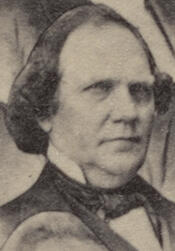
Here you will find contact information for Representative James Kennedy Moorhead, including email address, phone number, and mailing address.
| Name | James Kennedy Moorhead |
| Position | Representative |
| State | Pennsylvania |
| District | 22 |
| Party | Republican |
| Status | Former Representative |
| Term Start | December 5, 1859 |
| Term End | March 3, 1869 |
| Terms Served | 5 |
| Born | September 7, 1806 |
| Gender | Male |
| Bioguide ID | M000929 |
About Representative James Kennedy Moorhead
James Kennedy Moorhead (September 7, 1806 – March 6, 1884) was a Republican member of the U.S. House of Representatives from Pennsylvania who served five consecutive terms in Congress from 1859 to 1869. Over the course of a long career in business, infrastructure development, and public life, he played a notable role in the economic and political transformation of Pennsylvania in the mid-nineteenth century.
Moorhead was born on September 7, 1806, in Halifax, Dauphin County, Pennsylvania. Little is recorded about his early family life, but as a young man he entered a trade rather than a formal profession, serving an apprenticeship at the tanner’s trade. This early experience in manual and commercial work provided him with practical knowledge of business operations and local economic conditions in Pennsylvania, which would later inform his activities in transportation, communications, and politics.
After completing his apprenticeship, Moorhead turned to internal improvements and quickly became involved in canal construction, a central element of Pennsylvania’s early transportation network. He became a canal contractor and, in 1828, served as superintendent and supervisor on the Juniata Canal, an important link in the state’s canal system. Demonstrating both entrepreneurial initiative and an understanding of emerging transportation needs, he projected and established the first passenger packet line on the Pennsylvania Canal in 1835. His work in canal development helped facilitate commerce and travel across the state and contributed to Pennsylvania’s broader economic growth in the antebellum period.
Moorhead’s prominence in infrastructure projects led to further responsibilities and public recognition. In 1838 he was appointed adjutant general of Pennsylvania, a senior state military administrative post, reflecting growing confidence in his leadership and organizational abilities. He subsequently constructed the Monongahela Navigation Canal, a key improvement to navigation on the Monongahela River, and served as president of the company that operated it for twenty-one years. His interests extended beyond transportation into the rapidly developing field of communications; he became president of the Atlantic & Ohio Telegraph Company, which later became part of the Western Union Telegraph Company, placing him at the forefront of the technological changes that were reshaping business and communication in the United States.
In his early political career, Moorhead was aligned with the Democratic Party, but the shifting political landscape of the 1850s led him to change his affiliation. Following the fall elections of 1854, he left the Democrats and joined the Know Nothing movement, reflecting contemporary nativist and reform currents. As the Republican Party emerged as the principal anti-slavery and Unionist party in the latter half of the decade, Moorhead again shifted his allegiance and became a Republican, a decision that would define his subsequent national political career.
Moorhead was elected as a Republican to the Thirty-sixth Congress and to the four succeeding Congresses, serving in the U.S. House of Representatives from Pennsylvania from March 4, 1859, to March 3, 1869. His ten years in the House coincided with a critical period in American history, encompassing the secession crisis, the Civil War, and the early years of Reconstruction. As a member of the House of Representatives, he participated in the legislative process during these transformative years and represented the interests of his Pennsylvania constituents. During the Thirty-eighth and Thirty-ninth Congresses, he served as chairman of the Committee on Manufactures, a position that placed him at the center of debates over industrial policy, tariffs, and the economic dimensions of the Union war effort and postwar recovery. On March 31, 1868, he appeared as a witness for the prosecution in the impeachment trial of President Andrew Johnson, underscoring his engagement with the central constitutional and political controversies of Reconstruction.
After a decade in Congress, Moorhead declined to be a candidate for renomination in 1868, bringing his formal congressional service to a close. He remained active in Republican politics, serving as a delegate to the Republican National Convention in 1868, where the party nominated Ulysses S. Grant for the presidency. He later sought higher office and was an unsuccessful candidate for election to the United States Senate in 1880, indicating his continued prominence within Pennsylvania’s Republican ranks even after leaving the House.
In his later years, Moorhead focused on business and civic leadership in Pittsburgh, a city that was rapidly becoming an industrial center. He served as president of the chamber of commerce of Pittsburgh from 1877 until his death in 1884, playing a leading role in promoting the city’s commercial and industrial interests. His family was also connected to the region’s financial and social elite; he was the father of Pittsburgh financier Maxwell K. Moorhead, who became a member of the South Fork Fishing and Hunting Club, later associated with the Johnstown Flood. James Kennedy Moorhead died on March 6, 1884, at the age of seventy-seven, leaving a legacy that spanned transportation, communications, state service, national politics, and civic leadership in Pennsylvania.