Representative James Willis Nesmith
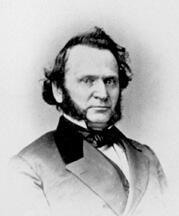
Here you will find contact information for Representative James Willis Nesmith, including email address, phone number, and mailing address.
| Name | James Willis Nesmith |
| Position | Representative |
| State | Oregon |
| District | 1 |
| Party | Democratic |
| Status | Former Representative |
| Term Start | July 4, 1861 |
| Term End | March 3, 1875 |
| Terms Served | 2 |
| Born | July 23, 1820 |
| Gender | Male |
| Bioguide ID | N000050 |
About Representative James Willis Nesmith
James Willis Nesmith (July 23, 1820 – June 17, 1885) was an American politician and lawyer from Oregon who served as both a United States senator and a Representative from Oregon in the United States Congress. A member of the Democratic Party, he was in national office during a significant period in American history, contributing to the legislative process during two terms in Congress and participating in debates surrounding the Civil War and Reconstruction. Over the course of his career he also held a variety of territorial and federal posts, including service as a judge in the Provisional Government of Oregon and as United States Marshal and Superintendent of Indian Affairs in the Pacific Northwest. Nesmith’s family was prominent in regional politics; his grandson, Clifton N. McArthur, and his son-in-law, Levi Ankeny, both later served in Congress.
Nesmith was born on July 23, 1820, in what is now the Canadian province of New Brunswick, then a British colony, while his American parents were on a visit from their home in Washington County, Maine. Of Scottish and Irish heritage, he was the son of William Morrison Nesmith and the former Harriet Miller. Around 1828, he and his father moved to Claremont, New Hampshire, where he received a limited formal education. As a young man he migrated westward, moving to Ohio in 1838 and then to Iowa in 1842, where he waited for an opportunity to immigrate to Oregon Country. He initially planned to travel the Oregon Trail with Elijah White’s party in 1842 but arrived too late and instead spent time working as a carpenter at Fort Scott in what is now Kansas. In the spring of 1843 he joined the party led by missionary Marcus Whitman and journeyed over the Oregon Trail to the Pacific Northwest.
Arriving in Oregon in 1843, Nesmith studied law and was admitted to the bar. He quickly entered public life in the emerging Provisional Government of Oregon, and in 1845 he was selected to serve as Supreme Judge of that government. He completed his term in 1846 and then moved to Polk County, where he took a land claim, began farming, and on June 21 married Pauline Goff. The couple would have seven children. In 1847, he was elected from Polk County to the Provisional Legislature of Oregon and served briefly in the 1848 session before resigning. During this early period in Oregon he combined legal practice, agriculture, and public service, helping to shape institutions in the territory before formal American statehood.
Nesmith also had a significant record of military and frontier service. He served as a captain during the Cayuse War against Native Americans in Eastern Oregon from 1847 to 1848, following the Whitman Massacre. When news of the California Gold Rush reached the Willamette Valley in 1848, he traveled to the gold fields and remained there until 1849. Upon his return to Polk County in 1849, he purchased a flour mill on Rickreall Creek near the county seat of Dallas and engaged in agricultural pursuits and stock raising in a nearby community that for a time bore his name. He again served as a captain in militia forces during the Rogue River War in 1853 and the Yakima Indian War in 1855. Between these conflicts he was appointed United States Marshal for the Oregon Territory, succeeding Joseph Meek, and from 1857 to 1859 he served as Superintendent of Indian Affairs for the Oregon and Washington Territories. In that capacity he pursued an aggressive policy toward Native peoples on Oregon’s south coast and once wrote to Commissioner of Indian Affairs George Manypenny that the extermination of the Chetco people “would occasion no regrets at this office,” a statement reflecting the harsh and often violent federal Indian policy of the era.
On February 14, 1859, Oregon was admitted to the Union as the 33rd state, and Nesmith soon moved onto the national stage. In 1860, the Oregon Legislative Assembly elected him to the United States Senate. A Democrat, he served in the Senate from March 4, 1861, to March 3, 1867, a period that encompassed the entire Civil War and the beginning of Reconstruction. During his Senate tenure he represented Oregon’s interests while navigating the divided politics of the time. Notably, he and fellow Oregon senator Benjamin F. Harding were the only Democrats in the Senate to vote for the Thirteenth Amendment to the United States Constitution, which abolished slavery. After his term ended, he was an unsuccessful candidate for re-election. He was appointed Minister to Austria, but the Senate did not confirm his nomination, and he returned to Oregon.
After leaving the Senate, Nesmith resumed local and regional public service. Returning to his home near Rickreall in Polk County, he served as road supervisor of Polk County in 1868 while continuing his agricultural and business pursuits. His national political career was revived in the 1870s when he was elected as a Democrat to the Forty-third Congress to fill the vacancy in the House of Representatives caused by the death of his cousin, Representative Joseph G. Wilson. Nesmith served as a Representative from Oregon from December 1, 1873, to March 3, 1875. During this term in the House of Representatives, he participated in the democratic process and represented the interests of his constituents at a time when the nation was grappling with the later stages of Reconstruction and postwar economic issues. He did not seek renomination in 1874 to the Forty-fourth Congress and, after the expiration of his term, returned permanently to his farm and local affairs in Polk County.
Nesmith’s family connections reinforced his place in Pacific Northwest political history. In addition to his cousin Joseph G. Wilson, his grandson, Clifton Nesmith McArthur, later served as a United States Representative from Oregon in the early twentieth century, and his son-in-law, Levi Ankeny, became a United States senator from Washington. James Willis Nesmith died at his home near Rickreall, Oregon, on June 17, 1885, at the age of 64. He was interred in Polk County on the south bank of Rickreall Creek, near the lands he had farmed and the community where he had lived for much of his adult life.