Senator James Warren Nye
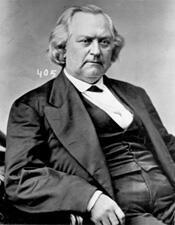
Here you will find contact information for Senator James Warren Nye, including email address, phone number, and mailing address.
| Name | James Warren Nye |
| Position | Senator |
| State | Nevada |
| Party | Republican |
| Status | Former Representative |
| Term Start | January 1, 1864 |
| Term End | March 3, 1873 |
| Terms Served | 2 |
| Born | June 10, 1815 |
| Gender | Male |
| Bioguide ID | N000177 |
About Senator James Warren Nye
James Warren Nye (June 10, 1815 – December 25, 1876) was an American attorney, jurist, militia officer, and politician who became most notable for his service as Governor of Nevada Territory and as a United States senator from Nevada. A member of the Republican Party in his national career, he represented Nevada in the U.S. Senate from 1863 to 1873, serving two terms during a transformative period in American history that encompassed the Civil War and Reconstruction.
Nye was born in DeRuyter, Madison County, New York, on June 10, 1815. He attended the common schools and later Homer Academy in Homer, New York, receiving the classical and preparatory education typical of aspiring professionals of his era. He then studied law in Hamilton, New York, reading in the offices of Lorenzo Sherwood and Martin P. Sweet. After completing his legal studies, he was admitted to the bar and entered into practice with Sherwood in Hamilton, where the two formed the firm of Sherwood & Nye.
Nye’s early public career was rooted in New York’s legal and judicial system. In 1843 he was appointed a master in chancery, a position that involved handling certain equity matters in the state’s courts. He subsequently served as surrogate of Madison County from 1844 to 1847, overseeing probate and related proceedings, and then as county judge from 1847 to 1851, presiding over a broad range of civil and criminal cases. Concurrent with his legal and judicial work, Nye was active in the New York Militia. In the early 1840s he commanded the 35th Brigade of the 17th Division with the rank of brigadier general, and in 1846 he was appointed commander of the entire 17th Division, receiving promotion to major general.
Politically, Nye emerged as an antislavery Democrat during the intense factional struggles within the New York Democratic Party in the late 1840s. He aligned himself with the Barnburners, the reformist, anti-slavery wing of the party, in opposition to the more conservative Hunkers. In the presidential election of 1848 he supported former President Martin Van Buren, who ran as the Free Soil Party’s candidate on a platform opposing the expansion of slavery into the western territories. That same year Nye was an unsuccessful Free Soil candidate for election to the Thirty-first Congress, an early indication of his willingness to break with party orthodoxy over the slavery issue.
After leaving the Madison County bench, Nye continued his legal career in urban centers of New York. From 1852 to 1857 he resided in Syracuse, New York, where he practiced law and remained engaged in public affairs. In 1857 he moved to New York City, where he assumed a prominent administrative role as president of the Metropolitan Board of Police, serving from 1857 to 1860. In that capacity he was involved in the organization and oversight of the metropolitan police force during a period of rapid urban growth and political tension, gaining experience in executive administration that would later inform his territorial governorship.
With the outbreak of the Civil War and the organization of new western territories, Nye’s career shifted to the national stage. In 1861 President Abraham Lincoln appointed him Governor of the newly created Nevada Territory, entrusting him with the task of establishing stable civil government in a strategically important mining region whose loyalty and resources were significant to the Union cause. As territorial governor, Nye oversaw the development of Nevada’s institutions and the transition toward statehood. Upon the admission of Nevada as a state into the Union in 1864, he was elected a Republican to the United States Senate. His formal Senate service is recorded from February 1, 1865, to March 3, 1873, and he was reelected in 1867, serving two full terms. During this decade-long tenure, he participated in the legislative process at the height of the Civil War’s aftermath and Reconstruction, representing the interests of his Nevada constituents and contributing to national debates over reunion, civil rights, and western development.
During his years in the Senate, Nye held several committee assignments that reflected both procedural and substantive responsibilities. He served as chairman of the Committee on Enrolled Bills in the Thirty-ninth Congress, overseeing the final preparation of legislation before it was sent to the president. He was a member of the Committee on Revolutionary Claims in the Fortieth Congress, dealing with claims arising from the Revolutionary War, and he served on the Committee on Territories in the Forty-first Congress, a key panel in shaping policy for the governance and admission of western territories. Although he was an established figure in the chamber, he was an unsuccessful candidate for reelection at the end of his second term, and his Senate service concluded on March 3, 1873. Contemporary observers noted his distinctive personality in the Senate. Washington journalist Benjamin Perley Poore wrote that Nye, who for years sat at the right hand of Senator Charles Sumner, delighted in making running comments on Senate proceedings in language that offended Sumner’s fastidious sensibilities. Poore observed that Nye lacked conventional senatorial dignity and was not especially witty in formal debate compared with colleagues such as Proctor Knott, McCreery, or Samuel Cox, but that he possessed “a vast store of humor and genial humanity,” qualities that endeared him personally even as they cost him some measure of formal respect.
Nye’s Senate office also intersected with American literary history. Mark Twain briefly served as his Senate secretary, and later recounted their association in his collection Sketches New and Old. Twain described their parting as the result of his having written intentionally absurd letters to constituents after Nye instructed him to avoid addressing controversial issues, an anecdote that underscored both Nye’s informal working style and Twain’s emerging satirical voice. Nye’s name was permanently attached to the state he had helped administer and represent when Nye County, Nevada, was named in his honor, reflecting his prominence in the territory’s early political development.
In his later years, Nye’s health and mental condition deteriorated severely. He was widely regarded as insane during this period and resided in an asylum, where he suffered from pronounced delusions, including the belief that he was already dead and merely awaiting the arrival of his coffin. James Warren Nye died in White Plains, New York, on December 25, 1876. He was interred at Woodlawn Cemetery in The Bronx, New York, closing a public career that had spanned local judicial service, militia command, urban police administration, territorial governance, and a decade in the United States Senate.