Representative James Breck Perkins
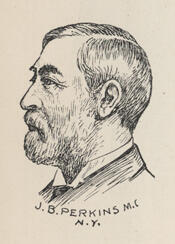
Here you will find contact information for Representative James Breck Perkins, including email address, phone number, and mailing address.
| Name | James Breck Perkins |
| Position | Representative |
| State | New York |
| District | 32 |
| Party | Republican |
| Status | Former Representative |
| Term Start | December 2, 1901 |
| Term End | March 3, 1911 |
| Terms Served | 5 |
| Born | November 4, 1847 |
| Gender | Male |
| Bioguide ID | P000234 |
About Representative James Breck Perkins
James Breck Perkins (November 4, 1847 – March 11, 1910) was an American historian, United States congressman, and writer whose work on French history earned him national recognition. He was born in St. Croix Falls, Wisconsin, then a frontier settlement, where his father, a New England–born lawyer and judge, had moved in connection with his legal practice. During Perkins’s youth the family returned to New York State, and he was raised and educated there, an experience that helped shape his later professional and political life.
Perkins pursued higher education at the University of Rochester in Rochester, New York, graduating in 1867. While at the university he was a member of the St. Anthony Hall fraternity, an association that connected him with a network of professionals and public figures. After completing his degree, he studied law and was admitted to the bar, establishing his legal practice in Rochester. His training and early work as a lawyer provided the foundation for both his municipal service and his later legislative and congressional careers.
Perkins entered public life in Rochester as a municipal law officer. He served as city attorney of Rochester from 1874 to 1878, a role in which he handled the city’s legal affairs during a period of urban growth and modernization. Alongside his legal and civic responsibilities, he developed a serious interest in European, particularly French, history. By the 1880s he had begun publishing substantial historical works, combining careful archival research with a clear narrative style that attracted both scholarly and general readers.
His reputation as a historian was established with the publication of “France under Mazarin” in 1887, a detailed study of French politics and administration during the ministry of Cardinal Mazarin. This was followed by “France under Louis XV” in 1897, which examined the political, social, and diplomatic history of France in the eighteenth century. In 1900 he published “Richelieu” in the “Heroes of the Nations” series, a biographical and historical account of Cardinal Richelieu’s role in shaping modern France. Recognized as the leading authority in the particular historical field to which he devoted himself, especially the political history of early modern France, Perkins was honored by membership in the National Institute of Arts and Letters, reflecting his standing in the American intellectual community.
Perkins’s growing prominence in Rochester and New York State led him into elective politics. A Republican, he was elected to the New York State Assembly as the representative for Monroe County’s 1st District, serving in 1898. In the Assembly he gained experience in legislative procedure and public policy that would prove valuable in national office. His combined reputation as a lawyer, historian, and capable state legislator positioned him as a strong candidate for Congress at the turn of the century.
In 1900 Perkins was elected to the United States House of Representatives from New York and took his seat in March 1901. He served continuously in Congress from 1901 until his death in 1910, being reelected to successive terms. During his congressional service he was associated with important committee work, including assignments related to foreign affairs and the judiciary, areas that aligned with his legal background and historical expertise. His knowledge of European history and international relations informed his approach to questions of American foreign policy and diplomacy in the early twentieth century, and he was regarded by colleagues as a thoughtful and well-informed legislator.
Even while serving in Congress, Perkins maintained his interest in historical scholarship. His posthumously published work, “France in the American Revolution” (1911), reflected his enduring engagement with the transatlantic dimensions of the Revolutionary era, examining French participation in and influence on the American struggle for independence. The book drew on his long study of French political and diplomatic history and connected it directly to the origins of the United States, further cementing his reputation as a historian of Franco-American relations.
James Breck Perkins died in office on March 11, 1910, in Washington, D.C., while still serving as a representative from New York. His death placed him among the members of the United States Congress who died in office in the first half of the twentieth century. Memorial addresses in his honor were delivered in the House of Representatives and later published, reflecting the respect he commanded among his colleagues. He was remembered as a distinguished public servant and an accomplished historian whose legal, legislative, and scholarly careers were closely intertwined.