Representative James H. (Jimmy) Quillen
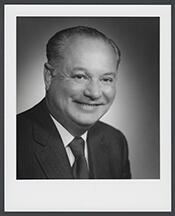
Here you will find contact information for Representative James H. (Jimmy) Quillen, including email address, phone number, and mailing address.
| Name | James H. (Jimmy) Quillen |
| Position | Representative |
| State | Tennessee |
| District | 1 |
| Party | Republican |
| Status | Former Representative |
| Term Start | January 9, 1963 |
| Term End | January 3, 1997 |
| Terms Served | 17 |
| Born | January 11, 1916 |
| Gender | Male |
| Bioguide ID | Q000013 |
About Representative James H. (Jimmy) Quillen
James Henry Quillen (January 11, 1916 – November 2, 2003) was an American politician who served as a Republican member of the United States House of Representatives from Tennessee from 1963 to 1997. A member of the Republican Party, he represented Tennessee’s 1st congressional district, which covers the northeast corner of the state, including the Tri-Cities region. Over the course of 17 consecutive terms in office, he contributed to the legislative process during a significant period in American history, participating in the democratic process and representing the interests of his constituents in East Tennessee.
Quillen’s early life and formative years preceded his long public career, and like many of his generation he came of age during the Great Depression and the Second World War. He served in the United States Navy during World War II, where he was assigned to the aircraft carrier USS Antietam. The Antietam entered the Pacific theater of operations too late in the war to participate in combat, arriving in Hawaii from the Panama Canal just as the first atomic bomb was dropped by the United States on Japan. Although the ship did not see combat, Quillen’s naval service placed him in the Pacific at the close of the war and helped shape his identification with veterans’ issues in his later political life.
Following the war, Quillen returned to civilian life in Tennessee and entered politics as a Republican at a time when the party was still a minority in much of the South but historically strong in his home region. Before seeking federal office, he served in the Tennessee House of Representatives, building a political base in the state’s northeast corner. The 1st District, encompassing the Tri-Cities and surrounding counties, was one of the few ancestrally Republican regions of the South; its voters had identified with the Republican Party after the Civil War and had remained staunchly Republican ever since. This tradition provided a favorable environment for Quillen’s rise within state and, later, national politics.
Quillen’s path to Congress opened in 1961, when B. Carroll Reece, who had represented Tennessee’s 1st congressional district for all but six of the previous 40 years, died in office. Reece’s wife, Louise, served as a caretaker representative until the next election. In 1962 Quillen decided not to run for a fifth term in the Tennessee House of Representatives and instead sought the Republican nomination for the 1st District seat in the U.S. House. In a five-way Republican primary, he secured the nomination with only 28 percent of the vote, then won the general election with 53.8 percent. He took office in January 1963, beginning a congressional tenure that would last 34 years.
During his long service in Congress, Quillen became one of the most durable Republican figures from the South. He was reelected 16 more times, reflecting both his personal popularity and the district’s strong Republican orientation. Apart from his initial run for the seat, he faced only one relatively close contest, in 1976, when he was held to 57 percent of the vote. The 1962 and 1976 elections were the only times that Quillen dropped below 64 percent of the vote and are the only occasions since 1898 in which a Democrat has even managed 40 percent of the vote in the 1st District. He faced no major-party opposition in 1966 and 1980, and he was completely unopposed in 1984 and 1990. Over time, he became the de facto leader of the Republican Party in East Tennessee and a statewide power broker within the tight circle of Tennessee Republican politics.
Quillen’s popularity in his district was not due solely to its heavy Republican tilt. He was widely perceived as maintaining B. Carroll Reece’s emphasis on strong constituent service, which reinforced his standing among voters. At the same time, his legislative record in terms of original federal bills was relatively modest. Over his 34 years in Congress, he managed to sponsor only three pieces of original federal legislation, including legislation pertaining to the Social Security “notch babies” benefit adjustment and an anti-flag desecration amendment to the U.S. Constitution. He was also associated with veterans’ and medical education issues, including the Teague-Cranston Act, which provided for the establishment of new medical schools in medically underserved areas of the United States. One of the Teague-Cranston Act medical schools was established at Texas A&M within the district of U.S. Representative Olin Teague and located about seventy miles from the nearest Veterans Administration hospital. Quillen became a signatory sponsor two months after Teague had introduced the original bill specifying the creation of these medical colleges. The Teague-Cranston Act was never in any danger of failing in the House of Representatives; it passed without a dissenting vote in October 1972 and was signed by President Richard Nixon, with a memo from the Nixon Administration indicating that Nixon signed the bill “primarily as an election-year gesture toward veterans.”
In the realm of campaign finance and political influence, Quillen amassed a large campaign treasury over the course of his career. He received many large individual and political action committee contributions, including from well-financed PACs representing the beer, wine, and spirits beverage industries. According to Vin Weber of the Brookings Institution, an important factor buttressing Quillen’s reelection campaign finance efforts was his “tremendous success…in shaking down the business community for [campaign] contributions.” Because of his district’s overwhelming Republican leanings and his entrenched incumbency, he rarely had to spend heavily from these funds in competitive races, further enhancing his position as a financial and political power within Tennessee Republican circles.
James Henry Quillen retired from Congress at the end of his 17th term in January 1997, concluding more than three decades of continuous service in the U.S. House of Representatives. His congressional career spanned eras from the civil rights movement and the Vietnam War through the Cold War’s end and the early post–Cold War period, during which he consistently represented the interests of his East Tennessee constituents. He died on November 2, 2003, leaving a legacy as one of the longest-serving and most influential Republican figures in the history of Tennessee’s 1st congressional district.