Representative Jim Ramstad
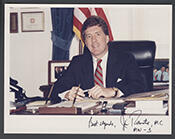
Here you will find contact information for Representative Jim Ramstad, including email address, phone number, and mailing address.
| Name | Jim Ramstad |
| Position | Representative |
| State | Minnesota |
| District | 3 |
| Party | Republican |
| Status | Former Representative |
| Term Start | January 3, 1991 |
| Term End | January 3, 2009 |
| Terms Served | 9 |
| Born | May 6, 1946 |
| Gender | Male |
| Bioguide ID | R000033 |
About Representative Jim Ramstad
James Marvin Ramstad (May 6, 1946 – November 5, 2020) was an American lawyer and Republican politician who represented Minnesota’s 3rd congressional district in the United States House of Representatives from January 3, 1991, to January 3, 2009. Over nine consecutive terms in Congress, he was known as a moderate Republican and a leading national advocate for addiction treatment and mental health parity. Before his service in the U.S. House, he served a decade in the Minnesota Senate from 1981 to 1991, building a reputation for bipartisan cooperation and constituent-focused leadership.
Ramstad was born in Jamestown, North Dakota, on May 6, 1946. He was raised in the Upper Midwest and later attended the University of Minnesota, where he completed his undergraduate education. He went on to earn a law degree from the George Washington University Law School in Washington, D.C., preparing for a career that would combine legal practice with public service. From 1968 to 1974, he served as an officer in the United States Army Reserve, an experience that contributed to his later interest in veterans’ and law enforcement issues. After law school, he worked as a private practice attorney and as a legislative aide to the Minnesota House of Representatives, gaining early exposure to the legislative process and state policymaking.
Before his election to the Minnesota Senate, Ramstad was active in local and state civic affairs. He served on the Wayzata-Plymouth Chemical Health Commission, the Plymouth Human Rights Commission, and the Minnesota State Human Rights Advisory Committee from 1979 to 1980. These roles reflected an early commitment to chemical health, human rights, and community-based problem solving—issues that would remain central to his later legislative agenda. During this period, he also confronted and began recovering from alcoholism, an experience that profoundly shaped his public advocacy and personal mission in politics.
Ramstad entered elective office as a Republican member of the Minnesota State Senate in 1981. He was first elected that year and was reelected through 1990, representing suburban communities in the Twin Cities metropolitan area. During his decade in the Minnesota Senate, he developed a reputation as a pragmatic, moderate Republican willing to work across party lines. His legislative work in St. Paul helped establish him as a credible candidate for higher office and provided a foundation for his subsequent congressional career. In 1990, he sought election to the U.S. House of Representatives from Minnesota’s 3rd congressional district and defeated former Minneapolis city councilman Lou DeMars, beginning a long tenure in federal office.
James M. Ramstad served as a Representative from Minnesota in the United States Congress from 1991 to 2009. He entered the U.S. House as part of the 102nd Congress and went on to serve in the 103rd, 104th, 105th, 106th, 107th, 108th, 109th, and 110th Congresses. Representing Minnesota’s 3rd congressional district, one of eight congressional districts in Minnesota and centered on the western suburbs of Minneapolis, he consistently won reelection eight times by landslide margins. As a member of the House of Representatives, Ramstad participated in the democratic process during a significant period in American history, contributing to the legislative process and representing the interests of his constituents through changing political majorities in Washington.
In Congress, Ramstad was widely regarded as the most moderate Republican member of the Minnesota delegation in the 109th Congress, scoring 68 percent conservative by a conservative group and 21 percent progressive by a liberal group. He was a member of The Republican Main Street Partnership and often aligned with centrist positions within his party. He was pro-choice and supported embryonic stem cell research, while opposing same-sex marriage. He voted in favor of an amendment to a whistleblower protection bill that would have allowed the government to influence stem-cell research. His committee assignments included service on the influential House Ways and Means Committee, where he served on the Subcommittee on Oversight, including as Ranking Member, and on the Subcommittee on Health. He also served as co-chair of several caucuses, including the Addiction Treatment and Recovery Caucus, the Disabilities Caucus, the Law Enforcement Caucus, and the Medical Technology Caucus, reflecting his broad policy interests in health, disability rights, public safety, and innovation.
Ramstad considered ending discrimination against people suffering from mental health and addiction problems a major part of his legislative legacy. Drawing on his own experience as a recovering alcoholic—he had been sober for 39 years at the time of his death—he became one of Congress’s most visible champions for addiction treatment and recovery services. For a time, he served as Alcoholics Anonymous sponsor to Representative Patrick J. Kennedy, illustrating the personal dimension of his advocacy. Working with colleagues from both parties and under both Republican and Democratic majorities, Ramstad helped lead efforts to pass a federal Mental Health Parity Bill to ensure more equitable insurance coverage for mental health and substance use disorders. Mental health parity legislation was ultimately passed and signed into law in December 2008, a capstone achievement of his congressional career. On February 25, 2008, it was announced that he had been elected to the board of directors of the National Center on Addiction and Substance Abuse at Columbia University, further underscoring his national role in this policy area.
On September 17, 2007, Ramstad announced that he would not seek reelection in 2008, and he reiterated this decision on December 19, 2007. He chose to retire at the conclusion of the 110th Congress, ending 18 years of service in the U.S. House. He was succeeded in representing Minnesota’s 3rd congressional district by Republican State Representative Erik Paulsen, who took office in January 2009. After leaving Congress, Ramstad was mentioned as a possible candidate for Director of the Office of National Drug Control Policy in the administration of President Barack Obama, though the position ultimately went to former Seattle police chief Gil Kerlikowske. He also considered running for Governor of Minnesota in the 2010 election but decided not to enter the race.
In his later professional life, Ramstad continued to work on issues related to addiction, public policy, and economic development. In 2010, he joined alliantgroup as a senior advisor on their Strategic Advisory Board, bringing his legislative experience and policy expertise to the private sector. He also remained active in education and civic engagement. At the time of his death, he was a resident fellow at the Harvard Institute of Politics, where he led a study group titled “The Policy and Politics of Addiction,” mentoring students and future public leaders on the intersection of health policy, recovery, and governance. His ongoing work at Harvard reflected his enduring commitment to public service and to improving the nation’s response to addiction.
Ramstad’s personal life and family connections were closely intertwined with his public commitments. He married Kathryn Mitchell Ramstad in 2005, and they had one daughter, Christen. His sister, Sheryl Ramstad, served as a Tax Court judge in Minnesota, and he was a member of the United Church of Christ. His faith and family life, together with his long-term recovery from alcoholism, informed his emphasis on compassion, ethics, and integrity in leadership. In recognition of his contributions and to carry forward his ideals, his widow Kathryn Ramstad established the Jim Ramstad Institute for Civility and Youth Leadership in 2022 at the YMCA Center for Youth Voice. The Institute is dedicated to perpetuating the principles Ramstad embraced in his political leadership—bipartisanship and bridge-building, ethics and integrity, constituent-centered leadership, compassion and resilience in leadership, and legislative process and civic literacy. Each year, the Institute helps train more than 200 young people to be effective servant leaders and supports professional development workshops for secondary teachers and students, focusing on the YMCA’s Respectful Conversations in Schools model.
James M. Ramstad died of Parkinson’s disease on November 5, 2020, at his home in Wayzata, Minnesota, at the age of 74. In 2020, his death marked the passing of a prominent Minnesota lawmaker whose career spanned local commissions, the Minnesota Senate, and nine terms in the U.S. House of Representatives. His legacy endures in federal mental health and addiction policy, in the lives of those he mentored in recovery and public service, and in the ongoing work of institutions that bear his name and reflect his commitment to civility, bipartisanship, and compassionate leadership.