Representative James A. Roe
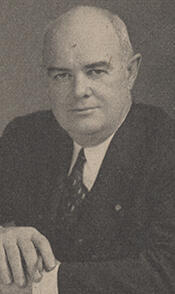
Here you will find contact information for Representative James A. Roe, including email address, phone number, and mailing address.
| Name | James A. Roe |
| Position | Representative |
| State | New York |
| District | 5 |
| Party | Democratic |
| Status | Former Representative |
| Term Start | January 3, 1945 |
| Term End | January 3, 1947 |
| Terms Served | 1 |
| Born | July 9, 1896 |
| Gender | Male |
| Bioguide ID | R000382 |
About Representative James A. Roe
James A. Roe Sr. (July 9, 1896 – April 22, 1967) was an American World War I and World War II veteran, businessman, and Democratic politician from New York who served one term as a United States Representative from New York from 1945 to 1947. A member of the Democratic Party, he contributed to the legislative process during this single term in office and was a prominent figure in Queens County politics for more than a decade as leader of the Queens County Democratic committee from 1938 to 1954.
Roe was born on July 9, 1896, in Flushing, Queens, New York. His father, also named James A. Roe, was a clerk of the court and was descended from an Irish family, giving Roe a background rooted in New York’s Irish-American community. He attended Flushing High School, where he received his early education, and later played semi-professional baseball, an early indication of his engagement with local civic and community life.
At the outset of American involvement in World War I in 1917, Roe joined the United States Army. He graduated from the Army’s School of Military Aeronautics at Cornell University and served in the United States Army Signal Corps, gaining technical and leadership experience that would shape his later public career. After the war, he returned to Queens and entered private business as a real estate and insurance broker. He expanded his activities into contracting and engineering, and he served on the board of directors of the Flushing National Bank. During this period, he developed tracts of land in Flushing and the Murray Hill section of Queens, contributing to the borough’s residential growth and establishing himself as a successful local businessman.
Roe became increasingly active in the Queens Democratic Party during the 1920s and 1930s. He was an early supporter of Franklin Delano Roosevelt’s presidential candidacy in 1932, aligning himself with the New Deal wing of the party. In 1934 he made an unsuccessful bid for leadership of the Queens County Democratic organization but continued to challenge the incumbent chairman, James Sheridan. After four years of internal party conflict, Roe defeated Sheridan in 1938 and became leader of the Queens County Democratic committee, a position he held from 1938 to 1954. In this role he became one of the most influential Democratic leaders in New York City, controlling patronage and endorsements in a rapidly growing borough. He was also a delegate to the Democratic National Conventions in 1940, 1948, and 1960, reflecting his continuing prominence in state and national party affairs.
With the United States’ entry into World War II, Roe again entered military service. He volunteered for the Army and was commissioned as a major in the Corps of Engineers. While still on active duty, he was elected in 1944 as a Democrat to the Seventy-ninth Congress from New York’s 5th congressional district. He resigned his commission in order to take his seat in the House of Representatives and was discharged with the rank of lieutenant colonel. Roe served in Congress from January 3, 1945, to January 3, 1947, representing his Queens constituents during the closing months of World War II and the immediate postwar period. During this significant period in American history, he participated in the democratic process in the House of Representatives and represented the interests of his district for one full term before leaving Congress at the conclusion of that term.
After his congressional service, Roe remained a central figure in New York Democratic politics as Queens County leader. In 1948 he courted controversy on the national stage when he led a movement to draft General Dwight D. Eisenhower for the presidency at a time when Eisenhower’s political affiliation was not yet clear. Convinced that President Harry S. Truman would be defeated in the 1948 election, Roe announced that the Queens delegation would not support any candidate at the 1948 Democratic National Convention. On the first ballot, the Queens delegation cast its votes for Roe himself. This defiance of the national party line prompted calls for his resignation, but he was nevertheless re-elected as county leader. In city politics, he supported the successful independent candidacy of Vincent R. Impellitteri for mayor of New York City in 1950. However, when Impellitteri sought re-election in 1953, Roe’s support put him at odds with Tammany Hall and the regular Democratic organization, which backed Robert F. Wagner Jr. Wagner refused Roe’s endorsement and worked to dislodge him from power. Roe’s refusal to support W. Averell Harriman for governor of New York in 1954 further alienated state party leaders and led to his ouster as Queens County Democratic leader. Although he continued to work behind the scenes as an insurgent and supported some successful candidates, he never returned to formal party leadership.
In his personal life, Roe married Margaret Farrell, whom he had met during the World War I era, in 1920. The couple had four children. Their son, James A. Roe Jr., went on to serve as a justice of the New York Supreme Court, extending the family’s involvement in public service into the judicial branch. In a tragic postscript to the family’s public life, James A. Roe Jr. was indicted for attempting to offer a $10 bribe to two police officers during a 1968 traffic stop; he was acquitted of the charge one day after he was killed in a plane crash.
After his removal from party leadership, Roe largely withdrew from front-line politics and resumed his former business interests in real estate, insurance, and related enterprises in Queens. He remained a notable figure in local civic circles until his death. James A. Roe Sr. died on April 22, 1967, in Hollywood, Florida. He was buried at Mount Saint Mary Cemetery in Flushing, Queens, returning in death to the community where he had been born, built his business career, and launched his long tenure in Democratic politics.