Representative J. Roy Rowland
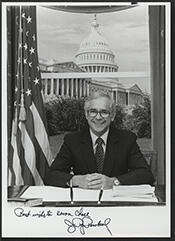
Here you will find contact information for Representative J. Roy Rowland, including email address, phone number, and mailing address.
| Name | J. Roy Rowland |
| Position | Representative |
| State | Georgia |
| District | 8 |
| Party | Democratic |
| Status | Former Representative |
| Term Start | January 3, 1983 |
| Term End | January 3, 1995 |
| Terms Served | 6 |
| Born | February 3, 1926 |
| Gender | Male |
| Bioguide ID | R000481 |
About Representative J. Roy Rowland
James Roy Rowland Jr. (February 3, 1926 – April 25, 2022) was an American World War II veteran, physician, and Democratic politician from the state of Georgia who served six terms in the United States House of Representatives representing Georgia’s 8th congressional district from 1983 to 1995. Over the course of a public career that spanned service in the Georgia House of Representatives and the U.S. Congress, he contributed to the legislative process during a significant period in late twentieth-century American history, representing the interests of his constituents while drawing on his background in medicine and military service.
Rowland was born in Wrightsville, Johnson County, Georgia, and attended the local public schools, graduating from Wrightsville High School in 1943. Shortly after graduation, he began his higher education at Emory University at Oxford, Georgia, in 1943. His studies were interrupted by World War II, during which he served in the United States Army from 1944 to 1946, attaining the rank of sergeant. After completing his military service, he resumed his education, attending South Georgia College in Douglas, Georgia, in 1946 and then the University of Georgia in Athens from 1946 to 1948, where he continued his undergraduate studies in preparation for a career in medicine.
Pursuing his interest in health and science, Rowland enrolled at the Medical College of Georgia in Augusta, where he earned his Doctor of Medicine degree in 1952. Following his graduation, he entered private medical practice and served as a practicing physician from 1952 to 1982. For three decades he provided medical care to his community, an experience that later informed his legislative priorities, particularly in the areas of health policy and veterans’ affairs. His long tenure in medicine established him as a respected figure in his region and provided a professional foundation for his eventual entry into elective office.
Rowland’s political career began at the state level when he was elected to the Georgia House of Representatives from the 119th district. He served in the Georgia House from 1976 through 1982, participating in state legislative deliberations during a period of economic and demographic change in Georgia. As a state legislator, he developed a reputation as a thoughtful lawmaker with a particular interest in health-related issues, reflecting his medical background. His service in the Georgia House of Representatives from 1976 to 1982 laid the groundwork for his subsequent campaign for national office.
In 1982, Rowland sought election to the United States House of Representatives from Georgia’s 8th congressional district. In the Democratic primary, he defeated incumbent Representative Billy Lee Evans, who had been politically weakened by a scandal involving accusations of accepting illegal campaign contributions. Rowland went on to win the general election and entered Congress on January 3, 1983. A member of the Democratic Party, he served six consecutive terms in the U.S. House of Representatives, from January 3, 1983, to January 3, 1995, during which he participated in the democratic process at the federal level and represented the interests of his central Georgia constituents through periods marked by the final years of the Cold War, the end of the Reagan era, and the early years of the Clinton administration.
During his congressional service, Rowland drew heavily on his experience as both a physician and a World War II veteran. He became particularly active in legislation affecting veterans and health care. Among his notable legislative achievements were the introduction of the Radiation-Exposed Veterans Compensation Act of 1988 and the Veterans Health Programs Extension Act of 1994, both of which were enacted into law. These measures reflected his commitment to improving benefits and health services for veterans, including those exposed to radiation during military service, and to strengthening the federal government’s health programs for former service members. His work in these areas underscored his broader concern for public health and the welfare of those who had served in the armed forces.
Rowland chose not to seek re-nomination in 1994, bringing his congressional career to a close at the conclusion of his sixth term on January 3, 1995. After leaving Congress, he returned to private life in Georgia, remaining a respected figure in his home region. In recognition of his public service and contributions to the state and nation, the federal courthouse in Dublin, Georgia—originally built in 1935—was renamed the J. Roy Rowland Federal Courthouse, a lasting honor that commemorates his role in public life and his service as a physician-legislator and veteran.
James Roy Rowland Jr. died on April 25, 2022, at the age of 96. He was interred in Westview Cemetery in Wrightsville, Georgia, near the community where he had been born and raised. His long life encompassed service as a soldier in World War II, decades as a practicing physician, and nearly two decades as an elected lawmaker at the state and federal levels, marking him as a significant figure in Georgia’s political and civic history.