Senator James Graves Scrugham
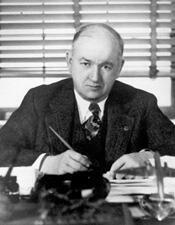
Here you will find contact information for Senator James Graves Scrugham, including email address, phone number, and mailing address.
| Name | James Graves Scrugham |
| Position | Senator |
| State | Nevada |
| Party | Democratic |
| Status | Former Representative |
| Term Start | March 9, 1933 |
| Term End | December 31, 1945 |
| Terms Served | 5 |
| Born | January 19, 1880 |
| Gender | Male |
| Bioguide ID | S000196 |
About Senator James Graves Scrugham
James Graves Scrugham (January 19, 1880 – June 23, 1945) was an American politician and engineer who served Nevada as a United States representative, a United States senator, and as the fourteenth governor of the state. A member of the Democratic Party, he held public office during a transformative period in American history, contributing to the legislative process in Congress and to the development of Nevada’s public works and institutions.
Scrugham was born on January 19, 1880, in Lexington, Kentucky. Details of his early family life are sparsely recorded in comparison with his later public career, but his formative years in Kentucky preceded a professional path that combined technical training with public service. His early experiences and education prepared him for a career as an engineer and educator before he entered the political arena in Nevada.
Trained as an engineer, Scrugham pursued higher education in engineering and went on to apply his technical expertise in both academic and governmental roles. Before rising to statewide office, he worked in engineering capacities that brought him into close contact with issues of infrastructure, resource management, and public administration—concerns that would later shape his gubernatorial and legislative priorities. His professional background gave him a reputation as a technically minded public servant at a time when western states were rapidly developing their physical and economic infrastructure.
Scrugham’s political prominence in Nevada began with his election as the fourteenth governor of the state. As governor of Nevada, he oversaw state affairs during an era when questions of economic development, transportation, and the use of natural resources were central to Nevada’s growth. His administration reflected his engineering background, emphasizing practical solutions to the challenges of a sparsely populated state seeking to modernize and diversify its economy. His gubernatorial service established him as a leading Democratic figure in Nevada and provided the platform for his subsequent national career.
After his tenure as governor, Scrugham was elected to the United States House of Representatives as a Democrat from Nevada. As a United States representative, he participated in the national legislative process and represented the interests of his state in the lower chamber of Congress. His service in the House allowed him to bring Nevada’s concerns—particularly those related to public lands, mining, and infrastructure—before the federal government, and it positioned him for elevation to the Senate.
James Graves Scrugham later served as a United States senator from Nevada from 1933 to 1945. A member of the Democratic Party, he contributed to the legislative process during five terms in office in Congress, including his combined service in both the House of Representatives and the Senate. His Senate career coincided with the Great Depression, the New Deal era, and the Second World War, a significant period in American history in which federal power and responsibility expanded dramatically. As a member of the Senate, Scrugham participated in the democratic process and represented the interests of his Nevada constituents while engaging with national issues of economic recovery, social welfare, and wartime mobilization.
Scrugham remained in office as a United States senator until his death. He died on June 23, 1945, while still serving in the Senate, bringing to a close a public career that had spanned state and national office and encompassed service as governor, United States representative, and United States senator. His life and work reflected the trajectory of a technically trained professional who became a central figure in Nevada’s political development during the first half of the twentieth century.