Representative James Andrew Shanley
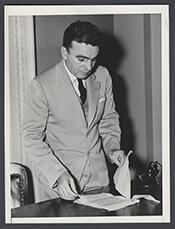
Here you will find contact information for Representative James Andrew Shanley, including email address, phone number, and mailing address.
| Name | James Andrew Shanley |
| Position | Representative |
| State | Connecticut |
| District | 3 |
| Party | Democratic |
| Status | Former Representative |
| Term Start | January 3, 1935 |
| Term End | January 3, 1943 |
| Terms Served | 4 |
| Born | April 1, 1896 |
| Gender | Male |
| Bioguide ID | S000285 |
About Representative James Andrew Shanley
James Andrew Haley (January 4, 1899 – August 6, 1981) was an American World War I veteran, businessman, and Democratic politician who served as a U.S. Representative from Florida for twelve consecutive terms from 1953 to 1977. During his long tenure in Congress, he played a prominent role in interior and territorial affairs and was a signatory to the 1956 Southern Manifesto opposing the desegregation of public schools. James Andrew Shanley served as a Representative from Connecticut in the United States Congress from 1935 to 1943; a member of the Democratic Party, Shanley contributed to the legislative process during four terms in office and participated in the democratic process while representing the interests of his constituents during a significant period in American history.
Haley was born in Jacksonville, Alabama, on January 4, 1899. He attended the public schools and later studied at the University of Alabama. His early years in Alabama provided the foundation for a career that would span military service, business, and politics in Florida. Details of Shanley’s early life and education are not contained in the available record, but his later service in Congress from Connecticut indicates that he, like Haley, emerged from a background that prepared him for public office during the mid-twentieth century.
During World War I, Haley enlisted in the United States Army in April 1917 and served overseas in France with Troop A, Second Cavalry. His wartime service placed him among the generation of veterans whose experiences in Europe shaped their later public careers. After the war, he relocated to Florida, where he began building his professional and political life. Shanley’s congressional career would come slightly earlier, with his service from 1935 to 1943 coinciding with the New Deal era and the onset of World War II, a time when members of Congress were deeply engaged in issues of economic recovery and national defense.
Following his military service, Haley settled in Sarasota, Florida, where he worked as an accountant from 1920 to 1933. In 1933 he became general manager of the John Ringling estate, a position he held until 1943. On December 4, 1942, he married Aubrey Ringling (née Aubrey Barlow Black), the widow of Richard T. Ringling, who had died in 1931. Richard Ringling was the son of Alf T. Ringling, one of the original Ringling brothers, linking Haley to one of the most prominent circus families in the United States. From 1943 to 1945, Haley served as first vice president of Ringling Circus and as president and director of Ringling Bros. and Barnum & Bailey. In 1944, a catastrophic fire broke out at a Ringling Circus show in Hartford, Connecticut, killing 169 people. On the day of the fire, Haley was the highest-ranking executive traveling with the circus. In the subsequent legal proceedings, he and five other circus officials pleaded no contest to charges of involuntary manslaughter and were sentenced to prison. Haley served eight months and in 1945 was returned to Florida, where he received a pardon from Governor Millard F. Caldwell. He continued to work for Ringling Bros. and Barnum & Bailey from 1946 to 1948 and later engaged in newspaper publishing and then in the general printing business.
Haley’s formal political career in Florida began at the local and state levels. He served as chairman of the Democratic executive committee of Sarasota County from 1935 to 1952, building influence within the state party over nearly two decades. He was elected to the Florida House of Representatives, serving from 1949 to 1952, and was a delegate to the Democratic National Conventions of 1952, 1956, and 1960. Shanley, serving as a Democratic Representative from Connecticut between 1935 and 1943, likewise participated in the legislative process during a transformative period in American politics, representing his constituents in the U.S. House of Representatives over four terms.
In 1952, Haley was elected as a Democrat to the Eighty-third Congress and subsequently won reelection to eleven succeeding Congresses, serving from January 3, 1953, to January 3, 1977, as a U.S. representative from Florida. During his tenure, he became particularly influential on issues related to public lands, natural resources, and U.S. territories. He served as chairman of the Committee on Interior and Insular Affairs in the Ninety-third and Ninety-fourth Congresses, a position that placed him at the center of legislative deliberations concerning federal lands, energy development, and the governance of U.S. island territories. In 1956, he was among the members of Congress who signed the Southern Manifesto, a document opposing the Supreme Court’s decision in Brown v. Board of Education and the desegregation of public schools. After more than two decades in the House, Haley chose not to be a candidate for reelection to the Ninety-fifth Congress in 1976, concluding his congressional service in January 1977. Shanley’s own congressional service had ended more than three decades earlier, in 1943, after which he left the House following his four terms representing Connecticut.
In his later years, Haley remained a notable public figure in Florida. He died in Sarasota, Florida, on August 6, 1981, and was interred in Boca Raton Cemetery in Boca Raton, Florida. His legacy in veterans’ affairs and public service was recognized when the United States Department of Veterans Affairs medical facility in Tampa was named the James A. Haley Veterans’ Hospital (often referred to as the James A. Haley VA Medical Center) in his honor.