Representative James Schoolcraft Sherman
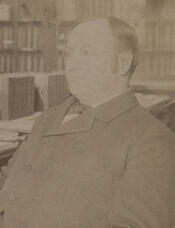
Here you will find contact information for Representative James Schoolcraft Sherman, including email address, phone number, and mailing address.
| Name | James Schoolcraft Sherman |
| Position | Representative |
| State | New York |
| District | 27 |
| Party | Republican |
| Status | Former Representative |
| Term Start | December 5, 1887 |
| Term End | March 3, 1909 |
| Terms Served | 10 |
| Born | October 24, 1855 |
| Gender | Male |
| Bioguide ID | S000345 |
About Representative James Schoolcraft Sherman
James Schoolcraft Sherman (October 24, 1855 – October 30, 1912) was the 27th Vice President of the United States, serving from 1909 until his death in 1912 under President William Howard Taft, and a long‑serving Republican member of the United States House of Representatives from New York. Over the course of 10 terms in Congress between 1887 and 1909, he contributed to the legislative process during a significant period in American history, representing the interests of his constituents while emerging as an influential committee chairman and party conservative. He was a member of the interrelated Baldwin, Hoar, and Sherman families, a network of prominent lawyers and politicians of New England and New York.
Sherman was born in Utica, New York, the son of Richard Updike Sherman and Mary Frances Sherman. He was of the ninth generation of descendants from Henry Sherman, in a line also connected to Roger Sherman, a signer of the Declaration of Independence, and William Tecumseh Sherman, the Union general during the Civil War. Raised in a milieu that combined law, politics, and public service, he attended Whitestown Seminary before enrolling at Hamilton College in Clinton, New York. At Hamilton he distinguished himself in oratory and debate, earning a Bachelor of Arts degree in 1878. His skill as a speaker and debater, noted during his college years, would later underpin his effectiveness in Congress and on the national political stage.
After graduation, Sherman remained at Hamilton College for an additional year to study law, then continued his legal training in Utica at the firm of Beardsley, Cookingham and Burdick, where his brother‑in‑law Henry J. Cookingham was a partner. He was admitted to the bar in 1880 and entered practice with Cookingham in the firm of Cookingham & Martin. In addition to his legal work, Sherman became active in local business affairs, serving as president of the Utica Trust & Deposit Company and the New Hartford Canning Company. He also quickly emerged as a force in Republican politics in central New York, becoming chairman of the Republican Party in Oneida County. At age twenty‑nine he was elected mayor of Utica, marking his first major public office and establishing his reputation as a capable and affable local leader. In 1881 he married Carrie Babcock of East Orange, New Jersey; the couple had three sons: Sherrill B. Sherman, Richard Updyke Sherman, and Thomas Moore Sherman.
In 1886, Sherman was elected as a Republican to the United States House of Representatives from New York’s 23rd congressional district. He entered Congress at the opening of the Fiftieth Congress in 1887 and ultimately served 20 years in the House—four years, followed by a two‑year break, and then sixteen additional years—holding office from 1887 to 1891 and again from 1893 to 1909. His service in Congress thus extended over 10 terms, during which he participated actively in the democratic process at a time of rapid industrialization, contentious tariff debates, and monetary policy struggles. Within the Republican Party, Sherman aligned with the conservative wing led by William McKinley, strongly supporting protective tariffs and defending the gold standard against the inflationary “free silver” movement that attracted many agrarian and populist reformers.
Sherman’s temperament and skills made him a natural congressional committee chairman. Although not regarded as a high‑powered administrator, he possessed a genial personality and a talent for managing debate and procedure, earning him the nickname “Sunny Jim.” He served as chairman of the House Committee on Indian Affairs from the 54th through the 60th Congresses, from 1895 to 1909, where he played a central role in shaping federal policy toward Native American communities. Through his efforts in 1900, the Sherman Indian High School in Riverside, California, was built and named in his honor. Because he had never held a formal party leadership post or chaired one of the most powerful committees such as Ways and Means or Appropriations, he was often viewed as sufficiently neutral to be appointed chairman of the Committee of the Whole. This position, crucial for expediting the passage of legislation by relaxing certain House rules, required judgment, impartiality, and firm control of proceedings. Senator Henry Cabot Lodge regarded the chairmanship of the Committee of the Whole as a major test of integrity and declared Sherman supremely fitted for it. His long House career, marked by steady committee work and procedural mastery, made him a key figure in the internal workings of the chamber.
At the 1908 Republican National Convention, Senator Charles Curtis suggested Sherman as the party’s vice‑presidential nominee to run with Secretary of War William Howard Taft. Although not an obvious front‑runner, Sherman’s candidacy was strongly supported by the New York delegation, and he was seen as a useful balance to Taft: an Easterner and a conservative paired with a candidate associated with the party’s progressive wing. Commentators remarked that the two wings of the Republican Party “flapped together” on the Taft–Sherman ticket. The Republicans won the 1908 election by a comfortable margin over the Democratic ticket of William Jennings Bryan and John W. Kern, and Sherman took office as vice president on March 4, 1909. Initially, he and Taft disagreed over tariff policy and the role of the vice president in administration and legislative liaison. Taft, confronting the powerful and conservative Speaker Joseph Gurney Cannon, hoped to rely on Sherman’s extensive House experience, telling him, “I am going to rely on you, Jim, to take care of Cannon for me. Whatever I have to do there will be done through you.” Sherman demurred, replying, “Not through me. You will have to act on your own account. I am to be Vice President, and acting as a messenger boy is not part of the duties as Vice President.” Over time, as Taft’s relations with the progressive faction of the party deteriorated, the president and vice president worked together more harmoniously, a relationship further eased by First Lady Helen Taft’s enjoyment of the company of Sherman and his wife. Taft later credited Sherman with accomplishing much on Capitol Hill through his “charm of speech and manner, and his spirit of conciliation and compromise,” combined with a “stubborn adherence” to his principles.
Sherman’s vice presidency coincided with growing divisions within the Republican Party and significant constitutional and political developments. He presided over the Senate during debates that led to major reforms, and his signature appears on the enrolled resolutions of the 16th and 17th Amendments to the Constitution. Personally popular and still identified with the conservative establishment, he became the first sitting vice president to be re‑nominated by his party since John C. Calhoun in 1828, when the Republicans again placed him on the ticket with Taft in 1912. By then, former President Theodore Roosevelt had broken with Taft and formed the Progressive, or “Bull Moose,” Party, making Republican victory highly unlikely. Nonetheless, New York Republicans once more pressed for Sherman’s inclusion on the ticket. During his tenure, he also achieved several personal firsts: in 1911 he became the first vice president to fly in an airplane and was the first to throw out the ceremonial first pitch at a baseball game. His genial manner and long House experience continued to ease the workings of Congress even as partisan and ideological conflicts intensified.
Sherman’s health, however, had been in decline for years. Diagnosed with Bright’s disease in 1904, he entered the 1912 campaign in failing condition. Less than a week before the November election, on October 30, 1912, he died at his home in Utica, New York, six days after his 57th birthday, making him the seventh and most recent vice president to die in office. His death left President Taft without a running mate; Nicholas Murray Butler was designated to receive any electoral votes that would have gone to Sherman. In the ensuing election, the Taft–Butler ticket finished third, carrying only Utah and Vermont with eight electoral votes, while Democratic nominee Woodrow Wilson and his running mate Thomas R. Marshall won the presidency and Progressive candidates Theodore Roosevelt and Hiram Johnson placed second. The vice presidency remained vacant until Marshall’s inauguration on March 4, 1913. Sherman was buried in Forest Hill Cemetery in Utica, closing the career of a New York lawyer, legislator, and vice president whose procedural skill, party loyalty, and affable disposition left a distinct imprint on the politics of his era.