Representative James Luther Slayden
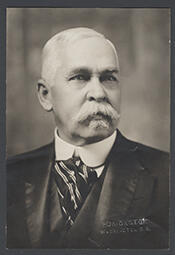
Here you will find contact information for Representative James Luther Slayden, including email address, phone number, and mailing address.
| Name | James Luther Slayden |
| Position | Representative |
| State | Texas |
| District | 14 |
| Party | Democratic |
| Status | Former Representative |
| Term Start | March 15, 1897 |
| Term End | March 3, 1919 |
| Terms Served | 11 |
| Born | June 1, 1853 |
| Gender | Male |
| Bioguide ID | S000482 |
About Representative James Luther Slayden
James Luther Slayden (June 1, 1853 – February 24, 1924) was an American politician, cotton merchant, and rancher who represented Texas in the United States House of Representatives from 1897 to 1919. A member of the Democratic Party, he was elected from San Antonio and served eleven consecutive terms in Congress, participating actively in the legislative process during a significant period in American history and representing the interests of his Texas constituents.
Slayden was born in Mayfield, Kentucky, to Letitia E. (née Beadles) and Thomas A. Slayden. After the death of his father in 1869, he moved with his mother and siblings to New Orleans, Louisiana. In New Orleans he attended the common schools and worked for two years to help support his family. Seeking further education, he enrolled at Washington and Lee University in Lexington, Virginia, where he studied during 1872 and 1873 and became a member of the Fraternity of Delta Psi (St. Anthony Hall). He later received a Phi Beta Kappa key from Washington and Lee University, reflecting his academic distinction. Slayden returned to New Orleans in 1873 and continued working there until he decided to move west.
In November 1876, Slayden moved to Texas, part of a broader migration of Americans seeking opportunity in the post–Civil War Southwest. He settled in San Antonio in 1879 and became a rancher and cotton merchant, occupations that tied him closely to the agricultural and commercial development of the region. His business activities and growing prominence in local affairs led him into Democratic Party politics. In the late 1880s, the community of Slayden in Gonzales County, Texas, was named in his honor, reflecting his rising influence in the state.
Slayden’s formal political career began in the Texas House of Representatives, to which he was elected in 1892 as a Democrat. He served in the state legislature from January 10, 1893, to January 8, 1893, sitting on several key committees, including the Finance Committee; Insurance, Statistics and History Committee; Judicial Districts Committee; Public Buildings and Grounds Committee; State Affairs Committee; and Town and City Corporations Committee. In the legislature he worked to expand trade between Texas and other regions and to promote the construction of railroads within the state, recognizing transportation as vital to economic growth. After this single term, he declined renomination and returned to his ranching and commercial interests, though he remained active in party affairs.
In 1896, Slayden was elected to the United States House of Representatives as a Democrat from Texas’s 12th congressional district. He took his seat in March 1897 and was re-elected in 1898 and 1900, serving that district until 1903. Following redistricting, he was elected from Texas’s 14th congressional district and served there from 1903 until 1919. In total, he served eleven consecutive terms in Congress, from 1897 to 1919, during an era that encompassed the Spanish–American War, the Progressive Era, and World War I. In the House, he promoted the continued growth of the railroad system in Texas, reflecting his long-standing interest in transportation and economic development. He served on the Committee on Military Affairs and was instrumental in making San Antonio a major military center, playing a key role in the enlargement of Fort Sam Houston. His influence on military policy and infrastructure helped shape both the local economy and the national defense posture.
During the Wilson administration, Slayden sought appointment as Secretary of War, a position that would have aligned with his committee work and interest in military affairs, but he did not receive the appointment. After losing this bid, he declined renomination for Congress in 1918 and left office at the conclusion of his final term in 1919. Upon his departure from Congress, he turned his attention back to private enterprise, managing mines in Mexico, a ranch in Texas, and an orchard in Virginia, thereby maintaining his long-standing ties to agriculture and resource development.
Slayden’s personal life was closely intertwined with his political and civic activities. In 1883, he married Ellen Maury of Charlottesville, Virginia. The couple had no children. Ellen Slayden became a notable figure in her own right; in 1889 she worked as the society editor for the San Antonio Express, and after his election to Congress they moved to Washington, D.C., in 1896, where she was active in social and political circles. Beyond his legislative work, Slayden was deeply involved in national and international peace efforts. In October 1910, he became one of the first trustees of the Carnegie Endowment for International Peace and later served as president of the American Peace Society, reflecting his engagement with emerging internationalist and peace movements in the early twentieth century. He was active in several fraternal organizations, including the Elks, the Masons, and the Odd Fellows, and was an Episcopalian, affiliations that underscored his standing in both civic and religious communities.
James Luther Slayden died in San Antonio, Texas, on February 24, 1924, at the age of 70. He was buried in Mission Park Cemetery in San Antonio. His career as a rancher, merchant, state legislator, and eleven-term member of Congress left a lasting imprint on Texas politics, the development of San Antonio as a military center, and the broader currents of American political and economic life in the late nineteenth and early twentieth centuries.