Representative James Albertus Tawney
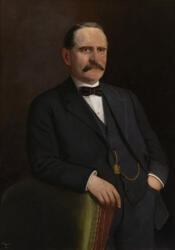
Here you will find contact information for Representative James Albertus Tawney, including email address, phone number, and mailing address.
| Name | James Albertus Tawney |
| Position | Representative |
| State | Minnesota |
| District | 1 |
| Party | Republican |
| Status | Former Representative |
| Term Start | August 7, 1893 |
| Term End | March 3, 1911 |
| Terms Served | 9 |
| Born | January 3, 1855 |
| Gender | Male |
| Bioguide ID | T000060 |
About Representative James Albertus Tawney
James Albertus Tawney (January 3, 1855 – June 12, 1919) was an American blacksmith, machinist, lawyer, and Republican politician who represented Minnesota in the United States House of Representatives from 1893 to 1911. Over the course of nine consecutive terms, he played a significant role in the legislative process during a transformative period in American history and became the first House Majority Whip, serving in that leadership position from 1899 to 1905.
Tawney was born in Mount Pleasant Township, near Gettysburg, Adams County, Pennsylvania. He apprenticed with his father as a blacksmith, acquiring skills in a traditional trade before expanding his expertise by learning the trade of machinist. These early experiences in manual and mechanical work shaped his understanding of labor and industry, perspectives that would later inform his public service. In 1877, he moved west to Winona, Minnesota, where he was employed as a blacksmith and machinist until 1881, establishing himself in the growing community along the Mississippi River.
While working in Winona, Tawney pursued legal studies, devoting his mornings and evenings to the study of law for about two years. He subsequently attended the law department of the University of Wisconsin–Madison, further formalizing his legal education. In 1882 he was admitted to the bar and commenced the practice of law in Winona, Minnesota. His transition from the forge and machine shop to the courtroom reflected both ambition and adaptability, and his legal practice provided a foundation for his entry into elective office.
Tawney’s political career began at the state level when he was elected to the Minnesota Senate in 1890. His service in the state legislature brought him to the attention of Republican leaders and voters, and in 1892 he was elected to Congress as a Republican from Minnesota. He entered the U.S. House of Representatives with the 53rd Congress and was subsequently reelected to the 54th, 55th, 56th, 57th, 58th, 59th, 60th, and 61st Congresses, serving continuously from March 4, 1893, to March 3, 1911. During these nine terms in office, Tawney participated actively in the democratic process and represented the interests of his Minnesota constituents in an era marked by industrial expansion, tariff debates, and the rise of Progressivism.
Within the House of Representatives, Tawney rose to positions of significant influence. He was the first to hold the formal position of House Majority Whip, serving from 1899 to 1905, where he was responsible for helping to marshal party votes and maintain Republican discipline on key legislative issues. He also served as chairman of the powerful House Committee on Appropriations, a role that placed him at the center of federal spending decisions and budgetary policy. Through these leadership posts, Tawney contributed to shaping national legislation and the internal organization of the House during the late nineteenth and early twentieth centuries.
Tawney’s long tenure in Congress came to an end amid shifting political currents within the Republican Party. In 1910 he was defeated in the Republican primary by 30-year-old Sydney Anderson, a younger Progressive Republican who had the support of former President Theodore Roosevelt, conservation leader Gifford Pinchot, and other reform-minded figures. Anderson campaigned on a platform calling for drastically reduced tariffs and opposition to “Cannonism,” the term used to describe the centralized, conservative control of the House under Speaker Joseph G. Cannon, with whom Tawney was closely identified. This intra-party challenge reflected the broader national struggle between conservative and progressive wings of the Republican Party.
After leaving Congress in 1911, Tawney continued his public service on the international stage. He was appointed a member of the International Joint Commission, an organization created by the United States and Canada to prevent and resolve disputes regarding the use of boundary waters between the two countries. He served on the commission from 1911 until his death and was chairman of the United States section from September 17, 1911, to December 1, 1914. In this capacity, he helped oversee the management of shared waterways and contributed to the development of cooperative mechanisms for addressing cross-border environmental and resource issues.
James Albertus Tawney died on June 12, 1919, at Excelsior Springs, Clay County, Missouri. His career spanned work as a blacksmith and machinist, the practice of law, service in the Minnesota Senate, nearly two decades in the U.S. House of Representatives—including pioneering service as the first House Majority Whip and leadership of the Appropriations Committee—and later international service on the International Joint Commission.