Representative James Webb Throckmorton
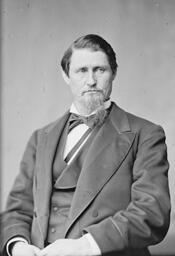
Here you will find contact information for Representative James Webb Throckmorton, including email address, phone number, and mailing address.
| Name | James Webb Throckmorton |
| Position | Representative |
| State | Texas |
| District | 5 |
| Party | Democratic |
| Status | Former Representative |
| Term Start | December 6, 1875 |
| Term End | March 3, 1887 |
| Terms Served | 4 |
| Born | February 1, 1825 |
| Gender | Male |
| Bioguide ID | T000246 |
About Representative James Webb Throckmorton
James Webb Throckmorton (February 1, 1825 – April 21, 1894) was an American politician and lawyer who became a prominent Texas statesman in the mid-nineteenth century, serving as the 12th governor of Texas during the early Reconstruction era and later as a United States Representative. Born in Tennessee, he moved with his family to Arkansas and then to Texas as a young man, becoming associated with Collin County in North Texas, which would remain his political base. He trained as a physician in his youth, but soon turned to law and politics as his principal vocations, rising to influence in the rapidly developing frontier society of Texas.
Following the outbreak of the Mexican–American War, Throckmorton entered military service, joining the 1st Texas Volunteers as a private in February 1847. Within a few months he was assigned as an assistant surgeon to the Texas Rangers, reflecting his medical training, and served in that capacity until he received a medical discharge in June 1847. After the war he returned to civilian life in Texas, where he practiced law and entered public affairs. By the late 1850s he had become a leading figure in Collin County and a delegate to state political conventions, aligning himself with the Democratic Party and gaining a reputation as an able and independent-minded legislator.
Throckmorton emerged as a notable Unionist during the secession crisis of 1860–1861. As a delegate to the Texas secession convention in 1861, he was one of only eight delegates to vote against secession from the United States. His negative vote became enshrined in Texas history. When his decision was met with hisses, boos, and catcalls from the convention floor, Throckmorton famously replied, “When the rabble hiss, well may patriots tremble.” The crowd, appreciating his boldness, gave him a grudging round of applause. Like many Texans who initially opposed secession, however, he accepted the outcome once Texas left the Union and chose to serve his state in the ensuing conflict.
During the Civil War, Throckmorton entered Confederate service, first as captain of Company K, 6th Texas Cavalry Regiment. He rose rapidly through the ranks and was promoted to brigadier general by 1862. Stationed in North Texas during the latter part of that year, he confronted the turmoil and abuses associated with conscription and militia activity. In Sherman, Texas, at a time of heightened violence following the Great Hanging at Gainesville in October 1862—during which a total of 42 men were killed, most by hanging—Throckmorton intervened to prevent further bloodshed. He is credited with saving all but five men in Sherman from being lynched by militia as suspected anti-conscription activists, an episode that underscored both the volatility of the region and his willingness to check extralegal violence.
With the end of the Civil War, Throckmorton turned again to civil government and quickly became central to Texas politics in the early Reconstruction period. On June 25, 1866, he defeated Elisha M. Pease in the Texas gubernatorial election, at the same time that the state adopted a new constitution. He was elected as the 12th governor of Texas, with George Washington Jones chosen as lieutenant governor. Taking office in 1866, he presided over a state struggling to reintegrate into the Union and to define the status of formerly enslaved people. Throckmorton’s generally lenient attitude toward former Confederates and his resistance to expansive civil rights measures for freedmen placed him at odds with the Reconstruction policies of the Radical Republicans in Congress and with federal military authorities overseeing Texas.
Throckmorton’s conflicts with federal officials culminated in his removal from office. Major General Charles Griffin, the local military commander, became increasingly dissatisfied with the governor’s approach and urged his superior, Major General Philip H. Sheridan, to act. In 1867 Sheridan removed Throckmorton from the governorship and replaced him with Elisha M. Pease, a Republican and Unionist appointed under congressional Reconstruction authority. After his removal, Throckmorton returned to private life and the practice of law, but he remained an influential Democratic voice in Texas politics as the state moved through the later phases of Reconstruction.
As the influence of Radical Republicans waned in the mid-1870s, Throckmorton resumed his political career at the national level. A member of the Democratic Party, he was elected to the United States House of Representatives from Texas’s 3rd Congressional District in 1874 and served in the Forty-fourth and Forty-fifth Congresses from March 4, 1875, to March 3, 1879. He was not a candidate for renomination in 1878. After a brief interval out of office, he returned to Congress representing Texas’s 5th Congressional District, winning election in 1882 to the seat vacated by his former lieutenant governor, George Washington Jones, who did not seek re-election. Throckmorton served in the Forty-eighth and Forty-ninth Congresses from March 4, 1883, to March 3, 1887, and was not a candidate in 1886. Across these four terms in the House of Representatives, from 1875 to 1879 and again from 1883 to 1887, he participated in the legislative process during a significant period in American history, representing the interests of his Texas constituents as the state and nation adjusted to the postwar order and the end of Reconstruction.
In his later years, Throckmorton remained a respected elder statesman in Texas, associated particularly with Collin County and the city of McKinney, where his legacy would later be commemorated, including by a courthouse statue. He continued to practice law and to engage in public affairs as his health permitted. Throckmorton died on April 21, 1894, at the age of 69, the result of a fall after he had become frail due to kidney disease. His long career—from Mexican–American War service and antebellum politics through the Civil War, Reconstruction governorship, and multiple terms in Congress—left a lasting imprint on Texas political history.