Representative James Baird Weaver
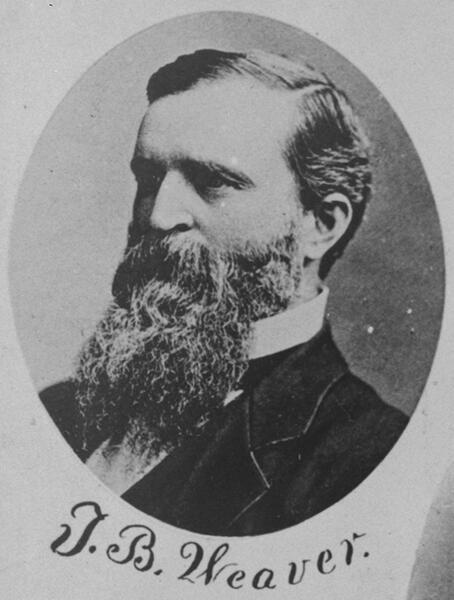
Here you will find contact information for Representative James Baird Weaver, including email address, phone number, and mailing address.
| Name | James Baird Weaver |
| Position | Representative |
| State | Iowa |
| District | 6 |
| Party | National Greenbacker |
| Status | Former Representative |
| Term Start | March 18, 1879 |
| Term End | March 3, 1889 |
| Terms Served | 3 |
| Born | June 12, 1833 |
| Gender | Male |
| Bioguide ID | W000225 |
About Representative James Baird Weaver
James Baird Weaver served as a Representative from Iowa in the United States Congress from 1879 to 1889. A member of the National Greenbacker Party, James Baird Weaver contributed to the legislative process during 3 terms in office.
James Baird Weaver’s service in Congress occurred during a significant period in American history. As a member of the House of Representatives, James Baird Weaver participated in the democratic process and represented the interests of constituents.
James Baird Weaver (June 12, 1833 – February 6, 1912) was an American politician in Iowa who was a member of the United States House of Representatives and two-time candidate for President of the United States. He joined the Republicans, opposed slavery, and served as an officer in the Union army during the Civil War, but after 1876 he switched to the Greenbacks, then the Populists, and finally the Democrats. He trained as a lawyer. Late in his career he served as mayor of Colfax, Iowa. He wrote A Call to Action: An Interpretation of the Great Uprising, Its Source and Causes published in 1892 when he was a Populist Party candidate for the U.S. presidency, he later wrote a history of Jasper County, Iowa. Born in Ohio, he moved to Iowa as a boy when his family claimed a homestead on the frontier. He became politically active as a young man and was an advocate for farmers and laborers. He joined and quit several political parties in the furtherance of the progressive causes in which he believed. After serving in the Union Army in the American Civil War, Weaver returned to Iowa and worked for the election of Republican candidates. After several unsuccessful attempts at Republican nominations to various offices, and growing dissatisfied with the conservative wing of the party, in 1877, Weaver switched to the Greenback Party, which supported increasing the money supply and regulating big business. As a Greenbacker with Democratic support, Weaver won election to the House in 1878. The Greenbackers nominated Weaver for president in 1880, but he received only 3.3 percent of the popular vote. After several more attempts at elected office, he was again elected to the House in 1884 and 1886. In Congress, he worked for expansion of the money supply and for the opening of Indian Territory to white settlement. As the Greenback Party fell apart, a new anti-big business third party, the People’s Party (“Populists”), arose. Weaver helped to organize the party and was their nominee for president in 1892. This time he was more successful and gained 8.5 percent of the popular vote and won five states, but still fell far short of victory. The Populists merged with the Democrats by the end of the 19th century, and Weaver went with them, promoting the candidacy of William Jennings Bryan for president in 1896, 1900, and 1908. After serving as mayor of his home town, Colfax, Iowa, Weaver retired from his pursuit of elective office. He died in Iowa in 1912. Most of Weaver’s political goals remained unfulfilled at his death, but many came to pass in the following decades.