Representative James Wickersham
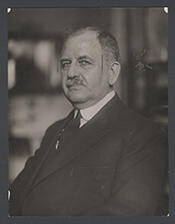
Here you will find contact information for Representative James Wickersham, including email address, phone number, and mailing address.
| Name | James Wickersham |
| Position | Representative |
| State | Alaska |
| District | At-Large |
| Party | Republican |
| Status | Former Representative |
| Term Start | March 15, 1909 |
| Term End | March 3, 1933 |
| Terms Served | 7 |
| Born | August 24, 1857 |
| Gender | Male |
| Bioguide ID | W000438 |
About Representative James Wickersham
James Wickersham (August 24, 1857 – October 24, 1939) was an American jurist, legislator, and territorial leader who played a central role in the political and institutional development of Alaska in the early twentieth century. A member of the Republican Party, he served as a district judge in Alaska and later as the territory’s delegate to the United States Congress, where he was a prominent advocate for territorial status, infrastructure development, higher education, and eventual statehood.
Wickersham was born on August 24, 1857, near Patoka, in Pike County, Indiana. He grew up in the Midwest and moved with his family to Illinois and then to Washington Territory, experiences that acquainted him early with frontier conditions and emerging American settlements. He studied law through traditional legal apprenticeship rather than formal law school, reading law and gaining admission to the bar. Before his federal judicial appointment, he practiced law and became active in public affairs in the Pacific Northwest, including service in local offices and participation in Republican Party politics, which helped establish his reputation as a capable lawyer and public servant.
By the end of the nineteenth century, Wickersham had become sufficiently prominent in legal and political circles that he was selected for federal judicial service in Alaska. In 1900, President William McKinley appointed him district judge for Alaska’s Third Judicial District, based in Eagle and later Fairbanks. As a district judge, he presided over a wide range of civil and criminal matters during a period of rapid change driven by the Klondike and Interior gold rushes. His court helped bring a measure of legal order to a frontier region marked by mining disputes, land claims, and the challenges of administering federal law in a vast and sparsely populated territory. He resigned his judicial post in 1908, positioning himself to seek elective office as Alaska’s representative in Washington.
Following his resignation from the bench, Wickersham was elected as Alaska’s delegate to the United States Congress, beginning his service in 1909. Although a delegate from a territory did not have a vote on the House floor, he served as Alaska’s voice in Congress and participated in committee work and debate. A member of the Republican Party, he contributed to the legislative process during seven terms in office, serving continuously until 1917 and then returning for another term after his re-election in 1930. His congressional service thus extended, with an interruption, from 1909 to 1933, a significant period in American history that encompassed the Progressive Era, World War I, and the early years of the Great Depression. During these years he participated in the democratic process and represented the interests of his Alaskan constituents, pressing for greater self-government, economic development, and recognition of the territory’s needs.
Wickersham was instrumental in the passage of the Organic Act of 1912, landmark legislation that granted Alaska territorial status and established a territorial legislature, thereby expanding local self-government. He also introduced the Alaska Railroad Bill, which led to the construction of a federally owned railroad linking the ice-free port of Seward with the interior, including Fairbanks, and he sponsored legislation to establish McKinley Park (later renamed Denali National Park), protecting one of Alaska’s most significant natural areas. In 1916 he introduced the first Alaska Statehood Bill in Congress, an early and symbolically important step in the long campaign that ultimately culminated in Alaska’s admission as a state in 1959. He was among those responsible for the creation of the Alaska Agricultural College and School of Mines, founded in Fairbanks and later developed into the University of Alaska; in recognition of his efforts, a residence hall on the University of Alaska Fairbanks campus was named in his honor.
Wickersham’s political career also reflected the vigorous and sometimes contentious nature of territorial politics. Campaigns in Alaska could be intense, and he was known as a forceful and eloquent speaker. In one notable contest, his Democratic opponent was Thomas A. Marquam, a Fairbanks lawyer and former mayor. At a rally held in the Liberty Theatre, Wickersham delivered a fiery address in which, according to a later account, “the walls of the Liberty Theatre virtually shook to the thunder of his denunciations.” Much of his criticism of Marquam was couched in such elaborate and eloquent language that many in the audience did not fully grasp the specific epithets he employed, though they understood from his tone that they were harsh. Years later it was recalled that Wickersham had, in effect, been calling Marquam a “loud-talking Irishman,” a characterization that illustrated both his rhetorical flair and the rough-and-tumble character of early twentieth-century Alaskan political life.
In his later years, after the end of his final term in Congress in 1933, Wickersham remained an influential elder statesman in Alaskan affairs. He continued to write, speak, and advocate on issues affecting the territory, and he took an active interest in the institutions he had helped to create, including the territorial government, the railroad, and the college at Fairbanks. He also devoted time to historical and legal scholarship, preserving records and reflections on Alaska’s formative years. James Wickersham died on October 24, 1939, leaving a legacy as one of the principal architects of Alaska’s transition from a remote federal possession to an organized territory with growing aspirations for statehood.