Representative James Mark Wilcox
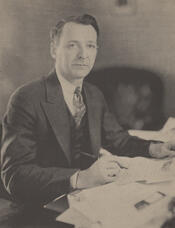
Here you will find contact information for Representative James Mark Wilcox, including email address, phone number, and mailing address.
| Name | James Mark Wilcox |
| Position | Representative |
| State | Florida |
| District | 4 |
| Party | Democratic |
| Status | Former Representative |
| Term Start | March 9, 1933 |
| Term End | January 3, 1939 |
| Terms Served | 3 |
| Born | May 21, 1890 |
| Gender | Male |
| Bioguide ID | W000455 |
About Representative James Mark Wilcox
James Mark Wilcox (May 21, 1890 – February 3, 1956) was a Democratic U.S. Representative from Florida who served three terms in Congress from 1933 to 1939. He is particularly remembered as the author of the Wilcox Municipal Bankruptcy Act of 1934, landmark legislation that initially enabled the city of West Palm Beach, Florida, to adjust its bonded indebtedness and avoid bankruptcy and that was later invoked to help New York City avert bankruptcy in 1972. Over the course of his public career, he held a series of local, county, and federal positions and played a notable role in debates over municipal finance, aviation policy, and labor standards during a formative period in American history.
Wilcox, commonly known by his middle name, was born on May 21, 1890, in Willacoochee, Georgia, the second son of Dr. Jefferson Taylor Wilcox and Marian Henson Wilcox. He attended public schools in Georgia before enrolling at Emory University, where he completed his undergraduate studies. After graduating from Emory, he worked as a teacher, an experience that preceded his decision to enter the legal profession. He then attended law school at Mercer University, graduating in 1910. That same year he was admitted to the bar and commenced the practice of law in Hazlehurst, Georgia, marking the beginning of a long legal and political career that would eventually extend into neighboring Florida.
On November 27, 1910, Wilcox married Lyde Christine Helm (1892–1973) of Birmingham, Alabama. The couple had two sons: James Mark Wilcox Jr. (1916–2005) and Joel C. Wilcox Sr. (1918–2009). During these early years of family life, Wilcox combined his growing legal practice with public service. From 1911 until 1918 he served as solicitor of Jeff Davis County, Georgia, a prosecutorial role in which he gained experience in courtroom advocacy and local administration. In 1919 he moved to Brunswick, Georgia, where he continued to practice law, and in 1925 he relocated to West Palm Beach, Florida. There he established himself in the Florida bar and quickly became involved in municipal affairs.
Wilcox’s legal and civic prominence in Florida increased during the late 1920s and early 1930s. He served as city attorney of West Palm Beach from 1928 until 1933, a period marked by the aftermath of the Florida land boom and mounting financial pressures on local governments. In 1931 he was appointed a member of the taxation committee of President Herbert Hoover’s Conference on Home Ownership, reflecting his growing reputation in matters of finance, taxation, and municipal law. These experiences with local fiscal challenges and national policy discussions helped shape his later legislative priorities in Congress, particularly his interest in mechanisms for municipal debt adjustment.
Wilcox entered national politics in 1932, when he sought a seat in the U.S. House of Representatives from Florida. In the June Democratic primary he defeated the incumbent, two-term Representative Ruth Bryan Owen, thereby securing the Democratic nomination in a state where that nomination was typically decisive. He was subsequently elected to the Seventy-third Congress and reelected to the Seventy-fourth and Seventy-fifth Congresses, serving from March 4, 1933, to January 3, 1939. His tenure in the House coincided with the New Deal era, a significant period in American history marked by economic crisis and extensive federal legislative activity. As a member of the House of Representatives, Wilcox participated in the legislative process on issues ranging from municipal finance to national defense and labor policy, representing the interests of his Florida constituents within the broader Democratic majority.
During his congressional service, Wilcox authored several notable pieces of legislation. His most enduring achievement was the Wilcox Municipal Bankruptcy Act, enacted in 1934, which provided a federal framework for municipalities to adjust their bonded indebtedness under court supervision. Initially crafted to allow West Palm Beach, a city in his district, to avoid bankruptcy, the act established principles that would later be used by other jurisdictions, including New York City in 1972, to restructure debt and maintain essential public services. In 1937 he also introduced H.R. 3151, a bill recommending the separation of the Army Air Corps from the U.S. Army and its establishment as an independent service, anticipating later developments that culminated in the creation of the United States Air Force in 1947. His legislative record thus reflected both local concerns and forward-looking views on national defense organization.
Wilcox’s congressional career also placed him in the midst of contentious debates over labor standards and race relations in the South. In discussions surrounding the Fair Labor Standards Act of 1937, he articulated the position of many Southern Democrats who opposed federal wage equalization across racial lines. He argued that there had “always been a difference in the wage scale of white and colored labor” in the South and warned that federal wage-setting that did “not make any distinction between the races” would, in his view, be unworkable in Southern states. He maintained that “you cannot put the Negro and the white man on the same basis and get away with it,” reflecting the segregationist and racially discriminatory attitudes prevalent among many white Southern politicians of his era. These statements form a significant part of the historical record of his views on labor and race.
In 1938 Wilcox chose not to seek reelection to the House of Representatives. Instead, he pursued the Democratic nomination for the United States Senate from Florida. His Senate campaign was ultimately unsuccessful, ending his tenure in Congress after three terms. Following his 1938 electoral defeat, he returned to private legal practice, this time in Miami, Florida. There he continued to build his career as an attorney, drawing on his legislative experience and his longstanding involvement in municipal and transportation issues.
In his later years, Wilcox remained active in public and quasi-public roles related to transportation and regional development. He served as attorney for the Dade County Port Authority and the Greater Miami Traffic Association from 1945 until his death, contributing legal expertise to the growth and administration of the Miami area’s transportation infrastructure. His association with aviation and port development was later recognized in the naming of Miami International Airport: the field’s official name is J. Mark Wilcox Field, honoring his role in the region’s transportation history. Wilcox died at his farm, ChrisMar, in White Springs, Florida, on February 3, 1956. He was interred in Woodlawn Park Cemetery in Miami, Florida, closing a career that spanned local prosecution, city and county legal service, and three terms in the United States Congress.