Representative Jared Young Sanders
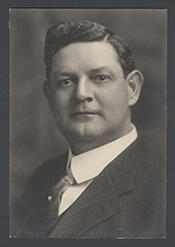
Here you will find contact information for Representative Jared Young Sanders, including email address, phone number, and mailing address.
| Name | Jared Young Sanders |
| Position | Representative |
| State | Louisiana |
| District | 6 |
| Party | Democratic |
| Status | Former Representative |
| Term Start | April 2, 1917 |
| Term End | March 3, 1921 |
| Terms Served | 2 |
| Born | January 29, 1869 |
| Gender | Male |
| Bioguide ID | S000035 |
About Representative Jared Young Sanders
Jared Young Sanders Sr. (January 29, 1869 – March 23, 1944) was an American journalist, attorney, and Democratic politician from Franklin, the seat of St. Mary Parish in south Louisiana, who rose through state and national office to become Speaker of the Louisiana House of Representatives, lieutenant governor, the thirty-fourth governor of Louisiana, and a United States Representative. Born in Franklin, he came of age in the post-Reconstruction South, a period in which the Democratic Party dominated Louisiana politics and the state’s legal and journalistic professions offered key avenues into public life. His early work as a journalist and lawyer in St. Mary Parish helped establish his reputation as an articulate advocate and positioned him for rapid advancement in state politics.
Sanders received his education in Louisiana and read law in the traditional manner of the time, gaining admission to the bar before establishing a legal practice in Franklin. Alongside his legal work, he became involved in journalism, contributing to and helping shape public opinion in south Louisiana. His dual experience in law and the press gave him both the technical understanding of legislation and the public platform that were essential to political success in the late nineteenth and early twentieth centuries. By the early 1890s he had entered active politics, aligning with the dominant Democratic Party and beginning a career that would span more than three decades.
Sanders’s formal political career began in the Louisiana House of Representatives, where he quickly emerged as a leading figure. He served as a member of the state House and was elected Speaker of the Louisiana House of Representatives, holding that position from 1900 to 1904. As Speaker, he presided over legislative deliberations during a period of economic and social transition in Louisiana, when issues of infrastructure, education, and regulation of emerging industries were increasingly prominent. His performance as Speaker enhanced his standing within the Democratic Party and set the stage for higher executive office.
In 1904 Sanders was elected lieutenant governor of Louisiana, serving from 1904 to 1908. In that role he acted as the state’s second-ranking executive officer, presiding over the Louisiana Senate and frequently representing the governor’s administration in public and political forums. His tenure as lieutenant governor coincided with efforts to modernize aspects of the state’s governance and economy, and his visibility in that office made him a natural candidate for the governorship. In 1908 he was elected the thirty-fourth governor of Louisiana, serving from 1908 to 1912. As governor, Sanders oversaw state government during the Progressive Era, a time marked nationally by calls for reform in areas such as regulation, public education, and governmental efficiency. His administration worked within the framework of one-party Democratic rule that characterized Louisiana politics of the period.
Sanders’s personal life intersected with his public career. He married Ada Veronica Shaw on May 31, 1891, and they had one son, Jared Y. Sanders Jr., who would later pursue his own political career in Louisiana. The couple divorced in 1912, the year his gubernatorial term ended. Sanders remarried in 1916, taking Emma Dickinson as his wife. His family connections, particularly through his son, helped extend the Sanders name in Louisiana political life beyond his own years in office.
After leaving the governorship, Sanders continued to play a prominent role in public affairs. He remained active in Democratic Party politics and, drawing on his legislative and executive experience, sought to influence the direction of state and national policy. In the context of Louisiana’s evolving political landscape, he became involved in campaigns and intra-party contests, including U.S. Senate races and other statewide contests that reflected the shifting balance of power within the Democratic Party in the early twentieth century.
Sanders entered national office when he was elected as a Democrat to the United States House of Representatives, serving as a Representative from Louisiana in the United States Congress from 1917 to 1921. He represented his state for two terms during the Sixty-fifth and Sixty-sixth Congresses, a period that encompassed the United States’ involvement in World War I and the immediate postwar years. As a member of the House of Representatives, Jared Young Sanders participated in the legislative process during a significant period in American history, contributing to debates over war measures, demobilization, and domestic policy. He represented the interests of his Louisiana constituents while working within the broader Democratic caucus in Congress.
Near the end of his political career, Sanders became a prominent figure in the anti-Long faction within the Louisiana Democratic Party, opposing the growing influence of Huey Pierce Long Jr. and his populist political machine. The rivalry between Sanders and Long was emblematic of the deep divisions within Louisiana’s Democratic ranks during the 1920s and 1930s. Their conflict became so intense that Huey Long once grappled physically with Sanders in the lobby of the Roosevelt Hotel in New Orleans, an incident that underscored the personal and ideological bitterness of the struggle between traditional Democratic leaders and Long’s insurgent movement.
In his later years, Sanders remained a respected elder statesman of Louisiana politics, his long record of service documented in works such as A Dictionary of Louisiana Biography and in collections like the Jared Young Sanders Papers at The Historic New Orleans Collection. He spent his final years in Baton Rouge, where he continued to be associated with legal, political, and civic affairs. Jared Y. Sanders died at Our Lady of the Lake Hospital in Baton Rouge on March 23, 1944, closing a career that had spanned journalism, law, state legislative leadership, the governorship, and service in the United States Congress. He was remembered as a central figure in Louisiana’s political life during the first decades of the twentieth century and as a key participant in the factional battles that shaped the state’s modern political history.