Representative Jason Chaffetz
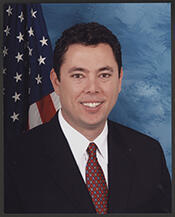
Here you will find contact information for Representative Jason Chaffetz, including email address, phone number, and mailing address.
| Name | Jason Chaffetz |
| Position | Representative |
| State | Utah |
| District | 3 |
| Party | Republican |
| Status | Former Representative |
| Term Start | January 6, 2009 |
| Term End | June 30, 2017 |
| Terms Served | 5 |
| Born | March 26, 1967 |
| Gender | Male |
| Bioguide ID | C001076 |
About Representative Jason Chaffetz
Jason Edwin Chaffetz (born March 26, 1967) is an American retired politician, commentator, and author who represented Utah’s 3rd congressional district in the U.S. House of Representatives from January 3, 2009, until his resignation on June 30, 2017. A member of the Republican Party, he served five terms in Congress and rose to national prominence as chairman of the House Committee on Oversight and Government Reform from 2015 to 2017. His tenure in Congress coincided with a significant period in American political history, during which he became known for high-profile investigations, particularly involving the Obama administration and former Secretary of State Hillary Clinton.
Chaffetz was born in Los Gatos, California, and raised in California, Arizona, and Colorado. His father, John A. Chaffetz (1935–2012), was a businessman who in the late 1970s became involved with the ownership group of the Los Angeles Aztecs, a professional soccer team. He later authored “Gay Reality: The Team Guido Story,” about a gay couple who competed on the television show The Amazing Race. His mother, Margaret “Peggy” A. Wood (1942–1995), was a Christian Scientist who later joined the Church of Jesus Christ of Latter-day Saints and operated a photography business. Chaffetz’s younger brother, Alex, runs a media consulting firm based in Colorado. On his father’s side, Chaffetz is of Jewish heritage. His paternal grandfather, Maxwell (Max) Chaffetz (1909–1986), the son of Russian immigrants, served as a Special Agent in the Federal Bureau of Investigation. Max Chaffetz was the brother of Hammond E. Chaffetz, a pioneering federal antitrust prosecutor whose work in United States v. Socony-Vacuum Oil Co. helped shape modern antitrust law before he became a leading figure at the law firm Kirkland & Ellis. Jason Chaffetz is also a second cousin of Washington, D.C., real estate developer and philanthropist Morris Cafritz.
Chaffetz’s family history intersected with national politics even before his own career. His father’s first wife, Kitty Dickson, later married Michael Dukakis, who became governor of Massachusetts and the 1988 Democratic presidential nominee. That marriage produced one son, John, Jason Chaffetz’s half-brother, who was adopted at age five by Dukakis and later chose to take the Dukakis surname at age 18. While in college, Jason Chaffetz served as a Utah co-chairman of Michael Dukakis’s 1988 presidential campaign, reflecting his early association with Democratic politics. Reports in 2009 and 2015 noted that Chaffetz remained close to his half-brother and to the Dukakis family. Raised Jewish, he later underwent a religious conversion and joined the Church of Jesus Christ of Latter-day Saints during his college years, a shift that paralleled his eventual move toward conservative Republican politics.
Chaffetz attended high school in California before graduating from Middle Park High School in Granby, Colorado. He then enrolled at Brigham Young University (BYU) in Provo, Utah, on an athletic scholarship and became the starting placekicker for the BYU Cougars football team in 1988 and 1989. Over two seasons, he converted 16 of 25 field goal attempts (64 percent) and 89 of 94 point-after-touchdown attempts (95 percent). As of 2011, he still held several BYU individual records, including most extra points attempted in a game, most extra points made in a game, and most consecutive extra points made in a game. He graduated from the BYU College of Fine Arts and Communications in 1989 with a Bachelor of Arts degree in communications. In 1989 he met Julie Johnson at a wedding in Arizona, when he was a senior and she was a junior at BYU; the couple married in February 1991. After college, Chaffetz worked for about a decade in public relations for Nu Skin International, a Utah-based multi-level marketing company.
Chaffetz’s political alignment shifted in the early 1990s. Although he had worked on the Dukakis presidential campaign, he became increasingly conservative and formally joined the Republican Party after meeting former President Ronald Reagan in 1990, when Reagan visited Nu Skin as a motivational speaker. In 2003, he applied to become an agent with the United States Secret Service but was not selected, being informed that “better qualified applicants existed.” This episode later became notable when, in 2015, the Secret Service Inspector General found that agency personnel had illegally accessed Chaffetz’s old application file after he began leading congressional investigations into the Secret Service. In Utah, Chaffetz built his political résumé by working on state and local issues. He served as campaign manager for Jon Huntsman Jr.’s successful 2004 gubernatorial campaign. When Huntsman took office in January 2005, Chaffetz became his chief of staff. He also founded Maxtera Utah Inc., a corporate communications and marketing firm, in 2005, and in 2006 Huntsman appointed him as a trustee of Utah Valley State College (now Utah Valley University). Chaffetz additionally served on the Highland City planning commission and as chairman for the Utah National Guard adjutant general review, roles that expanded his profile in Utah public affairs.
On January 1, 2007, before the 110th Congress was sworn in, Chaffetz announced that he was “testing the waters” for a congressional campaign in Utah’s 3rd District, challenging six-term Republican incumbent Chris Cannon. He formally entered the race for the Republican nomination on October 1, 2007, the same day that David Leavitt, brother of former Utah governor and Bush administration cabinet member Mike Leavitt, announced his own challenge to Cannon. Early polling in March 2008 showed Chaffetz with only 4 percent support among likely delegates. Running a lean, unconventional campaign, he pledged to have no paid staff, no campaign office, no free meals for delegates, no campaign debt, and no polling, and he committed to spending only about $70 to $80 per delegate. He argued that his frugal approach reflected how he would serve in office. Although Cannon was considered one of the most conservative members of the House, Chaffetz ran to his right, accusing Cannon of failing to uphold core conservative principles of fiscal discipline, limited government, accountability, and strong national defense. He emphasized tougher measures on immigration and the removal of incentives for illegal immigration, a theme that remained central to his campaign. At the Utah Republican state convention on May 10, 2008, Chaffetz won 59 percent of the 3rd District delegates to Cannon’s 41 percent, narrowly missing the 60 percent threshold needed to secure the nomination outright. Leavitt finished a distant third and endorsed Cannon. Despite being heavily outspent and facing an incumbent backed by President George W. Bush, Senators Orrin Hatch and Bob Bennett, and much of the state Republican establishment, Chaffetz defeated Cannon in the June 24, 2008, primary by a margin of 60 percent to 40 percent, an upset that drew national attention and concern among other Republican incumbents.
In the November 2008 general election, Chaffetz faced Democratic nominee Bennion Spencer and Constitution Party candidate Jim Noorlander. He campaigned on a pledge to refuse congressional earmarks, calling them “a cancer within the system” and vowing not to request them until the process was reformed. He won the election with 66 percent of the vote. Given that Utah’s 3rd District was one of the most Republican-leaning districts in the nation, with a Cook Partisan Voting Index of R+26 in 2008, his victory in the Republican primary had effectively secured his seat. Chaffetz began his congressional service on January 3, 2009, and soon became known for his personal frugality, announcing that he would sleep on a cot in his Washington, D.C., office rather than rent an apartment, a choice he said would save his family about $1,500 per month and symbolize his concern over the federal government’s mounting debt, which he frequently noted had reached $10 trillion. His family continued to reside in Alpine, Utah. Early in his first term, he appeared on “The Colbert Report” on January 6, 2009, in the “Better Know a District” segment, where he engaged in a humorous leg-wrestling match with host Stephen Colbert.
During his five terms in the House of Representatives, from 2009 to 2017, Chaffetz served on several key committees and caucuses and contributed actively to the legislative and oversight processes. He was a member of the Committee on the Judiciary, where he served on the Subcommittee on Intellectual Property, Competition, and the Internet and the Subcommittee on Crime, Terrorism, and Homeland Security. He also served on the Committee on Oversight and Government Reform, chairing the Subcommittee on National Security, Homeland Defense and Foreign Operations and serving on the Subcommittee on Federal Workforce, U.S. Postal Service and Labor Policy and the Subcommittee on Technology, Information Policy, Intergovernmental Relations and Procurement Reform. In November 2014, after three terms in Congress, he won a four-way race to become full chairman of the House Committee on Oversight and Government Reform, making him only the fifth member in 89 years to attain a full committee chairmanship after just three terms. He stated that as chairman he intended to focus on reform as well as investigation, telling Politico that the committee needed to “triangulate the problem” and move beyond merely highlighting issues to actually fixing them. Chaffetz was also a member of the House Baltic Caucus, the Congressional Arts Caucus, and the Congressional Constitution Caucus.
Chaffetz consistently secured reelection by wide margins. In 2010 he won a second term with about 72 percent of the vote, defeating Democratic nominee Karen Hyer; The Salt Lake Tribune endorsed him, noting that he had “delivered as advertised” for the district. In 2012 he was reelected to a third term with approximately 76 percent of the vote, defeating Democratic nominee Soren Simonsen in what was described as a low-key race in which he was heavily favored. During the 2012 presidential primary season, he served as a representative of Mitt Romney’s campaign, shadowing rival Newt Gingrich on the trail and offering rapid-response rebuttals to reporters after Gingrich’s events. That same year, he declined to endorse Republican congressional candidate Mia Love in Utah’s newly created 4th District, even as she received national support from Romney, House Budget Committee Chairman and vice-presidential nominee Paul Ryan, Speaker John Boehner, and House Majority Leader Eric Cantor. In 2014 Chaffetz won a fourth term with about 72 percent of the vote, defeating Democratic nominee Brian Wonnacott, and in 2016 he secured a fifth term with roughly 74 percent of the vote, defeating Democratic nominee Stephen Tryon, a former executive at Overstock.com.
As Oversight Committee chairman, Chaffetz became a prominent national figure, particularly for his investigations into the Obama administration and Hillary Clinton. He played a leading role in inquiries into the 2012 Benghazi attack and into Clinton’s use of a private email server while serving as Secretary of State, actions that drew strong support from many Republicans and intense criticism from Democrats. In 2015 he came to particular prominence for his extensive investigations into Clinton, frequently appearing in national media to discuss the committee’s work. During the 2016 presidential campaign, Chaffetz initially endorsed Republican nominee Donald Trump but rescinded his endorsement in early October 2016 following the release of the Access Hollywood tape. About three weeks later, he stated that he still intended to vote for Trump, distinguishing between endorsement and support at the ballot box. After the 2016 election, having spent years investigating Clinton and the Obama administration, Chaffetz drew criticism from Democrats and some watchdog groups for his reluctance to pursue investigations into potential conflicts of interest involving President Trump, members of Trump’s 2016 campaign, and officials in the new administration.
In early 2017, Chaffetz faced growing public scrutiny and vocal opposition at home. In February 2017 he held a town hall meeting in Utah that drew a large and often hostile crowd, with attendees questioning his positions on health care, public lands, and his willingness to hold President Trump accountable. The event was marked by protests and jeering. Chaffetz later suggested that many in the crowd were paid protesters and indicated he might avoid providing a venue “for these radicals to further intimidate,” comments that were not substantiated and drew further criticism. Some attendees responded by sending him mock “invoices” for their supposed paid participation. On April 19, 2017, Chaffetz announced that he would not seek reelection in 2018, and shortly thereafter he declared that he would resign from Congress before the end of his term. He left office on June 30, 2017, six months into his fifth term, concluding a congressional career that had spanned from January 3, 2009, through mid-2017.
Following his resignation from Congress, Chaffetz transitioned into media and policy commentary. He became a contributor to Fox News, appearing regularly as a political analyst and commentator on the network’s programs. He also pursued work as an author, writing about politics, government accountability, and public policy. In 2021 he joined the Government Accountability Institute, a research organization focused on government corruption and transparency issues. From his early involvement in Democratic politics to his later role as a conservative Republican lawmaker and media figure, Chaffetz’s career has reflected both the ideological shifts and the partisan intensity of American politics in the late twentieth and early twenty-first centuries, while his service in Congress marked a period of active participation in the legislative and oversight processes on behalf of his Utah constituents.