Representative Jay Dickey
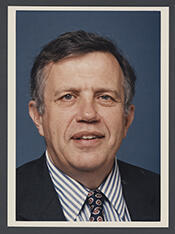
Here you will find contact information for Representative Jay Dickey, including email address, phone number, and mailing address.
| Name | Jay Dickey |
| Position | Representative |
| State | Arkansas |
| District | 4 |
| Party | Republican |
| Status | Former Representative |
| Term Start | January 5, 1993 |
| Term End | January 3, 2001 |
| Terms Served | 4 |
| Born | December 14, 1939 |
| Gender | Male |
| Bioguide ID | D000312 |
About Representative Jay Dickey
Jay Dickey is no longer in office and left on January 3, 2001. The biography below describes their time in office.
Jay Woodson Dickey Jr. (December 14, 1939 – April 20, 2017) was an American lawyer, businessman, and politician who served as a Republican Representative from Arkansas in the United States Congress from 1993 to 2001. A member of the Republican Party, he represented Arkansas’s 4th congressional district for four consecutive terms, becoming the first Republican to hold that seat. During his tenure, he contributed to the legislative process in a period of significant political change in the United States and became nationally known for sponsoring two major federal funding restrictions, the Dickey Amendment and the Dickey–Wicker Amendment.
Dickey was born in Pine Bluff, Arkansas, on December 14, 1939. He grew up in Pine Bluff and graduated from Pine Bluff High School in 1957. He attended Hendrix College in Conway, Arkansas, before transferring to the University of Arkansas at Fayetteville, where he earned a Bachelor of Arts degree in 1961. He then enrolled at the University of Arkansas School of Law, receiving his Juris Doctor in 1963. His education in Arkansas’s public and private institutions grounded him in the legal and political culture of the state he would later represent in Congress.
After completing his legal education, Dickey entered private practice as an attorney in Arkansas. He built a career in law and local public service, serving as city attorney of Pine Bluff from 1968 to 1970. In that role, he advised the city on legal matters and gained experience in municipal governance and public policy. His legal reputation in the state led to further responsibilities, and in 1988 then-Governor Bill Clinton appointed him as a special justice for a case before the Arkansas Supreme Court, giving him an opportunity to participate directly in the work of the state’s highest court.
Dickey’s congressional career began with the 1992 election cycle. On November 3, 1992, the same day Arkansas Governor Bill Clinton was elected President of the United States, Dickey won election to the U.S. House of Representatives from Arkansas’s 4th congressional district. He defeated Arkansas Secretary of State William J. “Bill” McCuen, who was described at the time as a scandal-plagued Democratic nominee. Dickey’s victory made him the first Republican ever to hold that House seat, a notable development in a region long dominated by Democrats. He was re-elected three times, serving in the 103rd, 104th, 105th, and 106th Congresses from January 3, 1993, to January 3, 2001. As a member of the House of Representatives, he participated in the democratic process and represented the interests of his constituents during a significant period in American political history.
In Congress, Dickey served on the powerful U.S. House Committee on Appropriations, where he sat on five of its subcommittees: Agriculture; National Security; Energy and Water; Transportation; and Labor, Health and Human Services, and Education. From these posts he was involved in shaping federal spending priorities across a wide range of domestic and defense programs. A staunch conservative and outspoken advocate of Second Amendment rights, he became particularly prominent in debates over federal funding for scientific and medical research. In 1995, he sponsored what became known as the Dickey–Wicker Amendment, which prohibits federal funds from being spent on research that involves the destruction of a human embryo, a measure that has had lasting effects on federal policy regarding embryonic stem cell research. In 1996, responding to what he and allies described as a pro–gun control bias in firearm injury research at the National Center for Injury Prevention and Control within the Centers for Disease Control and Prevention, he authored the Dickey Amendment. This provision blocked the CDC from using injury-prevention funds to conduct research that could be seen as advocating or promoting gun control and was accompanied by the elimination of $2.6 million from the CDC budget, an amount reflecting what the agency had previously spent on gun-related research.
Over time, Dickey’s outspoken and controversial conservative positions contributed to a decline in his popularity in a district that was more moderate overall. In the 2000 election, he faced Democratic challenger Mike Ross in a closely contested race. National figures from both parties intervened: House Speaker Dennis Hastert of Illinois campaigned in the district in an effort to help Dickey retain the seat, while President Bill Clinton directed substantial resources to support Ross. Dickey ultimately lost his bid for a fifth term, and Ross succeeded him in Congress. Seeking to regain his former seat, Dickey ran again against Ross in 2002, but he was defeated by a margin of 60 to 40 percent, ending his efforts to return to the House.
After leaving Congress, Dickey established and operated JD Consulting, a federal government lobbying and consulting firm. Through this enterprise he represented clients’ interests before the federal government in areas including children’s health care, navigation and water issues, tax matters, homeland security, and transportation and road projects. In the years following his departure from office, Dickey reassessed one of the most consequential aspects of his legislative legacy. After the mass shooting in Aurora, Colorado, in 2012, he publicly reversed his earlier stance on restricting federal gun violence research. He stated that he regretted having become “the NRA’s point person in Congress” in efforts to suppress what he came to view as valid and valuable scientific work, and he called for renewed, robust research into gun violence as a public health issue.
Jay Woodson Dickey Jr. died on April 20, 2017, after a long battle with Parkinson’s disease. His career in public life, spanning local legal service, a notable role in Arkansas politics, and four terms in the U.S. House of Representatives, left a complex legacy marked by influential amendments on federal research funding and an evolving perspective on the relationship between science, public health, and constitutional rights.
Frequently asked questions
Is Jay Dickey still in office?
No. Jay Dickey is a former U.S. representative from Arkansas. The office contact details on this page may no longer reach Jay Dickey.
What party was Jay Dickey in?
Jay Dickey served as a Republican U.S. representative from Arkansas.