Representative Jeb Hensarling
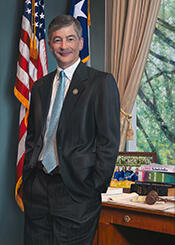
Here you will find contact information for Representative Jeb Hensarling, including email address, phone number, and mailing address.
| Name | Jeb Hensarling |
| Position | Representative |
| State | Texas |
| District | 5 |
| Party | Republican |
| Status | Former Representative |
| Term Start | January 7, 2003 |
| Term End | January 3, 2019 |
| Terms Served | 8 |
| Born | May 29, 1957 |
| Gender | Male |
| Bioguide ID | H001036 |
About Representative Jeb Hensarling
Thomas Jeb Hensarling (born May 29, 1957) is an American politician and attorney who served as the U.S. representative for Texas’s 5th congressional district from January 3, 2003, to January 3, 2019. A member of the Republican Party, he served eight consecutive terms in the House of Representatives, during which he became one of his party’s leading voices on fiscal and financial policy. Over the course of his congressional career, he chaired the House Republican Conference from 2011 to 2013 and the House Committee on Financial Services from 2013 until 2019. The Los Angeles Times described Hensarling as “a fervent believer in free market ideology” and “a pivotal player in the GOP effort to reduce financial regulation in the Trump era,” while The Wall Street Journal called him “a driver of economic policy in the House.”
Hensarling was born in Stephenville, the seat of Erath County in central Texas, and was raised on the family farm in College Station, Texas. He was born into a family with deep Texas roots and grew up in a rural environment that emphasized personal responsibility and self-reliance. He had two siblings: an older brother, James Andrew Hensarling (born 1954, now deceased), and a sister, Carolyn Hensarling Arizpe. He was raised in the Episcopal faith and remains an Episcopalian. His father, who also attended Texas A&M University, was an important influence on his educational and professional aspirations.
Following in his father’s footsteps, Hensarling attended Texas A&M University, where he earned a bachelor’s degree in economics in 1979. His study of economics would later underpin his approach to fiscal policy and free-market advocacy in Congress. He continued his education at the University of Texas School of Law in Austin, receiving his Juris Doctor in 1982. His legal training, combined with his economics background, prepared him for a career that would span law, business, and politics, with a particular focus on financial and regulatory issues.
Before his election to Congress, Hensarling built a career in both politics and the private sector. From 1985 to 1989, he served as state director for U.S. Senator Phil Gramm of Texas, a prominent fiscal conservative who became Hensarling’s political mentor. He managed Gramm’s 1990 re-election campaign and, from 1991 to 1993, served as executive director of the National Republican Senatorial Committee, helping to coordinate Republican Senate campaigns nationwide. In the private sector, Hensarling held vice president positions at two companies before becoming owner of San Jacinto Ventures in 1996. He later served as vice president of Green Mountain Energy from 1999 to 2001 and became chief executive officer of Family Support Assurance Corporation in 2001. This combination of political and business experience informed his later emphasis on market-based solutions and limited government.
Hensarling was first elected to Congress in 2002, winning the open seat in Texas’s 5th congressional district by defeating Democrat Ron Chapman with 58 percent of the vote. He was reelected in 2004 with 64 percent of the vote over Democratic challenger Bill Bernstein. In 2006, he secured 62 percent of the vote against Democrat Charlie Thompson, who received 36 percent. He was reelected in 2008 with 84 percent of the vote against Libertarian Ken Ashby, who received 16 percent. In 2010, he won reelection with 71 percent of the vote; in 2012, with 64 percent; in 2014, with 85 percent; and in 2016, again defeating Ken Ashby with 80 percent of the vote to Ashby’s 20 percent. Throughout his tenure, he maintained a strongly conservative voting record, reflected in a 97 percent lifetime rating from the American Conservative Union, and he consistently presented himself as a fiscal hawk and advocate of limited government.
During his early years in Congress, Hensarling quickly emerged as a leading budget and spending critic. A December 31, 2005, article in National Review profiled him as the nation’s “budget nanny,” stating that he had effectively replaced his mentor Phil Gramm in that role. His legislative proposals sought to require Congress to determine how much it could afford to spend and then prioritize within those limits. He co-authored a proposed constitutional amendment known as the “Spending Limit Amendment,” which would have prohibited federal spending from growing faster than the economy. He campaigned for a one-year moratorium on all congressional earmarks, arguing that the process needed fundamental reform. In 2007, he introduced the “Taxpayer Bill of Rights” and co-authored the “Taxpayer Choice Act,” both aimed at restraining federal spending and offering alternatives to the existing tax and budget structure. In January 2008, he co-authored the Economic Growth Act of 2008, and in May of that year he urged House Republican leaders to convene a special session to debate a new policy platform and sharpen the party’s message ahead of the 2008 elections.
Hensarling’s prominence increased during the financial crisis of 2008. In September 2008, he led House Republican efforts to oppose Treasury Secretary Henry Paulson and Federal Reserve Chairman Ben Bernanke’s proposed $700 billion financial bailout under the Emergency Economic Stabilization Act. He urged caution and voted against the initial bailout bill, warning that no one knew whether the plan would work or the full extent of taxpayer exposure. He argued that the legislation risked undermining personal responsibility, rewarding bad behavior, and altering the traditional role of the federal government in the free-market economy, asking, “How can we have capitalism on the way up and socialism on the way down?” After the House initially rejected the bill on September 29, 2008, the Dow Jones Industrial Average fell 777 points in a single day, its largest one-day point drop at the time. The House later passed a revised version on October 3. On November 19, 2008, House Minority Leader John Boehner appointed Hensarling to the five-member Congressional Oversight Panel created to oversee implementation of the Troubled Asset Relief Program (TARP). He was the lone dissenter on the panel’s January 9, 2009, “Accountability for the Troubled Asset Relief Program” report.
Within the House Republican Conference, Hensarling steadily rose in leadership. After the 2006 congressional elections, he was elected chairman of the Republican Study Committee, the principal caucus of conservative House Republicans, defeating Representative Todd Tiahrt. In 2008, he was mentioned as a possible candidate for Republican Conference Chairman, then the number three leadership position, but instead endorsed his ally and former Republican Study Committee chairman Mike Pence. Following the Republican victory in the 2010 midterm elections and Pence’s decision to run for governor of Indiana, Hensarling was elected chairman of the House Republican Conference, becoming the fourth-ranking Republican in the House and serving in that role from 2011 to 2013. During this period, he also served on the House Committee on the Budget and became a key figure in internal GOP debates over spending and entitlement reform.
Hensarling played a central role in several high-profile fiscal and budgetary bodies. He served on the Congressional Oversight Panel for TARP, the National Commission on Fiscal Responsibility and Reform (often called the Simpson–Bowles Commission), and was co-chair of the Joint Select Committee on Deficit Reduction, commonly known as the “super committee,” which was created in 2011 to identify long-term deficit reduction measures. He also served on the Joint Select Committee on Deficit Reduction in his capacity as co-chair. On January 29, 2010, during President Barack Obama’s televised meeting with House Republicans, Hensarling publicly challenged the administration’s budget policies, asserting that the Obama White House was increasing the national deficit at a monthly rate comparable to the previous administration’s annual increases. President Obama rebutted the claim as factually incorrect, noting that the projected deficit when he took office was already approximately $1.2–1.3 trillion, as estimated by the Congressional Budget Office in January 2009.
After Republicans retained control of the House in the 2012 elections, Hensarling stepped down as Conference Chairman to assume the chairmanship of the House Committee on Financial Services, succeeding Representative Spencer Bachus of Alabama. As chairman, he also led the full Committee on Financial Services and was involved with its Subcommittee on Capital Markets, Insurance, and Government-Sponsored Enterprises and the Subcommittee on Financial Institutions and Consumer Credit. During his three terms as chairman, he shepherded more than 80 bills into law. These included the Economic Growth, Regulatory Relief, and Consumer Protection Act, which revised numerous provisions of the Dodd–Frank Wall Street Reform and Consumer Protection Act; the bipartisan “JOBS 2.0” legislation, which facilitated capital formation for startups and early-growth companies; and the Foreign Investment Risk Review Modernization Act of 2018, which significantly reformed the Committee on Foreign Investment in the United States (CFIUS) to strengthen national security review of foreign investments. He was a vocal opponent of Dodd–Frank and a leading critic of the Consumer Financial Protection Bureau (CFPB). According to the nonprofit Americans for Financial Reform, he received $210,500 from the payday lending industry, directly and through his political action committee, during the 2013–2014 election cycle, and he maintained close ties to Wall Street, receiving campaign contributions from every major Wall Street bank as well as various payday lenders.
Hensarling’s policy positions frequently reflected his commitment to risk-based pricing and market discipline. He opposed the Homeowner Flood Insurance Affordability Act of 2013, which sought to delay some reforms to the National Flood Insurance Program, arguing that it would “postpone actuarially sound rates for perhaps a generation” and undermine key elements of risk-based pricing necessary to transition to market competition. He criticized the National Flood Insurance Program for regularly underestimating flood risk. His broader legislative agenda emphasized limiting federal intervention in financial markets and promoting private-sector solutions. After the election of Donald Trump as president in 2016, Hensarling met with him at Trump Tower and was considered a potential nominee for Secretary of the Treasury, though the position ultimately went to Steven Mnuchin. While he supported many of the administration’s deregulatory efforts, he later became one of the earliest and most vocal Republican critics of the Trump administration’s trade policies, arguing that tariffs and protectionism were inconsistent with free-market principles.
Throughout his congressional service, which spanned from 2003 to 2019, Hensarling represented a largely conservative district in Texas and participated actively in the legislative process during a period marked by the wars in Iraq and Afghanistan, the 2008 financial crisis, the Great Recession, the rise of the Tea Party movement, and the early years of the Trump administration. He was frequently mentioned in the press and among colleagues as a potential future leader of the House Republican Conference beyond his existing roles, and prior to House Majority Leader Eric Cantor’s primary defeat in 2014, Hensarling was sometimes cited as a possible rival to Cantor to succeed John Boehner as leader of the House Republicans. On October 31, 2017, he announced that he would not seek reelection in 2018, bringing his eight-term House career to a close at the end of the 115th Congress.
After leaving Congress in January 2019, Hensarling moved into the private financial sector. In 2019, he announced that he was joining UBS Group AG as executive vice chairman for the Americas region, a senior advisory role that drew on his extensive experience in financial regulation and capital markets. He remained with UBS until 2023, when he stepped down from that position. Hensarling continues to be associated with conservative economic thought and free-market advocacy, and his long tenure in Congress, particularly as chairman of the House Financial Services Committee, has left a lasting imprint on debates over financial regulation, federal spending, and the role of government in the American economy.