Representative Jehu Baker
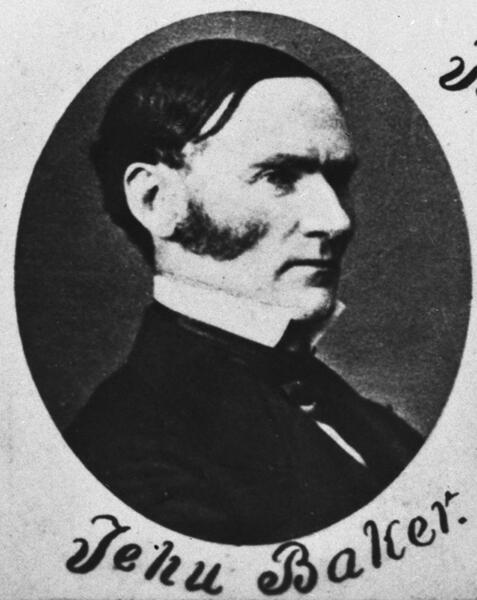
Here you will find contact information for Representative Jehu Baker, including email address, phone number, and mailing address.
| Name | Jehu Baker |
| Position | Representative |
| State | Illinois |
| District | 21 |
| Party | Democratic |
| Status | Former Representative |
| Term Start | December 4, 1865 |
| Term End | March 3, 1899 |
| Terms Served | 4 |
| Born | November 4, 1822 |
| Gender | Male |
| Bioguide ID | B000066 |
About Representative Jehu Baker
Jehu Baker (November 4, 1822 – March 1, 1903) was a United States Representative from Illinois whose congressional service, spanning four nonconsecutive terms between 1865 and 1899, coincided with major transformations in American political and social life. Over the course of his career he served in the House of Representatives as both a Republican and a Democrat, contributing to the legislative process during Reconstruction, the Gilded Age, and the late nineteenth century, and representing the interests of his Illinois constituents during these pivotal decades.
Baker was born near Lexington, Fayette County, Kentucky, on November 4, 1822. In 1829 he moved with his father to Lebanon, Illinois, then a developing community in St. Clair County. He was educated in the common schools of the area and pursued further studies at McKendree University in Lebanon, one of the oldest institutions of higher learning in the state. His early education in Illinois, combined with his later legal training, prepared him for a professional life closely tied to the civic and political affairs of his adopted state.
After completing his studies, Baker read law and was admitted to the bar in 1846. He established a private law practice in Belleville, Illinois, which would remain his professional and personal base for the rest of his life. His legal abilities and growing local reputation led to his appointment as master in chancery of St. Clair County, a judicial and administrative position he held from 1861 to 1865. In that capacity, he dealt with equity matters and court-ordered proceedings during the tumultuous years of the Civil War, further enhancing his standing in the community and positioning him for entry into national politics.
Baker was first elected to Congress as a Republican, winning a seat in the Thirty-ninth Congress and defeating incumbent William R. Morrison. He served in the Thirty-ninth and Fortieth Congresses from March 4, 1865, to March 3, 1869, a period that encompassed the immediate aftermath of the Civil War and the early years of Reconstruction. During his initial tenure he held significant committee responsibilities, serving as chairman of the Committee on Expenditures in the Post Office Department in the Thirty-ninth Congress and as chairman of the Committee on Education and Labor in the Fortieth Congress. Through these assignments he participated in oversight of federal expenditures and in deliberations on issues affecting public education and the labor force at a time of national readjustment.
After leaving Congress in 1869, Baker remained active in Republican politics and continued his legal practice. In the presidential election of 1876 he campaigned in Illinois on behalf of Republican nominee Rutherford B. Hayes. Following Hayes’s contested victory, Baker was rewarded for his political support with a diplomatic appointment. He was named United States Minister to Venezuela, serving two separate terms, first from 1878 to 1881 and again from 1882 to 1885. In this role he represented American interests in Caracas during a period of shifting political conditions in Venezuela and expanding U.S. commercial and diplomatic engagement in Latin America.
Returning to Illinois, Baker reentered electoral politics and was again elected as a Republican to the Fiftieth Congress, serving from March 4, 1887, to March 3, 1889. His comeback underscored his continued influence in Illinois Republican circles and his enduring appeal to voters in his district. He sought reelection in 1888 to the Fifty-first Congress but was unsuccessful, after which he resumed the practice of law in Belleville. Despite this setback, he remained a figure of note in state and local politics.
In the 1890s Baker changed his party affiliation and joined the Democratic Party, reflecting the fluid and often regionally driven partisan alignments of the era. As a Democrat he was elected to the Fifty-fifth Congress and served from March 4, 1897, to March 3, 1899. This final term in the House extended his total congressional service to four terms over more than three decades, from 1865 to 1899. He declined to be a candidate for renomination in 1898 to the Fifty-sixth Congress, choosing instead to withdraw from national political life and return once more to his legal practice in Belleville.
In his later years Baker continued to reside in Belleville, where he remained engaged in professional and community affairs until shortly before his death. He died in Belleville, St. Clair County, Illinois, on March 1, 1903. He was interred in Walnut Hill Cemetery in Belleville, closing a long career that had encompassed legal practice, judicial service, diplomatic representation, and multiple periods in the United States House of Representatives during some of the most consequential decades of the nineteenth century.