Representative Jennifer Dunn
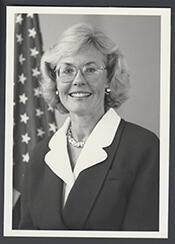
Here you will find contact information for Representative Jennifer Dunn, including email address, phone number, and mailing address.
| Name | Jennifer Dunn |
| Position | Representative |
| State | Washington |
| District | 8 |
| Party | Republican |
| Status | Former Representative |
| Term Start | January 5, 1993 |
| Term End | January 3, 2005 |
| Terms Served | 6 |
| Born | July 29, 1941 |
| Gender | Female |
| Bioguide ID | D000549 |
About Representative Jennifer Dunn
Jennifer Jill Dunn (née Blackburn; July 29, 1941 – September 5, 2007) was an American politician and engineer who served six terms as a Republican member of the United States House of Representatives from 1993 to 2005, representing Washington’s 8th congressional district. A member of the Republican Party, she contributed to the legislative process during six terms in office and participated actively in the democratic process on behalf of her constituents during a significant period in American history.
Dunn was born in Seattle, Washington, and grew up in the nearby city of Bellevue. She graduated from Bellevue High School in 1959. She attended the University of Washington, where she was a member of the Gamma Phi Beta sorority, and later transferred to Stanford University, from which she earned a Bachelor of Arts degree. After completing her education, Dunn worked as a systems engineer, a professional background that informed her later interest in technology and economic policy. She was also a distant cousin of Slade Gorton, who served as a United States Senator and Representative from Washington.
Dunn’s early political career was rooted in state and party leadership. She rose to prominence within the Washington State Republican Party, serving as its chair from 1981 to 1992. In that role, she helped shape the party’s strategy and candidate recruitment during a period of significant political realignment. Her growing national profile led to appointments as a delegate to the United Nations Commission on the Status of Women in 1984 and again in 1990, reflecting her engagement with issues affecting women and her emerging influence within the Republican Party at both the state and national levels.
In 1992, Dunn ran for an open seat in the United States House of Representatives from Washington’s newly created 8th congressional district. She won the general election with 60 percent of the vote and took office on January 3, 1993. At the time of her first term, she was Washington’s only Republican representative in the House, a distinction she held until the Republican Revolution of 1994, when Republicans captured all but two of Washington’s nine House seats. Over the course of her service from 1993 to 2005, Dunn became one of the most prominent Republican figures in the Pacific Northwest. In 1998, she made history by becoming the first woman ever to run for the position of House Majority Leader, underscoring her stature within the House Republican Conference.
During her congressional tenure, Dunn held several influential committee and leadership assignments. She served as vice-chair of the Select Committee on Homeland Security, a role that placed her at the center of legislative efforts to reorganize and strengthen national security structures in the wake of the September 11, 2001, terrorist attacks. She also served on the powerful House Ways and Means Committee, which oversees tax, trade, and entitlement policy, and on the Joint Economic Committee, where she participated in broader economic policy discussions. Reflecting the foreign policy debates of the early 2000s, Dunn voted on October 10, 2002, in favor of authorizing the use of military force in Iraq. Beyond Congress, she was active in national Republican politics, including service on the presidential election exploratory committee for then–Texas Governor George W. Bush in 2000.
In 2004, Dunn announced that she would retire from Congress and chose not to seek re-election. Her twelve-year tenure in the House concluded on January 3, 2005, and her 8th district seat was subsequently won by King County Sheriff Dave Reichert. After leaving Congress, Dunn remained engaged in public policy and political advocacy. She co-chaired the Information Technology and Innovation Foundation with former Representative Calvin Dooley, reflecting her ongoing interest in technology, innovation, and economic competitiveness. She also served as co-chair of the “Women for Mitt” campaign organization supporting presidential candidate Mitt Romney, a role she held at the time of her death; she was later succeeded in that position by U.S. Representative Kay Granger of Fort Worth, Texas.
Dunn’s personal life included a family with two children, among them Reagan Dunn, an attorney and politician who has served as a member of the King County Council since 2005, continuing the family’s involvement in public service. On September 5, 2007, Jennifer Dunn collapsed and died of a pulmonary embolism at her apartment in Alexandria, Virginia. Her death marked the end of a career that had spanned engineering, party leadership, and national legislative service. A memorial service honoring her life and public contributions was held at St. James Cathedral in Seattle, reflecting her enduring ties to the state and communities she represented.