Resident Commissioner Jenniffer González-Colón
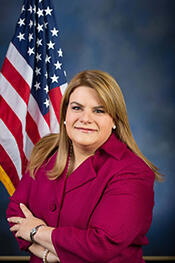
Here you will find contact information for Resident Commissioner Jenniffer González-Colón, including email address, phone number, and mailing address.
| Name | Jenniffer González-Colón |
| Position | Resident Commissioner |
| State | Puerto Rico |
| District | At-Large |
| Party | Republican |
| Status | Former Representative |
| Term Start | January 3, 2017 |
| Term End | January 3, 2025 |
| Terms Served | 4 |
| Born | August 5, 1976 |
| Gender | Female |
| Bioguide ID | G000582 |
About Resident Commissioner Jenniffer González-Colón
Jenniffer González Colón (born August 5, 1976), also colloquially known as JGo, is a Puerto Rican politician who has served as governor of Puerto Rico since January 2, 2025, and previously served as the 20th resident commissioner of Puerto Rico from 2017 to 2025. A member of the New Progressive Party of Puerto Rico (PNP) and the Republican Party of the United States, she is a pro-statehood, small-government, pro-business conservative. She is the second elected and third serving female governor of Puerto Rico, after Sila María Calderón and Wanda Vázquez Garced, and is the first and only woman to be elected or to serve as resident commissioner. As resident commissioner, she served as a Representative from Puerto Rico in the United States Congress from 2017 to 2025, completing three terms in office and participating actively in the legislative process on behalf of her constituents.
González Colón was born in San Juan, Puerto Rico, on August 5, 1976. She grew up in the capital region and became involved in public affairs at a relatively young age, gravitating toward the pro-statehood New Progressive Party. Her early political formation took place against the backdrop of long-running debates over Puerto Rico’s political status and economic development, themes that would later define much of her public career. Details of her immediate family background and early schooling are less prominently documented, but her trajectory into student leadership and party activism reflected a sustained interest in governance and lawmaking.
González Colón pursued higher education in Puerto Rico, studying political science and law, which provided the foundation for her subsequent legislative and executive roles. Her legal training and familiarity with both Puerto Rican and U.S. constitutional frameworks proved central to her later work in the island’s legislature and in the U.S. Congress. Through her academic and early professional experiences, she developed a profile as a committed advocate of statehood for Puerto Rico and as a supporter of market-oriented economic policies.
González Colón’s political career began in the Legislative Assembly of Puerto Rico, where she rose rapidly through the ranks of the House of Representatives of Puerto Rico. Within that body she served as speaker of the House and later as minority leader, becoming one of the most prominent figures in the New Progressive Party. She also served as vice-chair of the PNP and chair of the Puerto Rico Republican Party, cementing her role as a key link between Puerto Rico’s pro-statehood movement and the national Republican Party. Her leadership positions in the island’s legislature and party structures gave her significant influence over public policy debates on issues such as economic development, public administration, and the island’s relationship with the federal government.
In 2016, González Colón was elected resident commissioner of Puerto Rico, taking office on January 3, 2017, as the 20th person to hold that post. As resident commissioner, she served as Puerto Rico’s non-voting delegate in the U.S. House of Representatives, where she was formally aligned with the Republican Conference. Her tenure in Congress, from 2017 to 2025, spanned the 115th through the 118th Congresses, a period marked by significant national and territorial challenges, including natural disasters affecting Puerto Rico and broader debates over federal fiscal oversight of the island. In the first session of the 115th United States Congress, she was ranked the 19th most bipartisan member of the House by the Bipartisan Index, a metric published by The Lugar Center and Georgetown University’s McCourt School of Public Policy to assess congressional bipartisanship. During her three terms, she contributed to the legislative process through committee work, sponsorship and co-sponsorship of bills, and advocacy for Puerto Rico’s interests, even though, under House rules, she could not vote on final passage of legislation on the House floor.
González Colón’s congressional record reflected a blend of conservative positions and selective support for civil rights measures. In 2019, she was one of three House Republicans, along with Brian Fitzpatrick and John Katko, to co-sponsor the Equality Act, which sought to prohibit discrimination on the basis of sexual orientation and gender identity. Although she could not cast a final vote for the bill due to the limitations of her office, the legislation passed the House of Representatives during the 116th Congress. She was also an outspoken supporter of U.S. national security and regional stability, writing in a letter to President Donald Trump that Venezuelan leader Nicolás Maduro “is an open threat to the United States, our national security and stability in the region.” After the January 6, 2021, attack on the United States Capitol, she condemned the violence and blamed President Trump for inciting the riot, yet she later aligned with the majority of House Republicans in supporting efforts to remove Liz Cheney from her position as chair of the House Republican Conference. Throughout her service, she was frequently described in national media, including The Hill’s “Latina Leaders to Watch,” as a prominent Latina Republican and a leading pro-statehood voice.
In 2023, González Colón announced that she would run for governor of Puerto Rico and challenge incumbent Pedro Pierluisi in the 2024 New Progressive Party primary. In a notable upset, she defeated Pierluisi in the primary with 54.57 percent of the vote, becoming the first woman to run as the PNP’s official candidate in a gubernatorial election. In the general election held on November 5, 2024, she won the office of governor of Puerto Rico with over 40 percent of the vote. Her election made her the second woman to be elected governor and the third woman to serve in that capacity on the island, further solidifying her place in the history of women in Puerto Rico and among Hispanic Americans in U.S.-related political institutions.
González Colón was sworn into office as governor of Puerto Rico on January 2, 2025. As governor, she continued to advance a pro-statehood agenda and to emphasize economic growth and conservative social policies. On July 17, 2025, she signed into law a bill barring hormone therapy or gender-affirming surgeries for transgender youth in Puerto Rico, a measure that drew significant attention and debate both on the island and in broader U.S. political discourse. Her tenure as governor has taken place within the continuing context of Puerto Rico’s fiscal challenges, recovery from natural disasters, and ongoing discussions over the island’s political status, with González Colón remaining a central figure in those debates as both a long-standing party leader and a historic trailblazer for women in Puerto Rican and U.S. politics.