Representative Jere Cooper
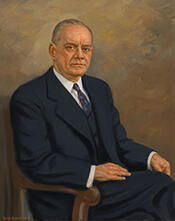
Here you will find contact information for Representative Jere Cooper, including email address, phone number, and mailing address.
| Name | Jere Cooper |
| Position | Representative |
| State | Tennessee |
| District | 8 |
| Party | Democratic |
| Status | Former Representative |
| Term Start | April 15, 1929 |
| Term End | January 3, 1959 |
| Terms Served | 15 |
| Born | July 20, 1893 |
| Gender | Male |
| Bioguide ID | C000755 |
About Representative Jere Cooper
Jere Cooper (July 20, 1893 – December 18, 1957) was a Democratic United States Representative from Tennessee who served in the U.S. House of Representatives from 1929 until his death in 1957. Over the course of fifteen consecutive terms, he represented his constituents during a significant period in American history and rose to key leadership positions, including chairmanship of the powerful House Committee on Ways and Means.
Cooper was born on a farm near Dyersburg, Dyer County, Tennessee, the son of Joseph W. and Viola May (Cooper) Cooper. He attended the local public schools before pursuing legal studies at the Cumberland School of Law in Lebanon, Tennessee, from which he graduated in 1914. The following year, in 1915, he was admitted to the bar and commenced the practice of law in Dyersburg. Deeply rooted in his home community, he built his early professional life in west Tennessee. In December 1930 he married Mary Rankley; the couple had one son, Leon Jere Cooper, who died in childhood.
With the entry of the United States into World War I in 1917, Cooper entered military service. He enlisted in the Second Tennessee Infantry, National Guard, and was commissioned a first lieutenant. When his unit was federalized, he was transferred with his company to Company K, 119th Infantry Regiment, Thirtieth Division, and served in France and Belgium. On July 9, 1918, he was promoted to captain and served as regimental adjutant, continuing in that role until his discharge from the Army on April 2, 1919. After returning from the war, he resumed the practice of law in Dyersburg, maintaining his legal career alongside growing involvement in public affairs.
Cooper’s early public service was at the local and state level. He served as a member of the Dyersburg city council and as city attorney from 1920 to 1928, playing a central role in municipal governance. In 1921 he was elected department commander of the American Legion of Tennessee, reflecting his prominence among veterans and his continuing engagement with issues affecting former servicemembers. These positions helped establish his reputation as a civic leader and provided a platform for his entry into national politics.
Elected as a Democrat to the Seventy-first Congress and to the fourteen succeeding Congresses, Cooper served in the U.S. House of Representatives from March 4, 1929, until his death on December 18, 1957. As a member of the House of Representatives from Tennessee, he participated in the democratic process and represented the interests of his constituents through the Great Depression, World War II, the early Cold War, and the beginnings of the modern civil rights era. Over nearly three decades in Congress, he contributed to the legislative process on a wide range of domestic and fiscal issues.
During his long congressional tenure, Cooper attained significant influence in matters of national finance and taxation. He served as chairman of the House Committee on Ways and Means in the Eighty-fourth and Eighty-fifth Congresses, overseeing key legislation related to federal revenue, social welfare programs, and economic policy. In addition, he served on the Joint Committee on Internal Revenue Taxation in the Eighty-fifth Congress, further solidifying his role in shaping federal tax law. His leadership on these committees placed him at the center of debates over federal spending and taxation in the postwar period. At the same time, he was a signatory to the 1956 Southern Manifesto, which opposed the desegregation of public schools ordered by the Supreme Court in Brown v. Board of Education, aligning him with many Southern legislators who resisted federal enforcement of civil rights in education.
Jere Cooper died in Bethesda, Maryland, on December 18, 1957, at the age of 64, while still serving in Congress. His death brought to a close a congressional career that had spanned fifteen terms and nearly three decades. He was interred at Fairview Cemetery in Dyersburg, Tennessee, returning to the community where he had been born, practiced law, and begun his public life.