Senator Jeremiah Clemens
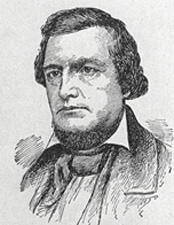
Here you will find contact information for Senator Jeremiah Clemens, including email address, phone number, and mailing address.
| Name | Jeremiah Clemens |
| Position | Senator |
| State | Alabama |
| Party | Democratic |
| Status | Former Representative |
| Term Start | December 3, 1849 |
| Term End | March 3, 1853 |
| Terms Served | 1 |
| Born | December 28, 1814 |
| Gender | Male |
| Bioguide ID | C000501 |
About Senator Jeremiah Clemens
Jeremiah Clemens (December 28, 1814 – May 21, 1865) was a United States senator and novelist from Alabama. A member of the Democratic Party and later associated with the Unionist and Know Nothing movements, he served one term in the United States Senate from 1849 to 1853, representing Alabama during a critical period in the sectional crisis. A prominent Southern Unionist, he opposed the secession of Alabama from the Union in 1861, briefly served in the Confederate military establishment, and later became one of Alabama’s leading Unionist voices. He was also the author of several widely read novels, including Tobias Wilson, one of the first works of fiction set during the American Civil War.
Clemens was born in Huntsville, Madison County, in what was then the Mississippi Territory, on December 28, 1814, the son of James and Sarah (Mills) Clemens. His parents had migrated from Kentucky to the region in 1812, settling in the area that would become northern Alabama. Raised in a frontier environment that was rapidly transitioning into a settled and politically active region, Clemens received a formal education unusual for the time and place. He attended LaGrange College in Alabama and then the University of Alabama, institutions that were among the earliest centers of higher learning in the state. Seeking professional training in the law, he later studied at Transylvania University in Lexington, Kentucky, which was then a leading law school in the West. In 1834, he married Mary L. Reed, the daughter of Huntsville merchant John Reed, thereby aligning himself with one of the town’s established commercial families.
Around the time of his marriage, Clemens enlisted in the United States Army and took part in military operations against the Cherokee Nation associated with the forced removals that culminated in the Trail of Tears. His early military experience foreshadowed a career that would repeatedly intersect with armed conflict on the expanding American frontier. Returning to Alabama, Clemens joined the Democratic Party and quickly entered public service. In 1839, President Martin Van Buren appointed him United States Attorney for the northern and middle districts of Alabama, a position that placed him at the center of federal legal affairs in the state. That same year he was elected to the Alabama House of Representatives, where he served from 1839 to 1841, beginning a legislative career that would eventually carry him to the national stage.
Clemens’s ambitions and interests extended beyond Alabama. He served in the Texian Army following the Texas Revolution, participating in the turbulent period as the Republic of Texas consolidated its independence. He was subsequently elected to the United States House of Representatives, serving from 1843 to 1845. After the annexation of Texas by the United States, Clemens again volunteered for military service and fought in the Mexican–American War. He left the army in 1848 with the rank of colonel, a distinction that enhanced his public reputation in Alabama and the broader South. His combined record of legal, legislative, and military service positioned him as a significant Democratic figure in his home state.
In 1849, Clemens was elected as a Democrat to the United States Senate from Alabama to fill the vacancy caused by the death of Senator Dixon Hall Lewis. Although formally a member of the Democratic Party, he owed his election in considerable part to the support of Alabama’s Whigs, who viewed him as more moderate on key national issues. Clemens served in the Senate from 1849 to 1853, completing one full term. During this period he participated in the legislative debates surrounding the Compromise of 1850, initially opposing the measures but then accepting them after their passage. In the wake of the Compromise, he helped organize the short-lived Union Party in Alabama, which sought to maintain the Union and resist radical secessionist sentiment. The Unionists achieved a sweeping victory in the 1851 state elections, carrying roughly two-thirds of Alabama’s counties. Nonetheless, Clemens’s own political fortunes declined. Accusations circulated that he had secured Whig support for his 1848 senatorial candidacy by promising to back President Zachary Taylor’s legislative program, and his role in the Union Party alienated many Democrats. When his Senate term expired in 1853, he was not returned to office and retired to his plantation with his public reputation significantly damaged.
Following his departure from the Senate, Clemens gravitated toward the nativist Know Nothing movement and became associated with the American Party. He ran unsuccessfully for the U.S. House of Representatives on the American Party ticket, and in the 1856 presidential election he supported former President Millard Fillmore, campaigning for him across northern Alabama. The state, however, cast its electoral votes for Democrat James Buchanan. After this defeat, Clemens largely withdrew from active partisan politics and turned his attention to literature. Between 1856 and 1860 he published three novels: Bernard Lile (1856), Mustang Gray (1858), and The Rivals (1859). Bernard Lile and Mustang Gray were at least partly autobiographical, drawing on his experiences in the Texas War of Independence and the Mexican–American War, and both received favorable critical attention. The Rivals was a historical novel dramatizing the famous political and personal conflict between Aaron Burr and Alexander Hamilton. During his lifetime, these works made Clemens better known nationally as a novelist than as a former senator.
The secession crisis that followed the election of Abraham Lincoln in 1860 drew Clemens back into public life. A committed Southern Unionist, he denounced secession in the pages of the Montgomery Advertiser and served as a delegate to the Alabama secession convention in 1861. At the convention he argued against leaving the Union, but when the majority of delegates voted in favor of secession, he reluctantly signed the ordinance formalizing Alabama’s withdrawal. He accepted a commission in the Alabama militia and briefly served in the Confederate military structure, but his deep ambivalence toward the Confederate cause led him to resign within a year. In 1862 he crossed into Union lines and emerged as Alabama’s foremost Southern Unionist, publicly supporting the federal war effort and aligning himself with the Lincoln Administration.
Clemens’s literary work continued amid the upheaval of the Civil War. His final novel, Tobias Wilson, published posthumously in 1865, was one of the first novels set during the Civil War and depicted Unionist guerrilla warfare in the mountains of northern Alabama near his native Huntsville. The war years radicalized his politics; he became an outspoken defender of President Lincoln and strongly supported Lincoln’s re-election in 1864, traveling to Washington, D.C., to write campaign literature for the National Union Party. After Lincoln’s assassination in April 1865, Clemens urged the new president, Andrew Johnson—himself a Southern Unionist—to complete the abolition of slavery and pursue a Reconstruction policy that would secure the results of Union victory. He also began work on a history of the war in northern Alabama, intended to illuminate the character, causes, and conduct of the conflict in his region, but this project remained unfinished at his death.
Jeremiah Clemens died on May 21, 1865. At the time of his death he was recognized both for his complex political career—spanning Democratic partisanship, Unionist activism, and brief Confederate service—and for his contributions to early American war literature. He was also known to be a distant cousin of Samuel Langhorne Clemens, the celebrated author Mark Twain, linking him by family ties to one of the most prominent figures in American letters.