Representative Jeremiah McLain Rusk
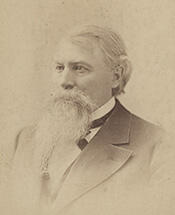
Here you will find contact information for Representative Jeremiah McLain Rusk, including email address, phone number, and mailing address.
| Name | Jeremiah McLain Rusk |
| Position | Representative |
| State | Wisconsin |
| District | 7 |
| Party | Republican |
| Status | Former Representative |
| Term Start | March 4, 1871 |
| Term End | March 3, 1877 |
| Terms Served | 3 |
| Born | June 17, 1830 |
| Gender | Male |
| Bioguide ID | R000517 |
About Representative Jeremiah McLain Rusk
Jeremiah McLain Rusk (June 17, 1830 – November 21, 1893) was an American Republican politician who served three terms as a United States Representative from Wisconsin, was the 15th governor of Wisconsin, and became the second United States secretary of agriculture. He was born in Malta, Morgan County, Ohio, the youngest of seven children of Daniel Rusk and Jane (Faulkner) Rusk. His elder brother, Allen Rusk, later also became active in Wisconsin politics and served in the Wisconsin State Assembly and in the Union Army during the Civil War. Jeremiah Rusk was raised in rural Ohio and began his working life as a planter. He subsequently turned to innkeeping and then to banking, gaining experience in business and finance that would later inform his public career.
Rusk married twice. In 1849 he wed Mary Martin, with whom he had two children before her death in 1856. Later that same year he married Elizabeth Marie “Berthe” Johnson. They had four children together, although one died young. His second wife survived him. Among his children, his eldest son, Lycurgus James Rusk, became a lawyer, served as his father’s private secretary, and later was elected to the Wisconsin State Assembly, where he became a prominent member of the Wisconsin bar. Jeremiah Rusk eventually moved to Wisconsin, where he established himself in business and public life and aligned with the emerging Republican Party.
Rusk’s formal political career began at the state level. A committed Republican, he was elected to the Wisconsin State Assembly in 1862, serving one term. That same year, as the American Civil War intensified, he entered military service with the Union Army. On August 14, 1862, he was commissioned major of the 25th Wisconsin Volunteer Infantry Regiment. He was promoted to lieutenant colonel on September 16, 1863. On July 22, 1864, during the Battle of Atlanta at Decatur, Georgia, he assumed command of the regiment when Colonel Milton Montgomery was wounded and captured. Rusk continued in command even after Montgomery’s exchange, as Montgomery was assigned to lead the brigade to which the 25th Wisconsin belonged. Rusk was wounded at the Salkehatchie River in Georgia on January 20, 1865, and was mustered out of the volunteer service on June 7, 1865. He received a brevet appointment as colonel, to rank from March 13, 1865. On February 24, 1866, President Andrew Johnson nominated him for appointment as a brevet brigadier general of volunteers, also to rank from March 13, 1865, and the United States Senate confirmed this appointment on April 10, 1866.
After the Civil War, Rusk resumed civilian life in Wisconsin and quickly returned to public service. From 1866 to 1870 he served as Bank Comptroller of Wisconsin, becoming the last person to hold that office before it was abolished. His work as bank comptroller drew on his earlier experience in banking and contributed to his reputation as a capable administrator. Building on his state-level prominence, Rusk sought national office as a Republican and was elected to the United States House of Representatives as the representative of Wisconsin’s 6th congressional district to the Forty-second Congress, serving from March 4, 1871, to March 3, 1873. When Wisconsin was redistricted, he was elected to represent the newly created 7th congressional district in the Forty-third and Forty-fourth Congresses, serving from March 4, 1873, to March 3, 1877. In total, he served three consecutive terms in the House, from 1871 to 1877, representing northwest Wisconsin.
Rusk’s service in Congress occurred during a significant period in American history, as the nation grappled with the aftermath of the Civil War and the end of Reconstruction. As a member of the House of Representatives, he participated in the legislative process and represented the interests of his constituents in northwest Wisconsin. He was a member of the Republican Party throughout his congressional career and contributed to debates on veterans’ affairs and postwar policy. During the Forty-third Congress he served as chairman of the Committee on Invalid Pensions, a role that placed him at the center of efforts to address the needs of disabled veterans and their families. His work on this committee underscored his continuing connection to the Union soldiers with whom he had served.
Leaving Congress in 1877, Rusk remained a leading figure in Wisconsin Republican politics. In 1881 he was nominated for governor and won election as the 15th governor of Wisconsin, taking office in January 1882. He was reelected and served three consecutive terms, remaining in office until 1889. During his governorship he resided in a house in Madison that he purchased and occupied as governor; this residence, later known as the Old Executive Mansion, was subsequently used by the state for several decades as the official residence of Wisconsin’s governors and is now listed on the National Register of Historic Places. Rusk’s tenure as governor is particularly remembered for his response to the labor unrest of May 1886. During the May Day labor strikes in Milwaukee, when strikers had shut down nearly every business in the city except the North Chicago Rolling Mills in the Bay View neighborhood, Rusk ordered the Wisconsin National Guard to maintain order and prevent the strikers from entering the mills. The guardsmen’s orders were interpreted by their captain to mean that, upon command, they should select individuals from the crowd and “shoot to kill.” This action resulted in the Bay View Tragedy, in which a number of workers were killed. The incident provoked widespread controversy, and Governor Rusk bore much of the public blame for the deadly use of force.
In 1889, after completing his third term as governor, Rusk was appointed by President Benjamin Harrison as the second United States secretary of agriculture, heading the newly elevated cabinet-level Department of Agriculture. He served in that position from 1889 to 1893. As secretary of agriculture, Rusk oversaw federal agricultural policy during a period of significant change in American farming, including the expansion of scientific agriculture and the increasing role of the federal government in supporting rural communities. His tenure helped establish the department’s role in promoting agricultural research, education, and market development, although the details of his specific initiatives are less well documented than his earlier military and gubernatorial service.
After leaving the cabinet in 1893, Rusk returned to private life in Wisconsin. He lived in Viroqua, Vernon County, where he had long maintained his home and business interests. He died there on November 21, 1893, and was buried in Viroqua. His second wife, Elizabeth, survived him, and members of his family, including his son Lycurgus, continued to play roles in Wisconsin public life. In 1905, more than a decade after his death, Gates County in northern Wisconsin was renamed Rusk County in his honor, reflecting the enduring recognition of his prominence in the state’s political and military history.